

 - EN
- EN  - EN
- EN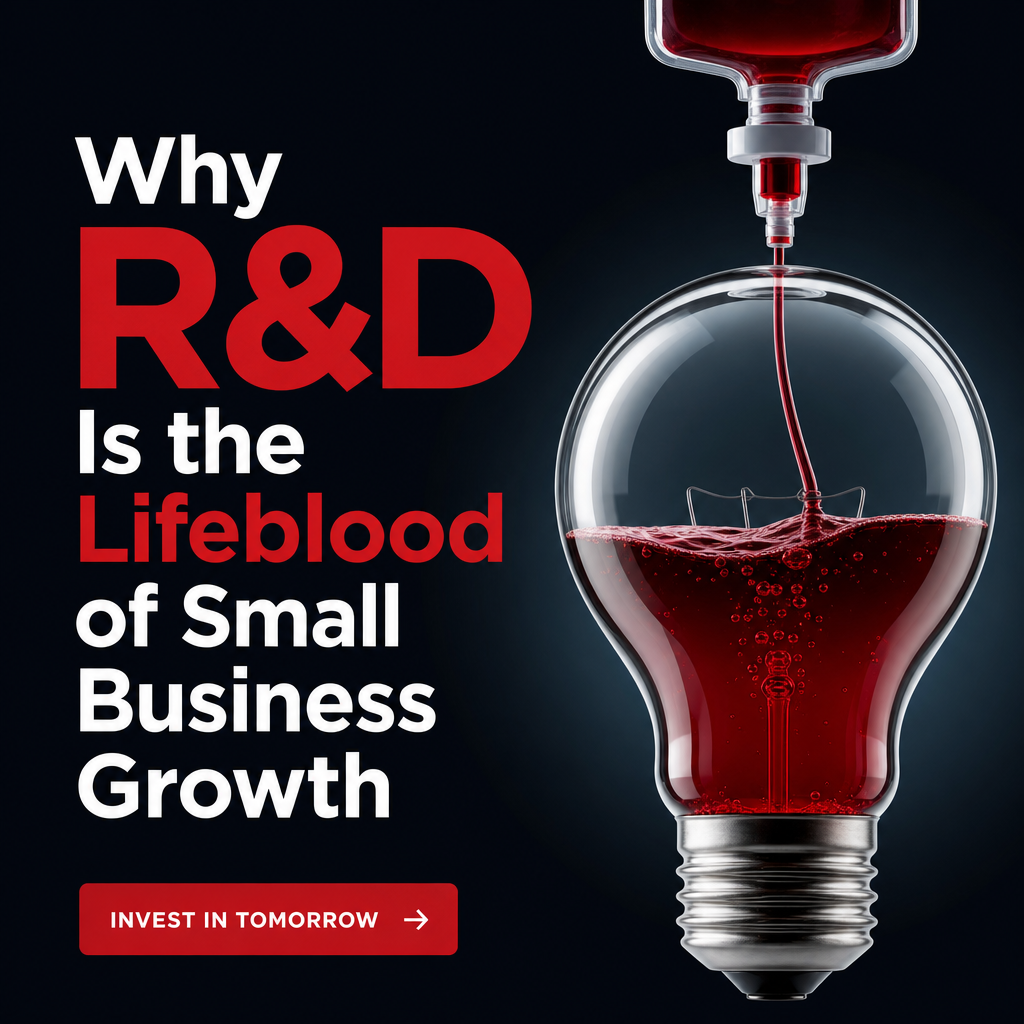
Why continuous R&D fuels exponential business growth:
Most small businesses believe growth comes from better sales and marketing. The highest-growth companies know that sustainable growth begins much earlier—with continuous innovation.
Sales and marketing can increase demand. Operations can improve efficiency. Finance can improve business cash flow. But none of those functions create the next product, the next feature, the next manufacturing process, or the next competitive advantage. Only R&D does.
That’s why R&D is the lifeblood of small business growth: it creates the conditions for compounding gains. Each improvement strengthens differentiation, raises switching costs, and builds knowledge that competitors can’t easily copy. And when those efforts are properly captured as Qualified Research Activities, they may also generate R&D Tax Credits—turning innovation effort into Tax Savings that can help fund the next cycle.
The growth story is simple and repeatable: identify customer problems, experiment with new ideas, solve technical uncertainties, launch improvements, gain market share, and reinvest into the next generation of innovation. A disciplined R&D motion doesn’t just build products—it builds momentum.
Identify Qualified Research Activities that move the business forward:
Many startups and small to mid-sized businesses run real experiments every year without labeling them “R&D.” Yet the IRS framework is often aligned with what practical builders already do: attempt to resolve technical uncertainty through a process of experimentation.
Common Qualified Research Activities (QRAs) for small businesses include software iteration to improve performance or reliability, prototyping and testing new designs, developing improved manufacturing methods, refining formulations, integrating hardware and firmware, and engineering for scalability, security, or compliance. If your team is asking “Can this work?” and systematically testing approaches, you may be closer to an R&D Tax Credit claim than you think.
From a Research and Development Tax Credits perspective, eligibility typically hinges on meeting the 4-part test (permitted purpose, technological in nature, elimination of uncertainty, and process of experimentation). The businesses that grow faster are often the same businesses that naturally do this work continuously—then later realize they should have been capturing it for an R&D Study.
The takeaway: your product and process improvements may already be creating both competitive advantage and potential R&D Tax Credit Refund opportunities.
Capture Qualified Research Expenses to strengthen cash flow and reinvest faster:
Once QRAs are identified, the next step is tying them to Qualified Research Expenses (QREs). This is where many small businesses leave money on the table—not because they lack R&D, but because they lack a clean method for documenting costs.
QREs often include wages for employees directly performing, supervising, or supporting qualified research; certain contractor costs (when structured properly); and supplies consumed during experimentation or prototyping. For software, engineering, manufacturing, and product development teams, this can represent a meaningful portion of annual spend.
When prepared correctly, R&D Tax Credits can reduce income tax liability and, for eligible small businesses, may be applied against payroll taxes—making the credit especially relevant for growth-stage companies focused on runway. That improvement in business cash flow helps businesses reinvest sooner into the next development sprint, test cycle, or prototype run.
This is how R&D creates the conditions for exponential small business growth: each cycle of learning builds the next cycle of advantage, and the R&D Tax Credit can help subsidize that learning.

“AI as a very powerful tool. What I’m most excited about is applying those tools to science and accelerating breakthroughs.
– Demis Hassabis, co-founder and CEO of DeepMind”
Create an R&D Study that tells the technical story:
A strong R&D Study is more than a list of projects—it’s a technical narrative that connects uncertainty, experimentation, and outcomes to the people and costs involved. It should clearly describe what the business was trying to achieve, why it wasn’t readily achievable at the outset, what alternatives were evaluated, and how the team tested hypotheses.
This is where R&D Tax Credit Services and experienced R&D Tax Credit Consultants add significant value: translating engineering and product work into documentation that is CPA-ready and supports IRS compliance requirements.
Well-prepared studies typically include project descriptions, experimentation details, technical risks addressed, version or release milestones, time allocation support (including time surveys where needed), and expense calculations aligned to wages, contractors, and supplies. The goal isn’t to overcomplicate—it’s to be precise, consistent, and defensible.
When a company treats documentation as part of Innovation Management, the R&D Tax Credit becomes easier to claim year after year. That repeatability turns a one-time benefit into a long-term innovation incentive.
Innovation management as a growth system—not a one-time breakthrough:
Small business growth accelerates when innovation becomes a system. Instead of waiting for a “big idea,” high-performing companies run steady cycles: roadmap assumptions, technical spikes, prototypes, test results, and measurable improvements.
This discipline reduces technical risk and shortens the path from idea to market. It also makes capturing R&D Tax Credits dramatically easier because the work is already organized around uncertainties, experiments, and outcomes.
In practice, the leaders who win build routines around:
• Defining technical objectives tied to customer needs
• Making uncertainty explicit (performance, scalability, reliability, manufacturability)
• Recording iterations and test results as the team learns
• Linking people, time, and costs to each experimental track
This is the bridge between product velocity and financial resilience. When innovation is continuous, Tax Savings can become continuous too—creating a self-funding innovation engine rather than a sporadic benefit.
How AI R&D CTOs are being applied to automate and facilitate R&D tax credit claims:
Even when a business has real qualifying R&D, the traditional approach to claiming the R&D Tax Credit can feel manual and disruptive: chasing down project histories, conducting interviews late in the year, reconstructing timelines, and scrambling for supporting documents.
This is where an AI R&D CTO model changes the workflow—focused specifically on R&D Tax Credits and technical leadership support (not on the company’s products or internal processes). An AI R&D CTO can operate as a Virtual CTO and AI Technology Advisor that strengthens both claim quality and innovation discipline by:
• Identifying Qualified Research Activities (QRAs) aligned to the 4-part test
• Calculating Qualified Research Expenses (QREs) with higher consistency
• Conducting structured technical interviews and extracting key uncertainties and experiments
• Producing time surveys and documentation packages that support IRS compliance requirements
• Drafting R&D Study narratives and organizing contemporaneous documentation
• Supporting Form 6765 preparation readiness through clean, auditable summaries
In addition to R&D Tax Credit execution, the AI R&D CTO also serves as an AI Chief Technology Officer and AI Technical Advisor for AI Product Strategy and AI Product Development guidance at a leadership level—bringing AI Product Intelligence and an AI Innovation Platform approach to benchmarking, technical barrier resolution, and innovation intelligence. The result is that smaller organizations can compete with enterprise-level rigor without building large internal teams.
From tax credit to self-funding innovation engine:
The businesses that scale fastest don’t just “do R&D.” They build a repeatable system where R&D produces learning, learning produces advantage, and advantage produces resources to reinvest.
R&D Tax Credits strengthen that loop by improving cash flow and lowering the net cost of experimentation. Over time, that can change how aggressively a small business can iterate, hire, test, and launch—especially when the work is supported by consistent documentation and a disciplined R&D Study approach.
With the right R&D Tax Credit Services, and with AI R&D CTO support that brings together Innovation Management and claim readiness, small businesses can level the playing field. They gain access to capabilities that historically required large budgets: structured technical documentation, ongoing capture of qualifying work, and strategic technical leadership.
Learn more about how an AI R&D CTO can enhance knowledge to world-class standards while seamlessly gaining R&D tax credits—and get an estimate of your potential R&D Tax Credit by selecting a button below.