

 - EN
- EN  - EN
- EN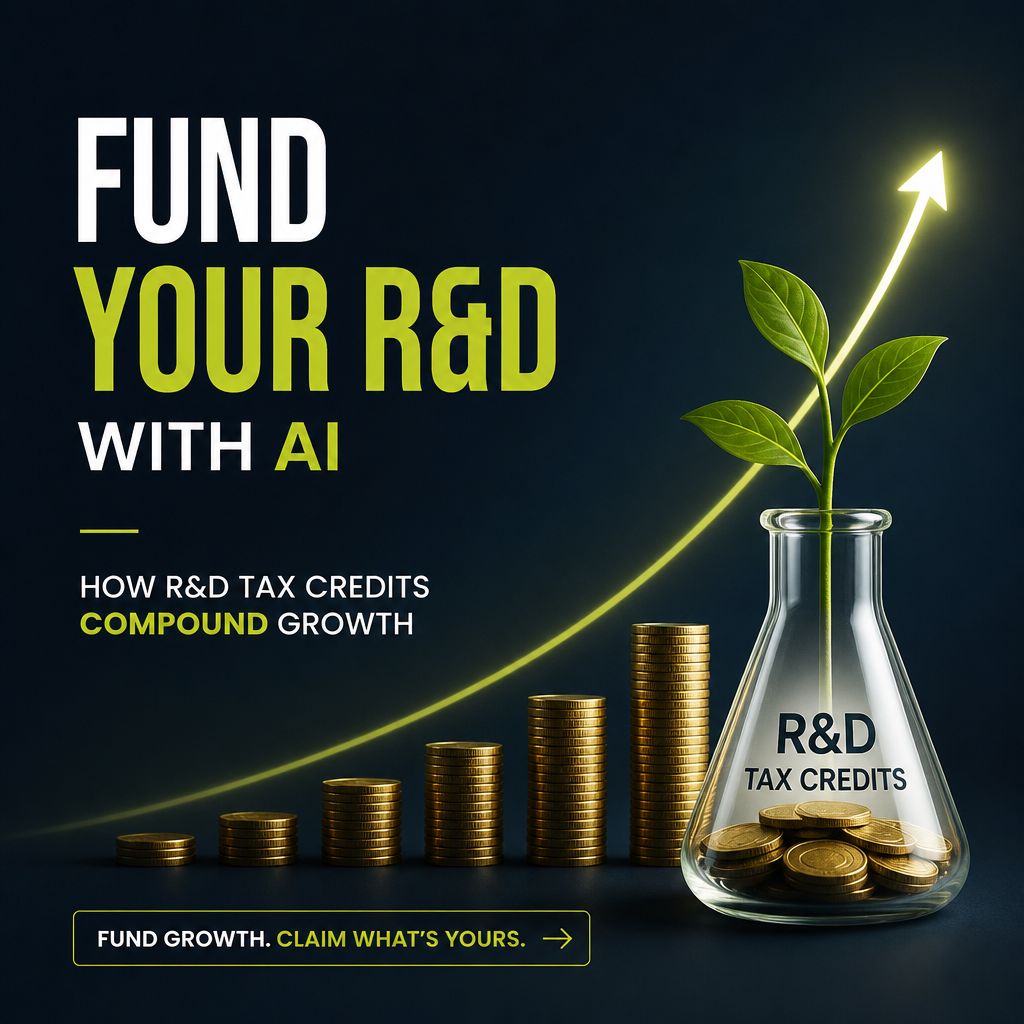
How R&D Tax Credits Lead to Better products year after year:
An R&D Tax Credit can do more than reduce taxes once. When businesses reinvest the resulting cash into engineers, developers, prototypes, equipment, testing, and new products, one year’s tax benefit can help FUND the next year’s innovation. Repeated over many years, that additional R&D capital can create a compounding effect.
The key is understanding the difference between a one-time savings event and a repeatable system. R&D Tax Credits don’t compound by themselves. But when businesses repeatedly reinvest the resulting capital into people, technology, experiments, and new products, their impact on innovation can compound over time.
Here’s the central concept—an R&D “FUND flywheel” that small and medium-sized businesses can run every year:
Invest in R&D
↓
AI identifies qualifying R&D
↓
Claim R&D Tax Credit
↓
Retain additional capital
↓
Reinvest in R&D
↓
Develop more technology
↓
Potentially generate additional qualifying R&D
↓
Repeat
In this model, modern R&D Tax Credit Services aren’t just about filing. They’re about continuously capturing Qualified Research Activities and Qualified Research Expenses while technical work is happening—so the claim is defensible, efficient, and aligned with IRS expectations.
Identify Qualified Research Activities (QRAs) to Keep the Flywheel Turning:
Most startups and growth companies underestimate how many projects contain Qualified Research Activities (QRAs). If your teams are trying to resolve technical uncertainty—especially in software, manufacturing, engineering, or applied science—you may already be performing qualifying work.
For Research and Development Tax Credits, QRAs commonly appear when teams:
• Attempt to achieve a performance improvement (speed, scalability, reliability, accuracy, durability)
• Evaluate alternatives in architecture, materials, methods, or algorithms
• Run iterative testing, prototyping, or simulation
• Conduct systematic experimentation to eliminate unknowns
A practical way to keep the flywheel moving is to stop treating the R&D Study as an annual reconstruction exercise. Instead, build an evidence habit around uncertainty, experimentation, and advancement. This is where structured Innovation Management matters: the more clearly a company documents technical challenges and investigative work, the easier it is to establish R&D Tax Credit eligibility and defend the position under IRS review.
For many companies, the biggest missed opportunity is simply not recognizing that “normal product development pressure” often includes qualifying experimentation. Capturing QRAs turns that hidden innovation into measurable tax savings and improved business cash flow.
Calculate Qualified Research Expenses (QREs) Without the Year-End Fire Drill:
Once QRAs are identified, the next step is calculating Qualified Research Expenses (QREs). In the real world, QREs are often missed because the data is fragmented across payroll, project tracking, contractor invoices, and accounting systems.
QRE categories often include:
• W-2 wages for employees performing, supervising, or supporting qualified research
• Contractor costs (subject to applicable rules and documentation)
• Supplies consumed in experimentation and testing
• In some cases, cloud or hosting costs may be considered depending on facts and circumstances (commonly relevant for software teams)
A strong R&D Tax Credit claim connects expenses to the underlying technical work—showing not just what was spent, but why it relates to qualified experimentation. That linkage is what separates “numbers-only” claims from well-supported claims.
When companies operationalize QRE capture as part of Innovation Management, they reduce disruption to engineering teams, improve accuracy, and shorten the time required to complete the R&D Study. The result is a smoother path to tax savings and a more predictable R&D Tax Credit refund profile where applicable.

“AI as a very powerful tool. What I’m most excited about is applying those tools to science and accelerating breakthroughs.
– Demis Hassabis, co-founder and CEO of DeepMind”
Create an IRS-Ready R&D Study with Contemporaneous Documentation:
An R&D Study is not just paperwork—it’s the narrative and evidence framework that supports the R&D Tax Credit. It typically explains:
• What the company was trying to develop or improve
• The technical uncertainties encountered
• The process of experimentation used to resolve them
• The technological advancement achieved (even if the project did not fully succeed)
Traditional manual approaches often rely on late-stage interviews, memory-based reconstructions, and rushed time estimates. That increases risk and burdens key technical staff.
Modern R&D Tax Credit Consultants focus on building a defensible story supported by contemporaneous documentation such as:
• Design notes, testing logs, and experiment results
• Issue tracking and change history
• Architecture decisions, prototypes, and evaluation summaries
• Time surveys and role-based allocations tied to projects
When documentation is assembled systematically, Form 6765 support becomes cleaner, the technical narrative becomes stronger, and IRS compliance requirements are easier to satisfy. Ultimately, the claim becomes less about “convincing” and more about “showing,” which is where the best R&D Tax Credit Services deliver long-term value.
Apply an AI R&D CTO to Automate and Facilitate R&D Tax Credit Claims:
The next wave of US innovation will be supported by a new category of leadership: the AI R&D CTO. Think of it as an AI Chief Technology Officer and AI Technology Advisor focused on two outcomes—turning qualifying innovation into repeatable funding, and raising technical decision quality through intelligence.
On the R&D Tax Credit side, an AI R&D CTO and Virtual CTO approach replaces many manual, error-prone steps by using sector-specific trained LLMs designed for R&D Tax Credit intelligence. The goal is precision and completeness in identifying QRAs, mapping work to the 4-part test, and generating support documents.
In practice, the AI R&D CTO helps smaller companies:
• Identify Qualified Research Activities (QRAs) across technical teams
• Calculate Qualified Research Expenses (QREs) with clearer traceability
• Establish R&D Tax Credit eligibility with stronger technical narratives
• Create R&D Studies using consistent, audit-aware structure
• Generate technical documentation aligned to uncertainty and experimentation
• Conduct technical interviews using repeatable question frameworks
• Produce time surveys that reduce engineering disruption
• Support IRS compliance requirements and improve claim defensibility
• Maximize available R&D Tax Credits and improve business cash flow
This matters because many startups, software companies, manufacturers, engineering firms, and technology businesses conduct qualifying R&D every year without realizing it. The AI R&D CTO helps ensure those opportunities are identified and captured—without waiting until year-end and without relying solely on institutional memory.
The positioning is simple: don’t reconstruct your R&D Tax Credit. Build it while the R&D happens.
Use the Credit to Reinvest: A 10-Year, Illustrative Compounding Story:
The “compounding” effect isn’t the tax credit itself—it’s what the business does with the retained capital.
Consider an illustrative scenario for a small or mid-sized business:
• Year 1 R&D Tax Credit: $75,000
• R&D expenditures (and therefore the illustrative credit opportunity) grow 8% annually
Over ten years, the hypothetical annual benefits could look like:
$75K → $81K → $87K → $94K → $102K → $110K → $119K → $129K → $139K → $150K
Cumulative tax benefits: approximately $1.09 million.
Now the strategic question: what happens if that $1.09 million isn’t simply distributed, but continually reinvested into innovation—more engineers, better tooling, more prototypes, additional testing capacity, and faster iteration?
That’s where the compounding growth story begins.
This is also why a continuous approach matters. When companies treat R&D Tax Credits as a repeatable annual funding lever—supported by clear documentation and disciplined tracking—they create a self-funding innovation engine that can help them compete against larger firms with bigger budgets.
Beyond FUND: The AI R&D CTO as Technical Leadership and Product Intelligence:
While R&D Tax Credits are the core funding mechanism, the AI R&D CTO category also addresses a second problem for smaller organizations: limited access to high-level technical leadership.
As an AI Technical Advisor and Virtual CTO, the AI R&D CTO supports better decision-making through:
• AI Product Strategy guidance (what to build next, and why)
• AI Product Intelligence that clarifies technical tradeoffs and risk
• Competitive benchmarking and innovation intelligence for Technology Strategy
• Emerging technology awareness that reduces blind spots
• Technical barrier resolution frameworks to improve Product Development outcomes
This is how the playing field becomes more level. Larger enterprises can afford specialized tax teams, CTO organizations, product strategy groups, and competitive intelligence resources. The AI R&D CTO democratizes innovation by pairing R&D Tax Credit recovery with leadership-grade insight—without requiring the small business to build large internal teams.
Next Steps: Estimate Your R&D Tax Credit and Build the FUND → SOLVE → GUIDE Flywheel:
If you want to build a repeatable system—FUND innovation through R&D Tax Credits, SOLVE technical barriers with stronger guidance, and GUIDE the roadmap using intelligence—the AI R&D CTO model is designed to do exactly that.
Learn more about how an AI R&D CTO can enhance knowledge to world-class standards while seamlessly gaining R&D Tax Credits, and get an estimate of how much your R&D Tax Credit could be by selecting a button below.