
 - EN
 - EN
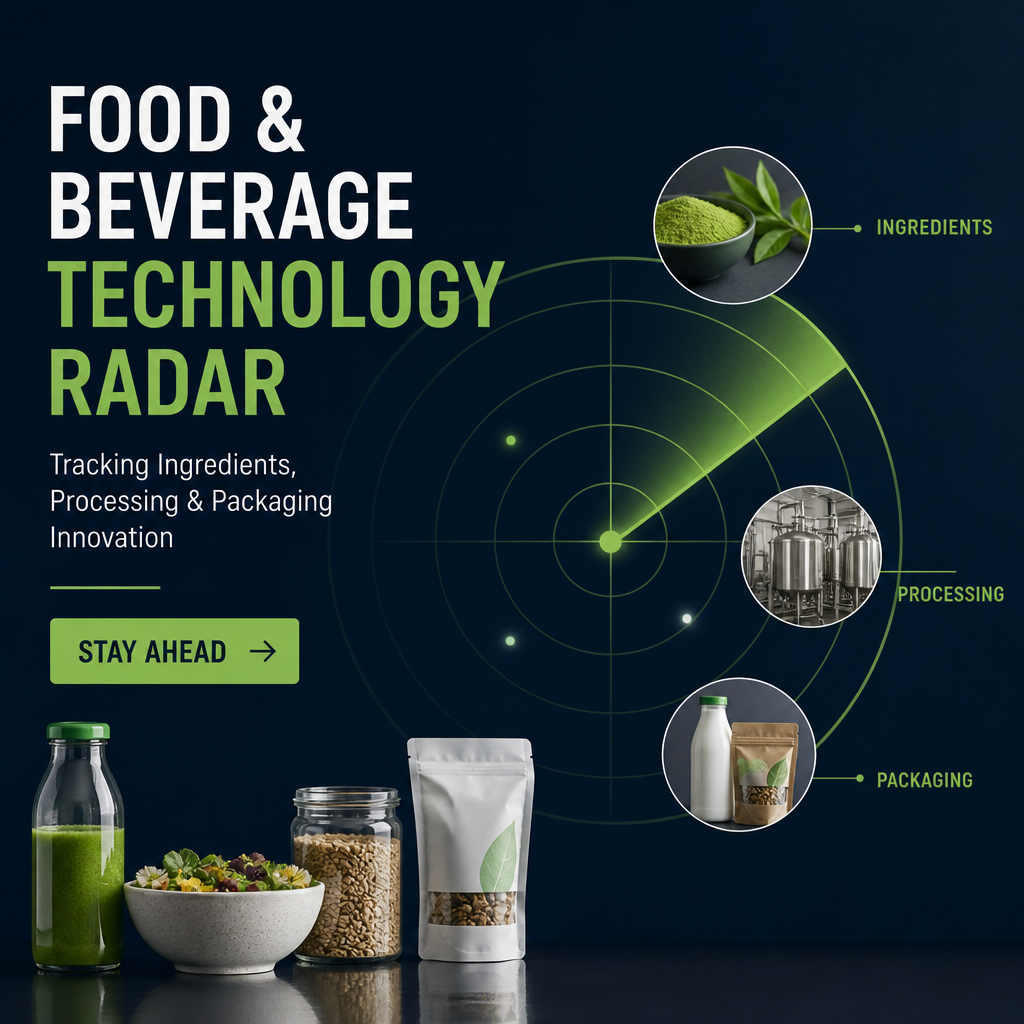
Technology Radar for Food & Beverage: Why external change must shape your next formulation, process, and packaging decision:
Food & beverage technical teams are often excellent at solving today’s issues—texture defects, separation, foaming, oxidation, microbial risk, line downtime—but too busy to continuously monitor what competitors, adjacent industries, open-source communities, and researchers are doing next. A Technology Radar turns external change into an organized R&D input so your next experiment is informed by what’s emerging, not only by internal experience.
For Food & Beverage leaders, the radar is especially valuable because the technical landscape shifts across ingredients, processing methods, packaging formats, and regulatory constraints at the same time. The outcome you want is practical: earlier awareness of an ingredient substitution that improves stability, a processing-method change that increases repeatability, or a packaging development that extends shelf life—before you commit to months of trial-and-error.
This is where an AI R&D CTO (or Virtual CTO / AI Chief Technology Officer) can act as an AI Technology Advisor and AI Technical Advisor: continuously scanning and structuring outside intelligence into a short list of “watch items” tied directly to your technical obstacles and objectives. That “GUIDE → SOLVE → FUND” flow helps you (1) guide your roadmap with Technology Radar intelligence, (2) solve technical barriers with targeted experimentation, and (3) fund a portion of that experimentation through R&D Tax Credits.
The Technology Radar model (GUIDE): signals → evaluation → experiments → roadmap updates:
A Technology Radar is not a trends list. It’s a repeatable model that converts external signals into internal R&D decisions directly related to your technical obstacles and objectives. In Food & Beverage, a simple operating rhythm works well:
First, define outcomes you care about (for example: longer shelf life at ambient, reduced separation, cleaner label preservation, improved heat transfer during pasteurization, higher process repeatability across plants, or better packaging performance under distribution stress). Second, track signals across ingredient suppliers, patents, academic publications, competitor claims, and process equipment advancements. Third, evaluate which signals actually matter to your formulations and lines. Finally, translate the best signals into experiments, pilot trials, and packaging validations.
An AI R&D CTO strengthens this model by maintaining continuity. Instead of depending on sporadic conference attendance or one vendor update, the AI R&D CTO keeps a living “radar backlog” aligned to Product Development and Technology Strategy—so your team sees the same landscape a top-tier innovation group would see, without building a large internal function.
For Food & Beverage, the radar typically organizes watch items into three primary rings:
Adopt: ready-to-test changes (e.g., swapping emulsifiers to reduce creaming).
Assess: promising innovations that need feasibility work (e.g., new barrier coating families).
Watch: early signals that might matter in 6–24 months (e.g., novel microbial control concepts).
Ingredient innovation watchlist: substitution, functional systems, and stability-by-design:
Ingredient change is one of the fastest ways to improve product performance—yet it’s also where hidden technical uncertainty appears. A Technology Radar for ingredients focuses on what could materially change formulation development, not just what’s “new.”
Key categories to track:
• Functional ingredient systems: evolving hydrocolloid blends, emulsifier systems, and stabilizer strategies aimed at controlling texture, separation, and mouthfeel under thermal abuse or freeze-thaw cycling.
• Ingredient substitution pathways: replacements driven by cost volatility, allergen constraints, supply continuity, or label expectations—paired with the technical tradeoffs (viscosity curves, phase behavior, flavor release).
• Preservation approaches: changes in acidification strategies, water activity management, hurdle concepts, or naturally derived options—always viewed through shelf-life and safety validation needs.
• Sweetener and fat system changes: shifts that impact crystallization, melting behavior, oxidation, and sensory stability over time.
Scenario: reformulating a beverage to reduce separation while maintaining sensory targets. The radar may surface a competitor’s approach (e.g., a different emulsification system) and a separate academic signal (e.g., protein-polysaccharide interactions that improve stability). Your R&D team can then design an experiment plan that tests mechanisms, not guesses—shortening the path to a stable formulation.
This is also where AI Product Intelligence can add value: an AI R&D CTO can maintain a structured map of formulation variables (pH, ionic strength, shear history, stabilizer dosage, homogenization pressure) and relate them to external learnings so your experiments become more diagnostic and repeatable.

“Technologies like Generative AI are rare; they come about once-in-a-lifetime, and completely change what’s possible for customers and businesses.”
– Andy Jassy, President and CEO of Amazon
Processing-method innovation: repeatability, heat transfer, and scale-up risk reduction:
Processing-method changes often deliver the biggest margin and quality improvements—but they can be difficult to benchmark because they’re not always visible to the market. A Food & Beverage Technology Radar should explicitly track process innovations that affect stability and consistency.
What to watch:
• Mixing and shear control: advances that reduce batch-to-batch variability and improve dispersion, which directly impacts texture and separation.
• Homogenization and emulsification techniques: shifts in equipment capability or parameter windows that can change droplet size distributions and stability outcomes.
• Thermal processing and heat transfer: improvements in pasteurization/sterilization profiles, hold times, and heat exchanger designs that can preserve sensory quality while meeting safety targets.
• Fermentation and bioprocess signals: for categories where microbial performance drives texture and shelf life.
• Process monitoring and quality methods: measurement techniques that improve detection of early instability (e.g., accelerated stability approaches, improved rheology methods).
Scenario: changing process parameters to improve stability. If external benchmarking indicates that leading products achieve stability through a narrower shear/temperature window than your line currently supports, that insight guides targeted trials—adjusting parameters, validating process repeatability, and documenting technical uncertainty as you work toward a more robust process.
For Innovation Management, the point is to make “process repeatability” a first-class metric on your radar—not an afterthought discovered after scale-up.
Packaging innovation radar: barrier performance, shelf-life extension, and distribution stress:
Packaging development is no longer separate from formulation; it’s part of system performance. A Technology Radar aimed at packaging innovation should track how packaging interacts with oxygen ingress, moisture loss/gain, light exposure, seal integrity, and distribution handling.
Important watch areas:
• Barrier materials and coatings: new approaches that improve oxygen or moisture barriers to extend shelf life without compromising recyclability goals.
• Seal and closure performance: innovations that reduce leakage, carbonation loss, or microbial ingress under real-world handling.
• Active and intelligent packaging concepts: where relevant, focusing on performance metrics (stability, detection thresholds, validation requirements) rather than hype.
• Scale-up and line compatibility: packaging changes that affect filling speeds, heat transfer during hot-fill, or deformation under cooling.
Scenario: developing packaging to extend shelf life. If the radar identifies a packaging format used in an adjacent category (for example, a barrier improvement trend in sauces that could apply to ready-to-drink products), your team can design a controlled shelf-life and stability protocol to test packaging performance alongside formulation tweaks—reducing the risk of attributing instability to the wrong cause.
Competitive benchmarking: turning market signals into engineering hypotheses:
A Technology Radar is strongest when paired with competitive benchmarking. Benchmarking is not limited to sensory panels; it should reveal performance gaps, engineering approaches, technical tradeoffs, and where you may need new experimentation.
In Food & Beverage, effective benchmarking asks:
• Performance gaps: Does a competitor achieve longer shelf life, better texture, or less separation under abuse conditions?
• Feature gaps: Are they delivering “cleaner label” stability or improved packaging convenience without tradeoffs?
• Engineering approach clues: What does the ingredient list, nutrition panel, packaging format, and stability behavior suggest about their formulation and processing choices?
• Tradeoffs: Are they sacrificing flavor stability for texture, or vice versa?
A practical framework your team can use:
Hypothesis: what you believe drives competitor performance (ingredient system vs processing vs packaging).
Test: the minimum experiment to validate the hypothesis (bench stability test, rheology, accelerated shelf-life study).
Decision: adopt, assess, or watch.
An AI R&D CTO can keep these hypotheses organized and continuously refreshed—so Product Development and AI Product Strategy stay anchored to evidence rather than assumptions.
FUND: capturing qualifying experimentation with R&D Tax Credits while you modernize R&D decision-making:
As you run formulation development trials, ingredient substitution experiments, processing-method changes, shelf-life and stability work, preservation testing, packaging development, and scale-up validations, you may be generating eligible Research and Development Tax Credits.
Many Food & Beverage companies perform Qualified Research Activities without labeling them as “R&D.” If your team is working to resolve technical uncertainty (for example, how to prevent separation, how to improve process repeatability, how to meet shelf-life targets under distribution stress, or how to maintain texture after a formulation change), those efforts may support an R&D Tax Credit claim when they meet the four-part test.
The AI R&D CTO helps connect the dots between technical work and the documentation required for R&D Tax Credits. Working alongside R&D Tax Credit Consultants or R&D Tax Credit Services, an AI R&D CTO can help:
• Identify Qualified Research Activities across formulation, processing, and packaging workstreams
• Map who did what and why, supporting technical narratives for an R&D Study
• Organize project evidence around technical uncertainties, experimentation, and results
• Help estimate Qualified Research Expenses such as wages, supplies used in trials, and certain contractor costs
• Support preparation inputs for Form 6765 and IRS compliance-ready documentation
The benefit is practical: Tax Savings and improved Business Cash Flow through an R&D Tax Credit Refund (where applicable), turning part of your experimentation spend into a self-funding innovation engine.
How an AI R&D CTO replaces manual, after-the-fact R&D Tax Credit prep with less time:
Traditional R&D Tax Credit preparation often relies on manual interviews, scattered notes, and retrospective reconstruction of what happened months ago. In Food & Beverage, that’s especially difficult because trials move fast: ingredient swaps, pilot runs, stability pulls, and packaging tests can blur together.
An AI R&D CTO—acting as a Virtual CTO and AI Technology Advisor—can modernize the workflow by using sector-specific trained LLM support to draft higher-precision technical narratives and supporting documentation focused on Food & Beverage realities (stability, preservation, texture, separation, packaging performance, and scale-up). The goal is not to change your products; it is to document the technical work you already perform in a way that is clearer, more complete, and easier to defend.
This approach helps teams:
• Describe technical uncertainties in plain, testable terms (e.g., “unknown interaction between stabilizer system and thermal profile causing separation at week 6”)
• Show the scientific method: hypotheses, trials, iterations, and conclusions
• Create contemporaneous documentation that reduces audit risk compared to memory-based writeups
• Produce stronger R&D Studies that align to Qualified Research Activities and Qualified Research Expenses
The result is often less disruption to technical staff, faster claim readiness, and more consistent support for Research and Development Tax Credits.
Next step: use an AI R&D CTO to GUIDE, SOLVE, and FUND your next Food & Beverage innovation cycle:
A Food & Beverage Technology Radar helps you watch what matters now—ingredients, processing, and packaging innovations that can shift your next roadmap decision. Pairing that radar with competitive benchmarking turns outside signals into better experiments. And capturing the work properly through R&D Tax Credits can improve cash flow, helping finance the next round of shelf-life, stability, preservation, and scale-up validation.
SHAIN’s AI R&D CTO positioning is straightforward: the AI R&D CTO democratizes innovation by helping startups, micro businesses, and small companies recover R&D Tax Credits while gaining access to technical leadership and innovation intelligence previously available only to large enterprises.
To learn how an AI R&D CTO can enhance knowledge to world class standards while seamlessly gaining R&D tax credits—and to get an estimate of your potential R&D Tax Credit—select the button below.