
 - EN
 - EN
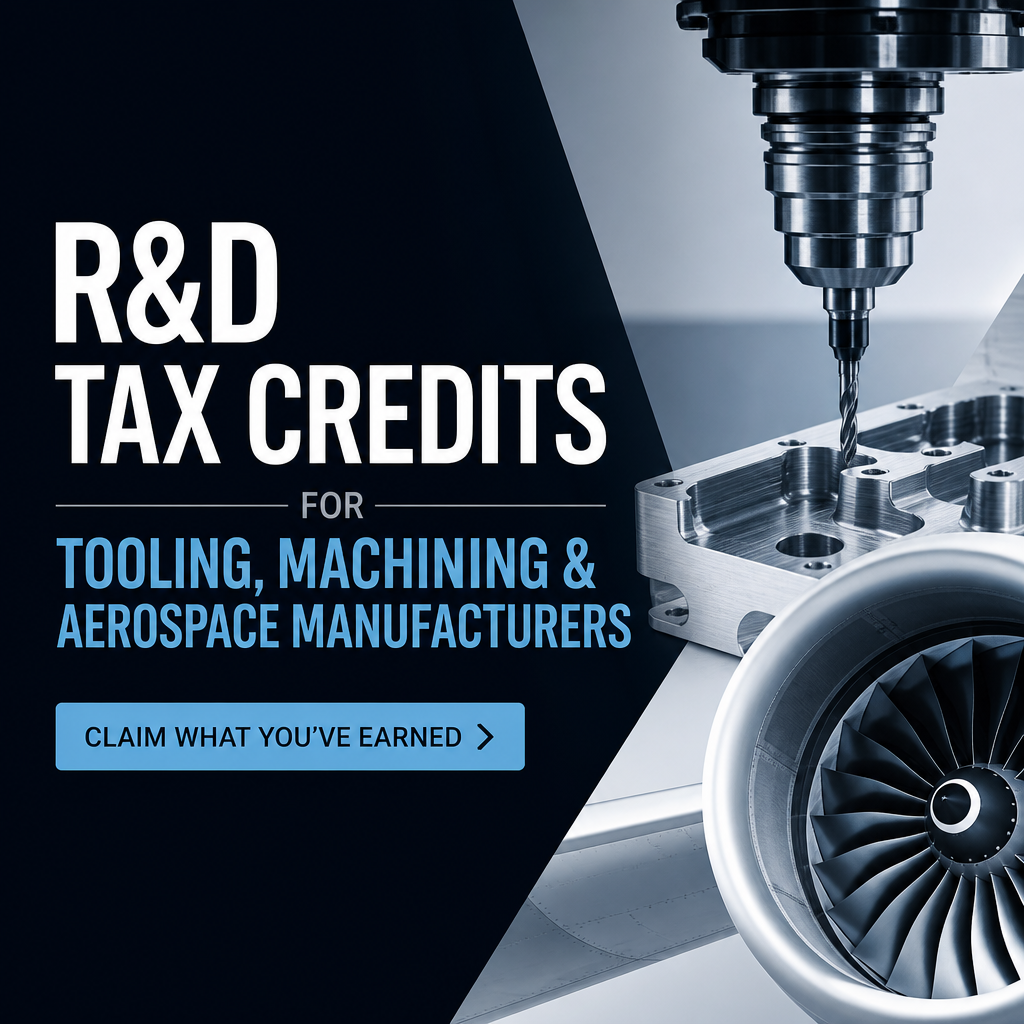
Tooling, Machining & Aerospace Manufacturers: Where the qualifying R&D is hiding:
For tool-and-die companies, precision machine shops, aerospace suppliers, and engineering leaders, the commercial question is simple: what everyday technical work may create an R&D Tax Credit opportunity—and why is it so often overlooked?
In this industry, qualifying R&D is frequently embedded in “normal” work: dialing in a hard-to-machine alloy, redesigning a fixture to hold tighter tolerances, reducing deflection or chatter, qualifying a new process parameter window, or developing a lighter aerospace component that still passes structural testing. Many teams don’t label these projects “R&D,” yet they often include the same elements the IRS looks for: a permitted improvement objective, technical uncertainty, and a process of evaluating alternatives through technical experimentation.
That’s why R&D Tax Credits can be relevant even for shops focused on production. The key is not your industry label—it’s whether specific projects included Qualified Research Activities (QRAs) that meet the Four-Part Test, supported by credible records and tied to Qualified Research Expenses (QREs).
CNC programming, process optimization under real constraints:
Machining and aerospace manufacturing regularly forces engineering teams to solve problems where the outcome is uncertain at the start. If you are iterating toolpaths, feeds/speeds, workholding, coolant strategies, or sequencing to achieve a measurable improvement (cycle time, scrap reduction, tolerance capability, surface finish, repeatability), you may be performing QRAs.
Example: machining a difficult alloy to a tighter tolerance
Technical objective: Achieve ±0.0005″ on a critical bore in Inconel while maintaining throughput.
Uncertainty: Will the material’s work-hardening and heat affect dimensional stability? Will tool wear cause taper or out-of-round?
Alternatives/testing: Multiple insert grades and geometries, revised CAM strategies, adjusted speeds/feeds, thermal soak controls, in-process probing, and new finishing passes.
Result: A stable process window that consistently hits tolerance.
Potential QRAs: CAM/CNC iteration, trials to reduce chatter, tool-life experiments, in-process inspection method refinement.
In aerospace work, “getting to print” frequently means overcoming technical uncertainty—not just executing a known recipe. When teams are iterating based on measured outcomes, that’s the experimentation pattern that often supports an R&D Tax Credit claim.
Tooling development, die design, and fixture redesign as qualifying experimentation:
Tooling and workholding are often where the most defensible technical experimentation lives. Tool-and-die and machining environments continually push for higher precision, faster changeovers, and lower variation. When you redesign tooling to improve performance and the solution is not readily determinable, you may have qualifying activity.
Example: redesigning tooling to reduce deflection
Technical objective: Maintain flatness on a thin-wall aerospace bracket while increasing MRR.
Uncertainty: Which tooling/fixture configuration will prevent part movement and maintain datum integrity?
Alternatives/testing: New fixture concepts, clamp point changes, backing plates, vacuum workholding trials, tool stick-out changes, and finite adjustments based on CMM results.
Result: Reduced deflection and fewer reworks.
Potential QRAs: Fixture design iteration, prototype fixture builds, trial runs, inspection-driven redesign.
These efforts can qualify even when the end goal is manufacturing efficiency—provided the work involves technical uncertainty and iterative evaluation. A well-constructed R&D Study can translate those shop-floor experiments into a compliant narrative tied to evidence.

“Bringing AI into the real world requires more than great models.”
– Roland Busch, President and CEO of Siemens AG
Aerospace component development: materials, weight reduction, and structural performance:
Aerospace suppliers often pursue improvements that inherently involve engineering uncertainty: weight reduction, fatigue resistance, thermal performance, corrosion resistance, or durability at extreme conditions. Even when you are building to customer requirements, your path to meeting those requirements can include qualifying experimentation.
Example: developing a lighter component while preserving structural performance
Technical objective: Reduce weight by 8% without compromising strength or fatigue life.
Uncertainty: Will a geometry change, ribbing strategy, or material choice pass test requirements?
Alternatives/testing: Multiple design revisions, prototype machining, surface treatment comparisons, torque/load testing, and iterative inspection and test analysis.
Result: A design that meets performance targets with lower mass.
Potential QRAs: Prototype iterations, test programs, analysis tied to physical trials, manufacturing method experimentation.
This is where the Four-Part Test becomes practical rather than theoretical: the work is technical, aims at improvement, involves uncertainty, and includes a systematic process of experimentation, not just routine production.
Surface finish, tolerance capability, and metrology-driven iteration:
Precision manufacturing frequently involves iteration that looks like “quality work,” but is actually technical problem-solving. When teams are changing processes to hit new finish or tolerance capability—and testing to prove what works—that can be qualifying.
Common areas where R&D Tax Credits for tooling & aerospace show up:
Surface-finish improvements: experimenting with tool coatings, machining strategies, post-processing, or sequencing to reduce Ra while maintaining cycle time.
Tolerance improvement: reducing variation by changing process parameters, stabilizing thermal effects, or redesigning datum schemes.
Repeatability initiatives: addressing drift over long runs by investigating tool wear mechanisms and compensation methods.
Evidence is often already created in normal operations: CMM reports, first-article inspection packages, SPC charts, in-process probe logs, nonconformance investigations, rework analyses, and engineering notes. The missed opportunity is that these artifacts are rarely organized into a coherent R&D Study with clear links to QRAs and QREs.
Connecting shop-floor reality to Qualified Research Expenses (QREs):
Even when you have clear QRAs, the R&D Tax Credit depends on properly identifying Qualified Research Expenses. In machining and aerospace environments, QREs commonly include:
Employee wages: engineers, programmers, tool designers, quality/inspection personnel, and certain manufacturing personnel when their time is directly tied to qualifying experimentation.
Supplies: materials consumed in prototype builds, test coupons, trial parts, and scrap generated during experimentation (not routine production).
Contract research: outside engineering or testing support, when structured properly and connected to qualifying work.
The nuance matters: not every engineering hour qualifies, and not every material cost qualifies. The job of a defensible R&D Tax Credit claim is to connect expenses to qualifying activities and business components, supported by records. That’s why a practical documentation approach is essential—especially for smaller companies that cannot afford weeks of disruption.
Documentation that manufacturers already have (but rarely assemble into an R&D Study):
Tooling, machining, and aerospace manufacturers typically have strong operational traceability. The R&D challenge is that evidence is fragmented across systems and teams. Useful support for Research and Development Tax Credits may include:
CAM revisions and toolpath change notes
CNC program versions and setup sheets
Drawings, redlines, and ECO histories
CMM reports, first-article inspection results, and SPC trends
Tool-life records, chatter investigations, and wear photos
Test results (load, torque, fatigue, thermal) and prototype build records
Deviation reports, MRB findings, and corrective action documentation
When organized into a clear project narrative—objective → uncertainty → alternatives/testing → results—these records can support IRS compliance expectations. The R&D Study becomes the structured package that turns scattered operational evidence into a coherent, CPA-ready claim.
How an AI R&D CTO modernizes R&D Tax Credit Services (replacing manual claim prep):
After the industry case is established, the next question is execution: how do you identify QRAs, map QREs, and create a defensible R&D Study without draining engineering time?
This is where an AI R&D CTO changes the model of R&D Tax Credit Services. Instead of relying on traditional, manual methods—spreadsheets, retrospective interviews, and one-time document scrambles—an AI R&D CTO acts as an AI Technology Advisor and AI Technical Advisor focused on R&D Tax Credit Intelligence.
In practical terms, an AI R&D CTO can help smaller companies:
Identify potential Qualified Research Activities across CNC programming, tooling development, fixture design, materials trials, and tolerance/surface-finish improvements.
Facilitate technical interviews and capture consistent technical uncertainty narratives using manufacturing language.
Organize contemporaneous documentation (e.g., CAM revisions, CMM reports, test results) into a structured R&D Study.
Support Form 6765 preparation by producing a CPA-ready package for human review.
Improve Business Cash Flow by accelerating access to an R&D Tax Credit Refund and ongoing Tax Savings.
This approach supports compliance while reducing the burden on engineering managers and CFOs—and helps ensure companies don’t miss credits simply because their “R&D” doesn’t look like a lab.
Beyond credits: AI Product Intelligence that helps SOLVE and GUIDE technical decisions:
A modern AI R&D CTO is not only about FUND (recovering R&D Tax Credits). It can also support Innovation Management and technical leadership that many small and mid-sized manufacturers lack.
As an AI Chief Technology Officer layer, it can provide AI Product Intelligence and AI Product Strategy support tied to your real technical barriers—without discussing or touching your company’s products or internal processes beyond R&D tax and technical documentation contexts. This includes:
SOLVE: Investigating root causes and options around tool wear, chatter, thermal distortion, difficult materials, fatigue risk, tight tolerances, surface finish, and repeatability.
GUIDE: Technology radar and competitive benchmarking to monitor emerging machining methods, metrology advances, and materials/finishing trends relevant to aerospace suppliers and precision shops.
The outcome is a more level playing field: Small Business Innovation teams gain enterprise-level R&D discipline and documentation, plus better technical decision support—without building a large internal staff.
Learn more: turn your R&D Tax Credit into a self-funding innovation engine:
If you’re doing CNC experimentation, tooling iteration, fixture redesign, aerospace component development, or materials and tolerance trials, there may be significant R&D Tax Credit eligibility hiding in plain sight.
SHAIN’s AI R&D CTO helps democratize innovation by helping startups and small-to-mid manufacturers identify Qualified Research Activities, connect Qualified Research Expenses, assemble an R&D Study, and prepare a CPA-ready package—while also providing world-class technical leadership through an AI Innovation Platform approach focused on R&D Tax Credit Intelligence.
To learn more and get an estimate of how much your R&D Tax Credit could be, select the button below.