
 - EN
 - EN
Beyond R&D Tax Credits: Why FUND, SOLVE & GUIDE is the new operating model:
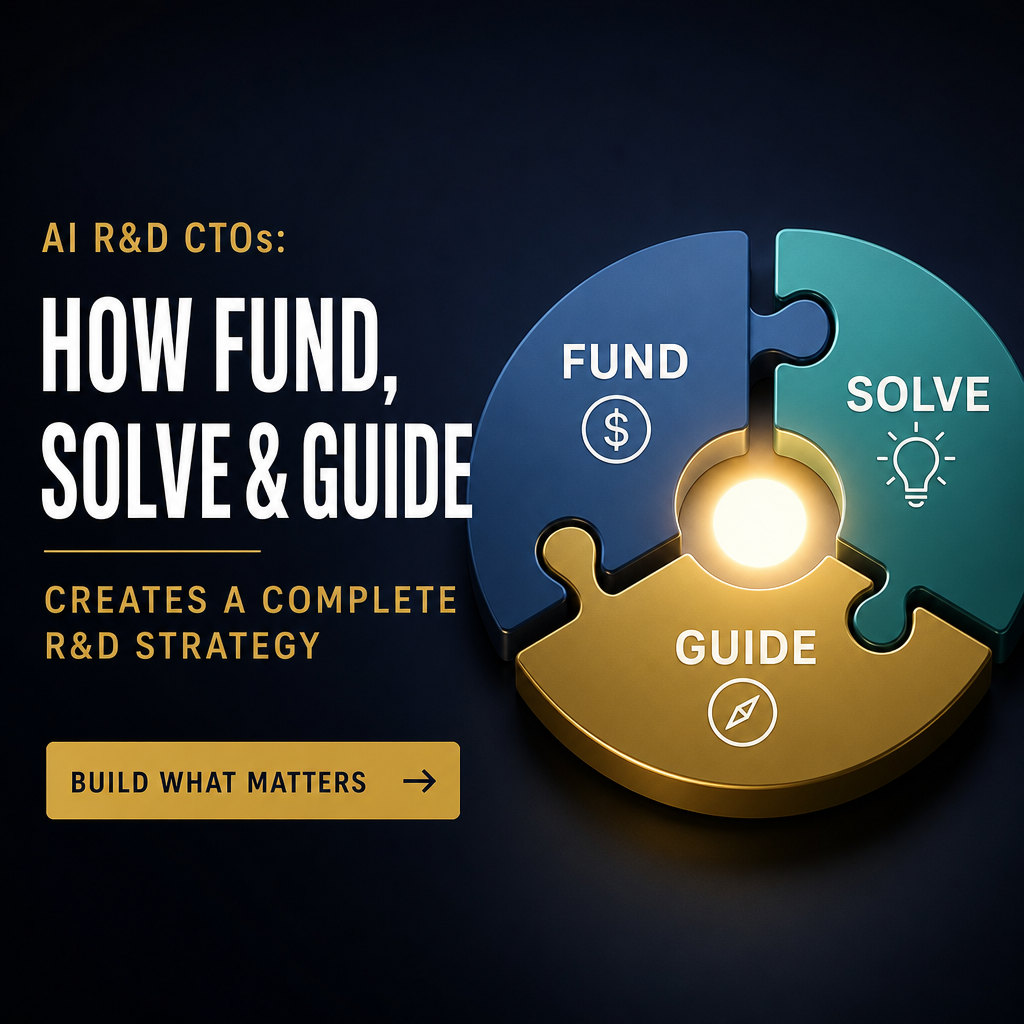
Most companies experience R&D as three disconnected motions: engineering teams build and experiment, leadership tries to set direction, and finance scrambles at year-end to see whether R&D Tax Credits are even available. The title “AI R&D CTOs: How FUND, SOLVE & GUIDE Creates a Complete R&D Strategy” points to a different, category-defining operating model: one continuous layer that funds innovation, resolves technical uncertainty faster, and guides technology strategy—without forcing teams to become tax experts.
An AI R&D CTO is not a generic automation tool. It functions like an always-on Virtual CTO and AI Technology Advisor focused on two outcomes: (1) creating a defensible, CPA-ready Research and Development Tax Credits package and (2) improving decision quality in Product Development through AI Product Intelligence and technology awareness. In practice, this role can sit alongside your technical leaders and external R&D Tax Credit Consultants, continuously capturing evidence, drafting technical narratives, organizing Qualified Research Expenses, and surfacing outside technical intelligence.
The result: FUND (recover cash through R&D Tax Credits), SOLVE (reduce time-to-resolution on hard engineering problems), and GUIDE (maintain a forward-looking AI Product Strategy and technology radar) become one integrated R&D strategy rather than separate annual projects.
FUND: Turn R&D Tax Credits into a self-funding innovation engine:
FUND is about transforming eligible engineering work into measurable Tax Savings and improved Business Cash Flow. Many software companies, manufacturers, engineering firms, and technology businesses perform Qualified Research Activities every year but miss credits because the evidence is scattered across tickets, code repos, lab notebooks, meeting notes, and payroll systems.
An AI R&D CTO changes FUND from “year-end reconstruction” to “continuous capture.” Throughout the year, the AI layer helps identify potential Qualified Research Activities that align to the IRS expectations (including the 4-part test concepts such as technical uncertainty, process of experimentation, and technological advancement), and it organizes the resulting documentation into an R&D Study format.
Examples of activities that often qualify when properly supported include:
– Software experimentation to improve performance, reliability, scalability, security, data processing, or deployment architecture.
– Manufacturing process trials to improve yield, cycle time, tolerances, material performance, or automation reliability.
– Engineering prototyping and test iterations to resolve design constraints under real operating conditions.
Instead of hoping people remember details months later, the AI R&D CTO supports technical interviews in near real time, drafts project narratives, and maps workstreams to the inputs needed for R&D Tax Credit eligibility—so finance teams can forecast potential R&D Tax Credit Refund impact earlier and make better reinvestment decisions.
FUND workflow: From technical work to Form 6765-ready support:
A practical way to understand FUND is to see the sequence the AI R&D CTO enables—without replacing your CPA or internal technical owners:
Technical work occurs → AI voice interview or structured prompts capture the activity → a potential QRA is flagged and summarized → evidence is anchored to artifacts (tickets, specs, test results) → employee time and cost inputs are confirmed → Qualified Research Expenses are organized (wages, contractor costs, supplies where applicable) → an R&D Study draft is produced → humans (engineering lead + tax reviewer) validate → R&D Tax Credit Services package is delivered to support Form 6765.
This workflow is where the AI R&D CTO can outperform traditional manual methods. Traditional approaches often depend on spreadsheets, retroactive time surveys, and narrative drafting that is expensive, inconsistent, and difficult to scale for startups and small business innovation teams.
By continuously capturing experimentation and uncertainty as it happens, companies can strengthen IRS compliance posture with contemporaneous documentation and reduce the organizational burden that typically causes missed credits or conservative claims.

“AI gives us a chance to empower people.”
– Doug McMillon, former President and CEO of Walmart
SOLVE: Use AI Product Intelligence to break through technical uncertainty faster:
SOLVE is the technical side of the operating model. In the real world, the very same barriers that make tax credits eligible in large part also slows down R&D: performance ceilings, model drift, brittle integrations, manufacturability constraints, latency and throughput limits, reliability problems, or regulatory requirements that force redesign.
The AI R&D CTO helps teams structure and document the “process of experimentation” while also bringing external technical intelligence into the decision loop. As an AI Chief Technology Officer and AI Technical Advisor, it can support engineering leaders with:
– Framing technical uncertainty clearly (what exactly is unknown, what constraints exist, what failure modes matter).
– Enumerating alternative approaches to test (architectures, algorithms, materials, control strategies, test designs).
– Encouraging disciplined experimental design and decision logs that also become excellent R&D Study evidence.
This is where FUND and SOLVE reinforce each other. The same disciplined record of hypotheses, trials, and results that improves Product Development also substantiates Qualified Research Activities. Instead of treating Innovation Management as overhead, the company turns it into a dual-use asset: faster learning cycles and stronger R&D Tax Credit claim support.
GUIDE: Maintain a technology radar so teams don’t get trapped in the day-to-day bubble:
GUIDE is what most small and mid-sized companies struggle to afford: continuous technology scouting, competitive benchmarking, and structured product strategy insight. Large enterprises have teams for this. Smaller teams usually rely on a handful of leaders who are already overloaded.
An AI R&D CTO (often delivered as a Virtual CTO model) supports a lightweight but consistent guidance layer:
– Competitive benchmarking: clarifying how peers approach similar problems and what “good” looks like.
– Technology radar: monitoring emerging methods, standards, and open-source directions relevant to the team’s domain.
– AI Product Strategy alignment: ensuring experiments map to customer outcomes, not just technical curiosity.
GUIDE is not about chasing trends. It is about reducing technology risk and helping leaders choose what to build next—especially when scarce cash and headcount make wrong bets expensive. When guidance is tied to FUND, leadership can make clearer reinvestment decisions: “If we recover part of these R&D costs through Research and Development Tax Credits, which roadmap bet do we accelerate?”
How an AI R&D CTO replaces manual R&D Tax Credit preparation (while keeping humans in the loop):
Manual R&D Tax Credit processes typically fail in three places: identifying eligible projects consistently, assembling evidence that clearly explains experimentation, and organizing costs into Qualified Research Expenses in a way that a CPA can rely on.
An AI R&D CTO strengthens each step while keeping humans in control:
– Continuous identification: prompts and interviews help teams capture QRAs while details are fresh.
– Documentation drafting: the AI drafts technical narratives, experiment summaries, and project descriptions for the R&D Study; engineering leaders review for accuracy.
– Cost organization: the AI helps map people, contractors, and (where applicable) supplies to projects and time periods to support QRE calculations; finance validates.
– Compliance readiness: evidence is anchored to artifacts so the claim is less dependent on memory and more dependent on contemporaneous records.
This is why the AI R&D CTO category matters: it integrates R&D Tax Credit Consultants’ best practices into an always-on operating rhythm and reduces the cost and disruption of annual claim cycles.
Learn more: See how an AI R&D CTO can fund, solve, and guide your R&D strategy:
If you want R&D Tax Credits to become a repeatable funding source—not a once-a-year scramble—an AI R&D CTO operating model can help your team document Qualified Research Activities as they happen, organize Qualified Research Expenses with higher precision, and produce an R&D Study that supports your CPA and strengthens compliance.
It also raises the bar on Innovation Management by adding Virtual CTO-level guidance and AI Product Intelligence so smaller companies can compete with enterprise capabilities.
To learn how SHAIN’s AI R&D CTO approach can enhance knowledge to world-class standards while seamlessly gaining R&D tax credits, request an estimate of how much your R&D Tax Credit could be by selecting the button below.