
 - EN
- EN  - EN
- EN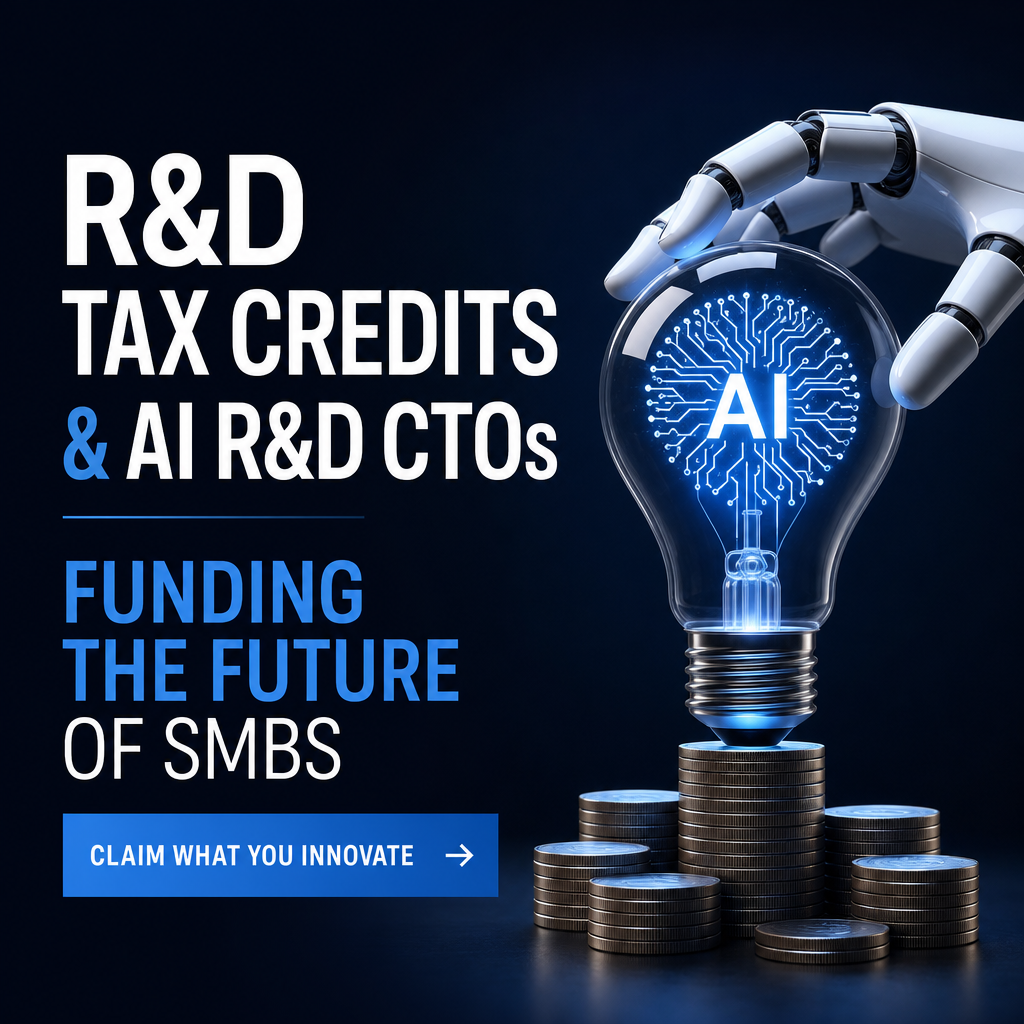
Every growing small or mid-sized business faces the same pressure: keep today’s operations running while still investing in tomorrow’s products. Headcount is tight, roadmaps move fast, and technical risk is real—yet competitors keep shipping. The good news is that many SMBs don’t actually have to choose between innovation and financial discipline. If you’re solving technical problems, you may be creating eligibility for R&D Tax Credits that can improve Business Cash Flow and help finance the next development cycle. This is where a modern model is emerging: pairing Research and Development Tax Credits with an AI R&D CTO. The result is a self-funding innovation engine—innovation creates potential Tax Savings, which improves cash flow, which funds more innovation. Instead of treating the R&D Tax Credit as a once-a-year scramble, SMBs can treat it as an innovation funding system supported by a Virtual CTO style of leadership and repeatable Innovation Management.
Identify Qualified Research Activities (QRAs) across real SMB workstreams:
Many companies assume only lab coats and breakthroughs qualify. In reality, Qualified Research Activities often show up in everyday engineering and development work—especially in software, manufacturing, hardware, and applied science. The key is whether your team is resolving technical uncertainty through a process of experimentation aimed at technological improvement.
Common QRA patterns include: building or improving software architecture and performance, developing prototypes, redesigning manufacturing methods, improving reliability, working through integration constraints, or validating new materials and tolerances. In IRS terms, the work typically needs to align to the “four-part test” (permitted purpose, technological in nature, elimination of uncertainty, and process of experimentation).
An AI R&D CTO, operating as an AI Chief Technology Officer and AI Technical Advisor, helps SMB leaders consistently spot QRAs within active projects—without relying on memory at tax time. The emphasis is not on changing your product or process; it’s on recognizing and properly describing the technical problem-solving you already do. This strengthens R&D Tax Credit eligibility and reduces missed opportunities that often happen when teams are too busy building to document.
Calculate Qualified Research Expenses (QREs) to drive measurable Tax Savings:
Once Qualified Research Activities are identified, the next challenge is translating technical work into the numbers behind the credit: Qualified Research Expenses. QREs typically include wages for employees directly performing, supervising, or supporting qualified research; certain contractor costs; and qualifying supplies used in experimentation.
For SMBs, the friction point is rarely the concept—it’s the data. Time allocation across projects, mixed-role employees, shifting priorities, and inconsistent job costing make it difficult to confidently estimate QREs. This is where R&D Tax Credit Services should feel less like a forensic exercise and more like a clean operational workflow.
An AI R&D CTO supports a disciplined approach to QRE calculation by aligning technical workstreams to cost categories, clarifying which roles and tasks map to qualified work, and helping teams create defensible allocations. The outcome is improved accuracy, better support for your CPA, and stronger cash-flow outcomes from R&D Tax Credits.

“Smart companies are viewing the introduction of AI as the rationale for a new look at end-to-end processes.”- Harvard Business Review
Create an R&D Study with CPA-ready technical narratives and documentation:
An R&D Study is the backbone of a credible claim. It’s not enough to say you built something new—you need to document the uncertainty, the alternatives evaluated, and the experimentation performed. This is where many traditional R&D Tax Credit Consultants spend significant time conducting interviews, drafting narratives, and assembling support.
With an AI R&D CTO approach, the goal is to modernize how that documentation is produced and maintained—so it becomes more timely, consistent, and aligned with IRS expectations. The AI R&D CTO helps structure technical interviews, organize project evidence, and turn engineering language into clear, compliance-ready narratives that describe experimentation and advancement.
Sector-specific examples where documentation quality matters include:
– Software: performance bottlenecks, scalability constraints, integration uncertainty, security tradeoffs
– Manufacturing: yield improvements, tooling iterations, process parameter experimentation
– Engineering: design alternatives, tolerance testing, failure analysis and corrective redesign
– Technology startups: prototype iterations, algorithmic approaches, data pipeline constraints
Better documentation strengthens your R&D Tax Credit claim, supports IRS compliance requirements, and can increase the likelihood of maximizing available Research and Development Tax Credits.
Replace manual time surveys and interviews with modern R&D Tax Credit Intelligence:
Most SMBs experience the R&D Tax Credit as a disruptive annual event: chasing calendars, reconstructing timelines, and asking technical staff to remember what happened months ago. An AI R&D CTO helps reduce that burden by shifting from after-the-fact reconstruction to guided, contemporaneous capture. Instead of relying solely on spreadsheets and memory, the process becomes more consistent: technical interviews are standardized, time survey frameworks are clearer, and supporting documentation is easier to assemble. The intent is to automate and facilitate claiming R&D tax credits by improving precision, completeness, and audit readiness—replacing traditional manual methods used to prepare and support R&D Tax Credit claims.
The practical benefit for SMBs is simple: less disruption, less employee time spent on tax-credit administration, and higher confidence that Qualified Research Expenses and Qualified Research Activities are supported. This is what “R&D Tax Credit Intelligence” should mean in practice—turning compliance into an operational strength.
Use AI R&D CTO leadership to strengthen AI Product Strategy and product intelligence:
R&D Tax Credits are the funding lever, but SMBs also need better technical decisions to compound growth. An AI R&D CTO functions like a Virtual CTO—bringing structured technical leadership, prioritization discipline, and outside-in perspective that smaller teams often lack.
Within that scope, the AI R&D CTO acts as an AI Technology Advisor and AI Technical Advisor to help teams evaluate technical pathways, weigh tradeoffs, and avoid dead-end experimentation. It’s also where AI Product Strategy and AI Product Intelligence become practical: better awareness of technical options, clearer benchmarking against competitive approaches, and stronger Innovation Management habits.
This is not about building AI into your company’s products or processes. It’s about applying AI-enabled leadership and intelligence to: document R&D work with higher quality, identify qualifying efforts with greater accuracy, and improve the strategic decision-making that shapes future R&D. For SMBs, that combination helps close the capability gap with larger competitors—without the cost of large internal teams.
Turn your R&D Tax Credit into a self-funding innovation engine:
When executed well, the R&D Tax Credit is more than a line item—it’s recurring innovation funding. The cycle looks like this: your teams tackle technical uncertainty, that work creates potential eligibility for R&D Tax Credits, the resulting Tax Savings improve Business Cash Flow, and that cash flow funds additional AI Product Development and experimentation.
An AI R&D CTO helps make the cycle repeatable by ensuring QRAs are identified, QREs are calculated, and a defensible R&D Study is produced with support that aligns to IRS standards and Form 6765 expectations. The result is a more level playing field where SMBs can invest more steadily in product development while maintaining financial resilience.
Learn more and estimate your potential R&D Tax Credit:
If you’re building, improving, or scaling technology—and your team is overcoming technical barriers—you may be missing valuable R&D Tax Credits. An AI R&D CTO approach helps SMBs reach world-class standards in documentation, technical decision-making, and Innovation Management while seamlessly supporting Research and Development Tax Credits.
To learn how an AI R&D CTO can support your claim and strengthen your innovation roadmap, and to obtain an estimate of how much your R&D Tax Credit can be, select the button below.