

 - EN
- EN  - EN
- EN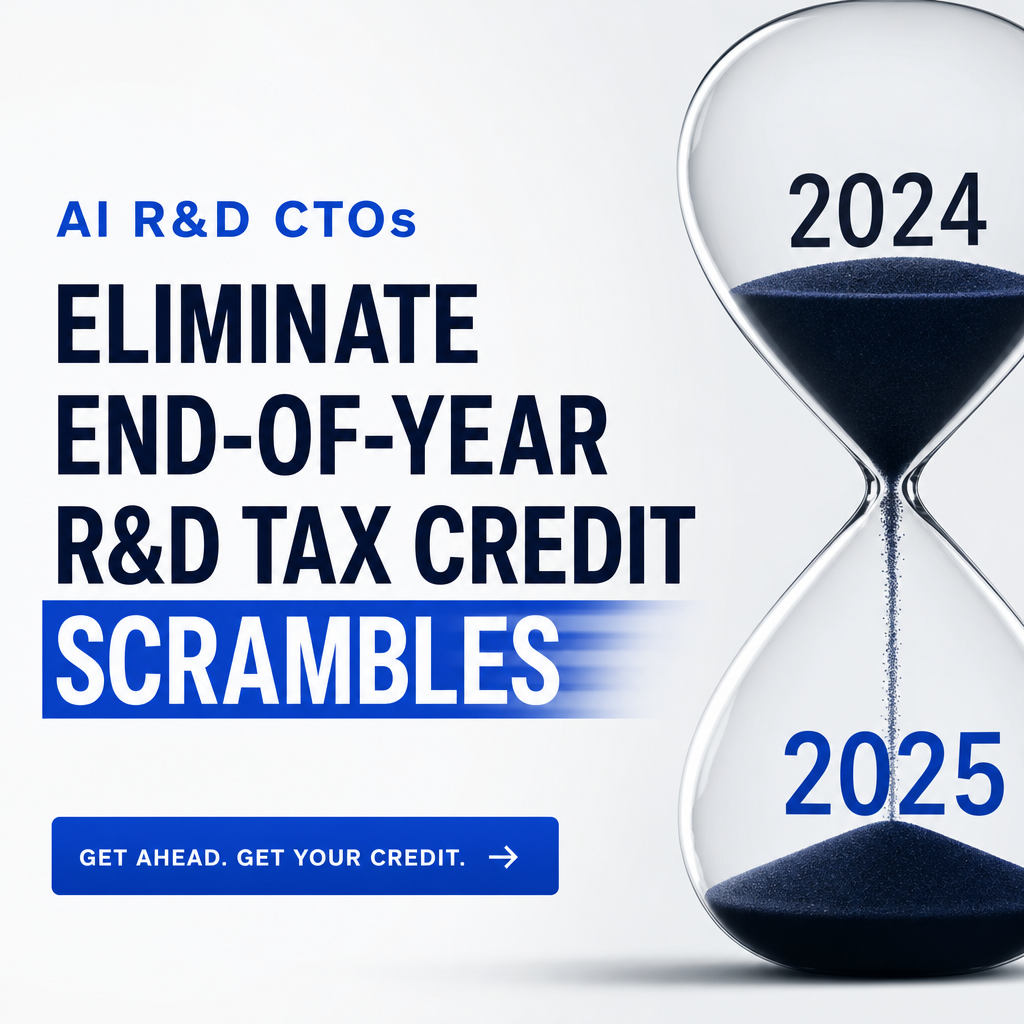
The end-of-year scramble is a documentation problem—not an innovation problem:
Every year, thousands of U.S. companies repeat the same painful cycle. As filing deadlines approach, founders, engineering leaders, finance teams, and CPAs try to reconstruct months of technical work from memory. Emails get searched, calendars get reviewed, meeting notes get pieced together, and employees are asked to estimate how much time they spent solving technical problems that happened 10 months ago.
The issue usually isn’t a lack of Qualified Research Activities—it’s that companies attempt to document innovation after it has already happened. By the time the R&D Tax Credit conversation starts, key facts have faded: the original technical uncertainty, which alternatives were evaluated, why certain designs failed, what tests were run, and who contributed.
This is exactly where an AI R&D CTO model changes the workflow. Instead of treating Research and Development Tax Credits as an annual paperwork exercise, the AI R&D CTO operates as a continuous system—capturing technical narrative as it happens so R&D Tax Credits can be prepared with far less disruption, stronger support, and better IRS readiness.
Identify Qualified Research Activities in real time using an AI R&D CTO:
Most companies that build or improve software, develop prototypes, refine manufacturing processes, or engineer new systems perform qualifying work without labeling it as such. An AI R&D CTO—working as a Virtual CTO and AI Technology Advisor—helps teams recognize when work is likely to meet the four-part test by focusing on what matters: technical uncertainty, a process of experimentation, technological advancement, and reliance on engineering or computer science.
For example, in software, Qualified Research Activities often show up in performance tuning, scalability redesigns, data pipeline re-architecture, security hardening approaches, or reliability improvements where outcomes aren’t known at the start. In manufacturing and engineering, it can be fixture redesigns, tolerance experimentation, materials trials, automation changes, or prototype iterations.
Because the AI R&D CTO is built around continuous Innovation Management and AI Innovation Management principles, the identification step becomes ongoing—not a retroactive guessing game. That creates a more complete and defensible record and reduces the friction engineers feel when tax credit requests arrive at year-end.
Capture technical uncertainty, experimentation, and outcomes while work is fresh:
R&D Tax Credit claims are strengthened by contemporaneous documentation: records created near the time the work occurs. Traditional approaches often rely on after-the-fact interviews, where people do their best to remember details. But memory is rarely specific enough to describe hypotheses, failed approaches, test conditions, iteration counts, or the precise “why” behind technical decisions.
An AI R&D CTO approach replaces the annual reconstruction model with a continuous documentation rhythm. Through guided technical prompts and structured interview workflows, teams can record what they attempted, what constraints existed, what experiments were run, and what was learned—while it’s still clear.
This is not just for tax. It also becomes a durable technical memory. As an AI Chief Technology Officer and AI Technical Advisor capability, the AI R&D CTO helps preserve decisions, rationale, and learnings that improve future engineering velocity—especially when employees change roles or new team members onboard.

“Firms that understand how to use AI as a new tool in the broader context of process reengineering will arguably get the most from AI in the long run.”
– Harvard Business Review
Track Qualified Research Expenses without burdening engineering teams:
One of the biggest causes of the end-of-year scramble is expense tracking—especially time. Engineers are asked to approximate how much effort was spent across projects long after the work is done. The same happens with contractor involvement, prototype supplies, and cloud or lab costs that may be embedded across accounts. In an AI R&D CTO model, companies can track Qualified Research Expenses with significantly less manual effort. The goal is to reduce the time-load and improve accuracy by capturing the essentials throughout the year.
Practically, this means the AI R&D CTO can help organize time survey workflows, track employee and contractor activity at a regular cadence, and build a project-by-project timeline that aligns technical work with financial records. For larger claims, it can also help map R&D-related activity to existing project management, ERP, and accounting data so eligible cost categories can be supported with clearer, audit-ready trails.
The result is that the R&D Tax Credit becomes feasible even for the smallest teams—startups, micro businesses, and small manufacturers—because the compliance burden no longer spikes at year-end.
Produce a CPA-ready R&D Study and support Form 6765 preparation:
Strong outcomes for R&D Tax Credits depend on turning raw engineering activity into a structured, supportable story: what was attempted, why it was uncertain, how experimentation occurred, and which costs tie to those efforts. This is where an R&D Study becomes the bridge between engineering reality and tax compliance.
An AI R&D CTO approach helps streamline the creation of an R&D Study by organizing Qualified Research Activities alongside the supporting technical documentation, interview notes, timelines, and cost summaries. This supports the information your tax preparer needs for Form 6765 while also helping meet IRS compliance expectations.
When companies use R&D Tax Credit Services or engage R&D Tax Credit Consultants, the bottleneck is often documentation completeness. Continuous capture means fewer missing pieces, fewer rushed interviews, and fewer last-minute requests to “please find that old testing report.” It also helps maximize available R&D Tax Credits by reducing the risk that legitimate activities go undocumented and therefore go unclaimed.
Add product intelligence: the AI R&D CTO as a year-round Virtual CTO and AI Product Strategy partner:
Eliminating the scramble is only part of the value. The AI R&D CTO also operates as a layer of product and technology leadership—supporting better decisions throughout the year. This is where the model extends beyond tax into competitive execution.
As a Virtual CTO, AI Chief Technology Officer, and AI Product Intelligence capability, the AI R&D CTO helps smaller companies access guidance that historically required large internal teams: technical leadership support, emerging technology awareness, competitive benchmarking, and innovation intelligence.
This can reinforce AI Product Strategy and AI Product Development by keeping teams aware of technical options, tradeoffs, and evolving standards—without turning tax credit work into a distraction. When organizations combine better technical decision-making with better R&D documentation, the tax credit becomes more than Tax Savings; it becomes improved Business Cash Flow that can be reinvested into the next iteration—turning the R&D Tax Credit Refund into a self-funding innovation engine.
Replacing manual R&D tax credit preparation with continuous R&D Tax Credit intelligence:
Traditional R&D Tax Credit preparation is episodic: a once-a-year push that depends on imperfect recollection. An AI R&D CTO reorients the process into continuous operations—continuous documentation, continuous classification of Qualified Research Activities, continuous QRE tracking, and continuous readiness for tax season.
This shift matters because it improves both precision and speed. Teams spend less time reconstructing, finance teams receive clearer support, and CPAs get more consistent inputs. Most importantly, companies reduce risk: fewer gaps in technical narrative, fewer unsupported assumptions, and a cleaner alignment between the R&D story and the numbers.
Done well, this is how Innovation Management becomes measurable and repeatable—while simultaneously improving the likelihood that companies capture the full value of their Research and Development Tax Credits.
Learn more and estimate your R&D Tax Credit:
SHAIN’s positioning is simple: the AI R&D CTO democratizes innovation by helping startups, micro businesses, and small companies recover R&D Tax Credits while gaining access to technical leadership and innovation intelligence previously available only to large enterprises.
If you’re tired of the end-of-year scramble—or you suspect your team is doing qualifying work without capturing it—learn how an AI R&D CTO can enhance knowledge to world-class standards while seamlessly gaining R&D tax credits, and obtain an estimate of how much your R&D Tax Credit can be by selecting a button below.