
 - EN
 - EN
Don’t Risk Years of R&D Claims with Unsupported Employee Hours:
Claiming Research and Development Tax Credits often breaks down at the same place: proving employee time when perfect R&D timesheets don’t exist. Many businesses know they performed Qualified Research Activities, but hesitate to file because they think the compliance requires exact hour-by-hour logs.
In practice, strong R&D Tax Credit documentation is built with a defensible model that connects (1) employee testimony about what they did and roughly when, (2) contemporaneous support documents that corroborate the timeline and technical nature of the work, and (3) human confirmation that the final record is reasonable. This approach supports an R&D Study, improves compliance readiness, and helps ensure Qualified Research Expenses are appropriately captured—without pretending that a stack of records can “mechanically compute” R&D hours.
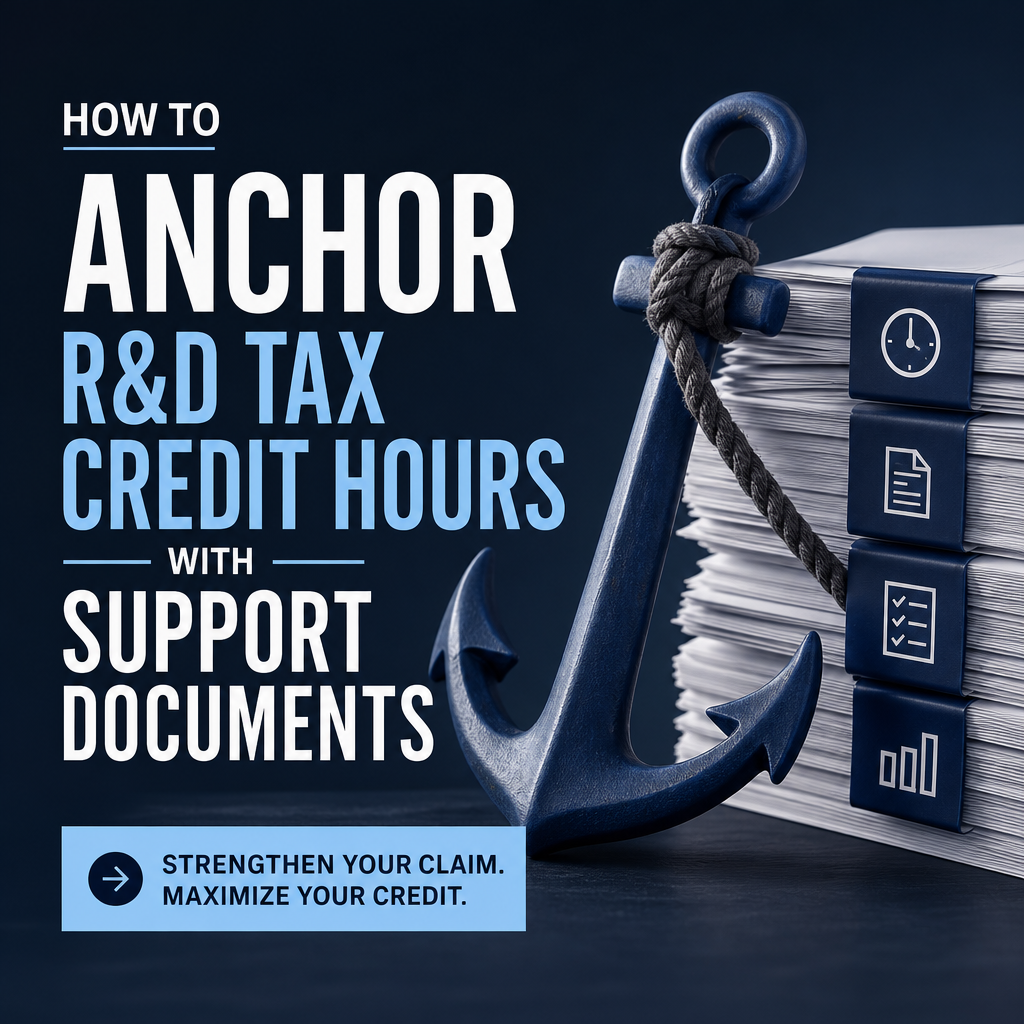
A key distinction: support documents should not be used to automatically calculate time (e.g., “15 Git commits = 15 hours” or “one ticket = 10 hours”). That’s not sound methodology. Instead, documents provide contemporaneous anchors—dated technical records that corroborate when R&D occurred, what employees worked on, and whether estimated time allocations are reasonable.
Define the Anchor: What an R&D Evidence Anchor Really Is:
An R&D evidence anchor is a dated technical record that helps corroborate an employee’s recollection of when an R&D activity occurred and what technical work was being performed.
Anchors are not “proof of hours.” They are proof of activity patterns: they show that experimentation, testing, prototyping, redesign, and problem-solving happened across the period being claimed. Good anchors commonly include:
• Jira / Azure DevOps tickets describing technical uncertainties and attempted solutions
• GitHub / Bitbucket records showing development iterations (not hour counts)
• Test results, performance logs, defect and failure reports
• Technical reports, architecture notes, design revisions, engineering emails
• Prototype builds, CAD revisions, lab notes, experiment logs, CMM results
When paired with employee explanations, anchors make an R&D Tax Credit claim far more defensible, especially when preparing Form 6765 support, building the project narratives, and substantiating Qualified Research Activities.
Evidence Isn’t Testimony: The 3-Layer Model that Withstands Scrutiny:
The strongest R&D Tax Credit Services don’t treat documents as a substitute for people. Instead, they connect three layers:
1) Employee testimony: The employee explains the technical uncertainty, the alternatives evaluated, the experiments or iterations performed, and their estimated portion of time.
2) Supporting evidence: Contemporaneous anchors corroborate that those activities occurred across the quarter or year.
3) Human confirmation: The employee (and technical leadership) reviews the assembled activity record and confirms it reflects what actually happened.
This is why support documents matter for Business Cash Flow outcomes. If you can’t substantiate the work, you risk leaving Tax Savings on the table—or worse, creating exposure. A well-structured R&D Study ties wages, contractor costs, and supplies to the underlying experimentation, supporting Qualified Research Expenses and strengthening your R&D Tax Credit Refund position.

“Agentic AI is a new labor model, new productivity model, and a new economic model.”
– Marc Benioff, Chair, CEO and co-founder of Salesforce
A Concrete Example: Corroborating a 30% Q2 R&D Time Estimate:
Suppose a developer estimates that 30% of Q2 was spent on qualifying experimental development work. A defensible approach does not simply accept the estimate—nor does it attempt to “calculate hours” from tools.
Instead, the employee explains the work performed, and then supporting records provide anchors throughout the quarter, such as:
• April 8 — Ticket describing a transaction-consistency problem (technical uncertainty)
• April 17 — Architecture revision documenting a new approach
• May 3 — Repository activity reflecting an experimental outbox implementation
• May 14 — Test results showing latency failure (failed hypothesis)
• May 27 — Revised architecture after performance constraints
• June 11 — Additional test results demonstrating partial improvement
• June 24 — Engineering discussion documenting the next experimental path
Those anchors don’t say: “The employee spent exactly 156 R&D hours.” They do something more important: they corroborate that qualifying work occurred repeatedly across Q2, supporting that a 30% estimate is plausible and consistent with the documented pattern of technical activity.
This distinction is central to credible R&D Tax Credit Consultants: commit counts, ticket counts, or message volume are not time. One day of deep uncertainty analysis might generate a single commit; another day might generate many commits quickly. Anchors validate timing and substance, not exact duration.
Turning Anchors into an R&D Study that Supports QREs (Without Overclaiming Precision):
Once you have testimony and anchors, you can build a clean R&D Study that connects the work to Qualified Research Activities and then to Qualified Research Expenses. This is where many claims either become strong—or become vulnerable.
A practical structure is:
Employee → Project → Technical Uncertainty → Activity → Date → Evidence Anchor → Result
Using this structure, you can support:
• Wages: who performed the experimentation and when it occurred
• Contractor costs: which external resources were engaged in qualifying work
• Supplies: what was consumed in experimentation or prototyping (where applicable)
The goal is not to make the documentation “look busy.” The goal is to show a coherent story of experimentation: uncertainty, alternatives, testing, results, and iteration—so the R&D Tax Credit claim aligns with the technical reality and the requirements for substantiation.
Where an AI R&D CTO and Virtual CTO Fit: Making Anchoring Scalable, Not Mechanical:
For many small and mid-sized businesses, the hardest part isn’t doing R&D—it’s organizing the proof. Traditionally, teams manually hunt through systems, ask employees to remember details months later, and struggle to tie documentation to claimed percentages.
This is where an AI R&D CTO—operating as a Virtual CTO, AI Chief Technology Officer, and AI Technical Advisor—modernizes the workflow without claiming false precision. Rather than “reading Jira and deciding your hours,” the AI R&D CTO helps companies:
• Identify Qualified Research Activities that likely meet the 4-part test
• Organize evidence anchors by project and technical uncertainty
• Streamline technical interviews and convert responses into usable narratives
• Produce time surveys that start from testimony, then check consistency against anchors
• Create draft R&D Study documentation that humans review and confirm
• Support IRS compliance requirements and strengthen Form 6765 support
The outcome is less administrative burden and stronger substantiation. Importantly, the AI R&D CTO approach respects the defensible sequence:
Employee explains work performed
↓
AI builds the activity record
↓
Supporting documents provide date/activity anchors
↓
AI compares the evidence pattern with the employee’s time allocation
↓
Employee reviews and confirms
This is also where broader AI Product Intelligence and Technology Strategy support can emerge. In the same process of organizing uncertainties, experiments, and outcomes, leadership can gain clearer visibility into recurring technical barriers, missed learning loops, and innovation throughput—supporting AI Product Strategy and Innovation Management without touching or altering your company’s products or processes.
Next Steps: Turn R&D Tax Credits into a Self-Funding Innovation Engine:
If your team is building, testing, prototyping, or iterating to overcome technical uncertainty, you may already have substantial Qualified Research Activities—and meaningful Qualified Research Expenses—without a perfect timekeeping system.
The right approach is to use employee testimony plus evidence anchors to corroborate timing and technical substance, then convert that into a defensible R&D Study that supports your R&D Tax Credit claim and improves Business Cash Flow.
To learn more about how an AI R&D CTO can help enhance knowledge to world-class standards while seamlessly gaining R&D Tax Credits—and to get an estimate of how much your R&D Tax Credit Refund could be—select the button below.