

 - EN
 - EN
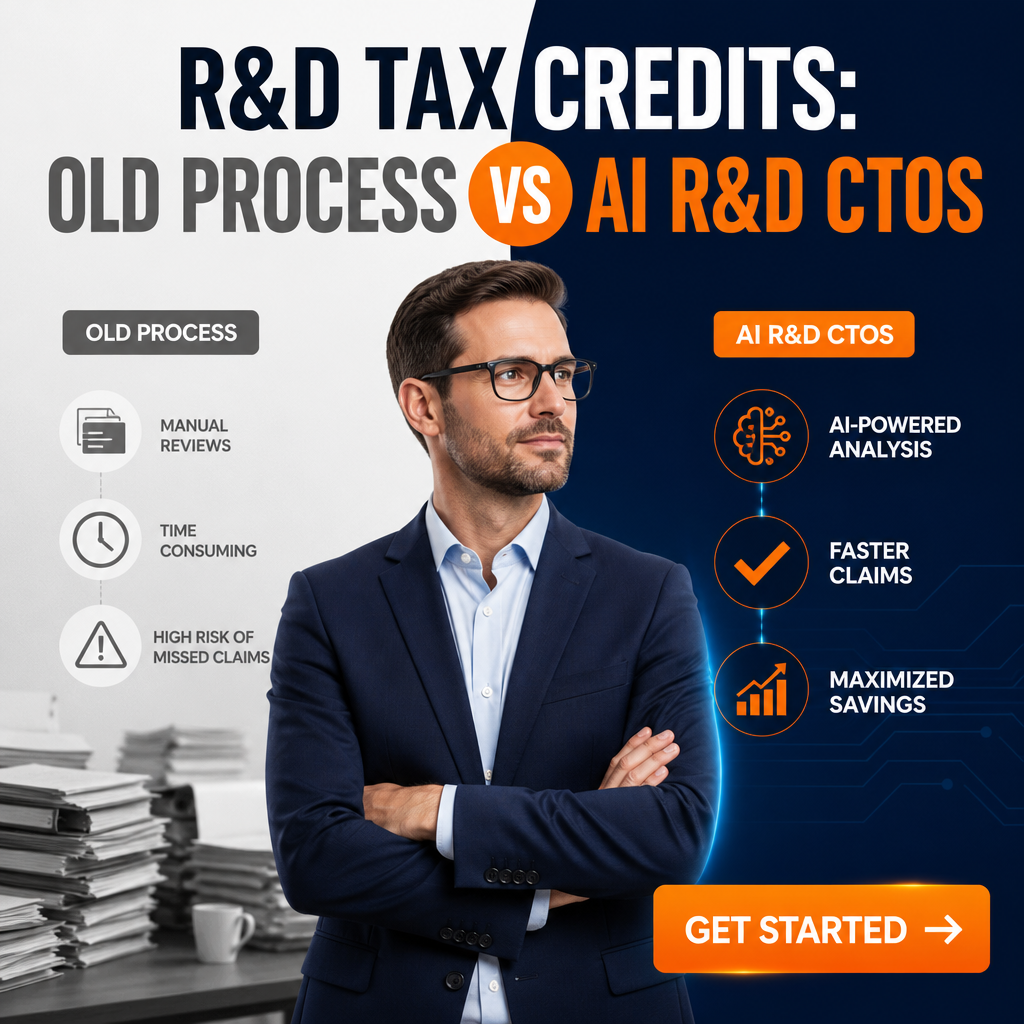
Why reconstruct once a year when AI can document continuously?:
The traditional R&D Tax Credit process typically starts after most Product Development work has already happened. Teams scramble to remember experiments, locate supporting documents, and estimate time allocations months later. Sound familiar? That “reconstruction” approach creates friction for engineers and risk for compliance.
An AI R&D CTO (and/or a Virtual CTO acting as an AI Technology Advisor) changes the operating model: capture the work while it happens, continuously build the R&D record, and shift professional effort from manual production to review. The goal isn’t “humans vs. AI.” The goal is AI production + human validation—so your R&D Tax Credit Services become more precise, less disruptive, and easier to defend.
Don’t reconstruct your R&D Tax Credit once a year. Build it while the R&D happens.
Traditional Process vs. AI R&D CTO: a visual comparison:
This is the core shift: in the traditional model, humans collect → humans organize → humans analyze → humans draft → humans review. With an AI Chief Technology Officer approach, AI collects and organizes → AI assists analysis → AI drafts → humans validate and review. Automation moves professional time from production to review.
Identify Qualified Research Activities (QRAs) earlier—while technical uncertainty is fresh:
R&D Tax Credits are driven by Qualified Research Activities that meet the “4-part test” (permitted purpose, technological in nature, elimination of uncertainty, and process of experimentation). The problem with year-end reconstruction is that uncertainty and experimentation are easiest to describe in the moment—not nine months later.
An AI R&D CTO supports Innovation Management by prompting lightweight check-ins during the year so teams can capture what actually happened: hypotheses considered, alternatives tested, failures, iterations, and why the final approach was not obvious at the outset.
This is especially relevant in common qualifying sectors—software, manufacturing, engineering, and technology businesses—where QRAs often show up as:
– building or improving software performance, scalability, security, or reliability
– prototyping and testing new materials, fixtures, or tooling
– developing algorithms, data pipelines, or system architecture alternatives
– integrating hardware/software systems under real constraints
Instead of asking engineers, “What did you do last year?”, the AI R&D CTO experience becomes: “Here’s what we captured during the quarter—does this accurately represent your R&D?” Engineers should explain the engineering. They shouldn’t be R&D Tax Credit documentation clerks.

“Industrial AI is no longer a feature; it’s a force that will reshape the next century.”
– Roland Busch, President and CEO of Siemens AG
Calculate Qualified Research Expenses (QREs) with less disruption and higher confidence:
The value of Research and Development Tax Credits depends on Qualified Research Expenses—typically wages, supplies, and certain contractor costs tied to QRAs. Traditional approaches often rely on spreadsheets, interviews, and retroactive time estimates that can be hard to support.
With an AI Technical Advisor mindset embedded into the process, data can be organized throughout the year so QREs are easier to substantiate:
– wages: supported by role-based project involvement and periodic confirmations
– contractors: matched to statements of work, deliverables, and technical purpose
– supplies: associated to prototypes, test runs, pilots, and experimental trials
This doesn’t replace professional judgment. It improves the inputs so R&D Tax Credit Consultants can spend more time validating positions and less time chasing missing details—improving Tax Savings outcomes and reducing strain on Business Cash Flow planning.
Build the R&D Study continuously: technical narratives and an Evidence Map, not a document hunt:
A strong R&D Study connects three things: the activities, the uncertainty/experimentation, and the evidence that supports the story. The biggest pain in the old process is the end-of-year scavenger hunt: search project tools, search code repositories, search emails, search folders—then try to figure out what supports what.
An AI R&D CTO approach emphasizes evidence mapping: Technical activity → supporting evidence → Evidence Map. The intent is not to “collect more files,” but to link evidence to specific Qualified Research Activities so the narrative and support structure align.
This is where AI-assisted drafting is most valuable. A sector-aware approach can help organize contemporaneous documentation into clear technical narratives (what was uncertain, what alternatives were evaluated, what tests were run, what results were observed, and what advancement was achieved). Then experienced R&D Tax Credit Services professionals perform human review, confirm accuracy, and shape the final defensible study.
Time surveys become quarterly confirmations: better engineer experience, better compliance posture:
Time is often the largest QRE category, yet it’s commonly supported by year-end estimates. That’s a recipe for inaccuracy and frustration.
Under a more modern model, employees provide quarterly confirmations informed by activity records and evidence anchors. The experience shifts from:
– Traditional: “What percentage of last year do you think you spent on this project?”
– AI R&D CTO: “Here’s what we captured this quarter. Is this an accurate representation of your R&D?”
This method supports IRS compliance expectations by keeping records closer to when the work occurred. Employees explain the R&D. Supporting documents anchor the activity. AI builds the record. Humans confirm it.
Automating and facilitating R&D Tax Credit claims: replacing manual production with AI production + human review:
The most important shift is timing and workflow. Traditional R&D Tax Credit preparation is episodic: R&D happens → year ends → reconstruct the study. The AI R&D CTO model is continuous: R&D happens → R&D is captured → the study develops throughout the year.
That change matters because it:
– reduces memory gaps and missing documentation
– standardizes technical interviews into repeatable prompts and checklists
– improves consistency across teams and projects
– makes Form 6765 preparation and support schedules easier to assemble
– increases confidence in R&D Tax Credit eligibility positions
For many startups and small businesses, this is the difference between “we should claim, but it’s too painful” and “we can claim every year with a manageable process.” The result is a more reliable R&D Tax Credit Refund pathway and improved Business Cash Flow—turning the credit into a self-funding innovation engine.
Beyond funding: FUND, SOLVE, GUIDE—the AI R&D CTO as ongoing technology leadership:
Traditional R&D Tax Credit Consultants are typically engaged for one primary outcome: FUND (capture Tax Credits). An AI R&D CTO expands the value while keeping the R&D Tax Credit foundation intact:
– FUND: Continuously identify Qualified Research Activities, calculate Qualified Research Expenses, and maintain an audit-ready R&D Study.
– SOLVE: Support technical barrier resolution by structuring experimentation thinking and clarifying what uncertainties must be eliminated.
– GUIDE: Provide AI Product Intelligence, competitive benchmarking, and emerging technology awareness to inform AI Product Strategy.
This is how smaller organizations get enterprise-level Innovation Management capabilities without building a large internal tax or technology leadership department. It’s also why the role can complement a Virtual CTO or function as an AI Technology Advisor / AI Chief Technology Officer for companies that need both technical direction and disciplined credit capture.
Learn more: turn R&D Tax Credits into a self-funding innovation engine:
SHAIN’s positioning is simple: the AI R&D CTO democratizes innovation by helping startups, micro businesses, and small companies recover R&D Tax Credits while gaining access to technical leadership and innovation intelligence previously available only to large enterprises.
If you want to see how an AI R&D CTO can enhance knowledge to world-class standards while seamlessly gaining R&D tax credits—and get an estimate of how much your R&D Tax Credit could be—select the button below.