
 - EN
 - EN
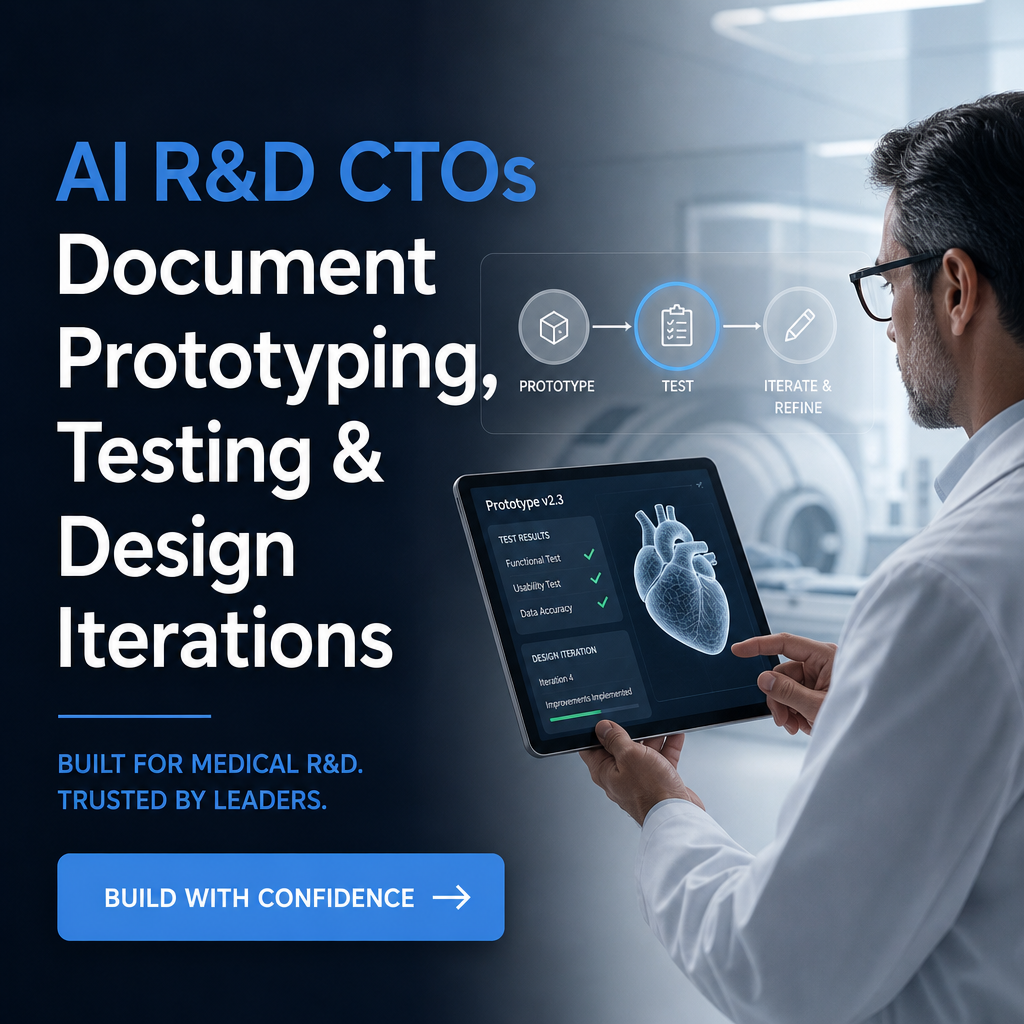
Automated Tax Credit R&D Study for Medical Product Design:
Medical R&D teams generate mountains of artifacts—test reports, design-history files, change orders, verification protocols, failure analyses, and meeting notes. Yet when it comes time to support R&D Tax Credits, many companies still struggle to turn those “normal” technical records into a defensible R&D evidence trail.
The problem is not simply having documents. The real problem is proving what happened, why it was technically uncertain, what was tested, who participated, and how the supporting records connect to the R&D Tax Credit claim.
This is where an AI R&D CTO (and AI R&D back office workflow) changes outcomes for medical device, diagnostics, digital health, and biotech-adjacent engineering teams. An AI Chief Technology Officer—deployed as a Virtual CTO and AI Technology Advisor—helps transform routine prototyping and testing records into an organized, reviewable map that supports Qualified Research Activities and Qualified Research Expenses. The goal is simple: build a credible, contemporaneous story that can support an R&D Study and withstand audit scrutiny—without turning engineers into documentation clerks.
Build the medical R&D evidence chain (from business component to supporting document):
A defensible R&D Tax Credit file is not a folder of PDFs; it’s a traceable chain. In medical R&D, the evidence chain must connect design iterations and testing to a technical objective and uncertainty, then to experiments and outcomes, then to people and costs.
A practical evidence chain looks like this:
Business component → technical objective → technical uncertainty → experiment / alternative evaluated → result → employee activity → Qualified Research Expense → supporting document.
For example, a “business component” might be a next-gen catheter handle assembly, a diagnostic assay workflow, or a wearable sensor subsystem. The technical objective might be higher signal stability, reduced occlusion risk, improved sensitivity/specificity, or tighter manufacturing repeatability. The technical uncertainty is what the team could not know at the outset (materials behavior, sensor drift, algorithm robustness, bonding performance, sterilization impact, etc.).
An AI R&D CTO supports Innovation Management by ensuring each link is captured and mapped. This is the difference between “we did a lot of testing” and “we performed Qualified Research Activities aimed at resolving technical uncertainties through a systematic evaluation of alternatives.”
Evidence mapping vs. document dumping: organizing what each record can prove:
Medical R&D teams often have strong quality systems, but R&D Tax Credit documentation has a different purpose: it must connect technical work to the credit’s requirements and to QREs.
Evidence mapping means anchoring each document to the specific R&D activity it supports. Different record types corroborate different parts of the story:
Design-history records / DHF: Corroborate design evolution, milestones, and design controls; alone they may not clearly articulate the technical uncertainty and experimentation.
Design inputs/outputs, drawings, and ECOs: Prove what changed and when; they don’t necessarily prove why a change required experimentation.
Prototype build records and traveler notes: Support that iterative prototyping occurred and who built what; they may not show the rationale or outcome.
Engineering test results (bench, environmental, reliability): Prove the experiments and results; without context they may not show the initial uncertainty or alternative hypotheses.
Verification records and protocols: Corroborate planned test methods and acceptance criteria; they might not capture exploratory iterations that occurred before verification.
Lab notebooks / method-development notes: Strong support for uncertainty and experimentation; may be inconsistent unless routinely captured.
Failure analyses (e.g., fracture, leakage, drift): Prove a technical problem and investigation; must be tied to iterative changes and retesting.
An AI Technical Advisor function—within the AI R&D CTO—helps teams move from “we have records” to “we have a mapped, defensible evidence trail.”

“AI is poised to accelerate progress at unprecedented scale.”
– Sundar Pichai, CEO of Google and Alphabet
Scenario 1: Device performance iteration (prototype → test → redesign) with a credit-ready trail:
Consider iterating a handheld surgical instrument to improve torque transmission while maintaining sterilization compatibility.
Business component: instrument torque mechanism.
Technical objective: improve torque transfer efficiency and durability.
Technical uncertainty: whether alternative gear geometry and polymer selection can meet durability after repeated sterilization cycles.
Experiment / alternatives evaluated: prototype builds with multiple geometries and materials; bench torque tests; accelerated aging; post-cycle inspection.
Result: certain geometry/material combinations fail under aging; final configuration meets performance.
Employee activity: mechanical engineers design iterations; technicians build prototypes; test engineers execute protocols; quality/engineering reviews interpret failures.
QRE tie-in: wages for technical staff time on iterations/testing, prototype supplies consumed, qualified contractor testing support (if applicable).
Supporting documents: CAD revision history, ECOs, torque test datasets, sterilization cycle logs, failure analysis memos, meeting notes deciding next iteration.
An AI R&D CTO helps convert this into an R&D Study-ready narrative by mapping each revision and test record to the specific uncertainty and the experiment performed—so the claim reads like a structured technical journey instead of a retrospective summary.
Scenario 2: Diagnostic method development (uncertain sensitivity/specificity) documented for R&D Tax Credits:
Now consider developing a diagnostic method where sensitivity is uncertain across sample matrices.
Business component: diagnostic method workflow.
Technical objective: achieve target sensitivity and limit of detection.
Technical uncertainty: whether sample prep and reagent conditions can reliably detect low concentrations without interference.
Experiment / alternatives evaluated: multiple sample prep protocols, reagent ratios, incubation times; repeated runs with controls; statistical analysis of variance.
Result: certain conditions improve signal but increase false positives; optimized protocol balances performance.
Employee activity: scientists define hypotheses; lab staff run experiments; analysts interpret results.
QRE tie-in: wages for those performing experimental work, supplies/reagents consumed in trials, and certain contractor lab work.
Supporting documents: lab notebook entries, run logs, raw instrument outputs, method-development records, change logs to protocols, validation planning notes.
The AI Product Intelligence capability (as part of an AI Innovation Platform supporting the AI R&D CTO) is used here only to structure and contextualize R&D documentation—capturing the evolution of method decisions and anchoring evidence to the uncertainty being resolved.
Scenario 3: Manufacturing process repeatability (process experiments) as evidence:
Medical manufacturing improvements can qualify when they involve technical uncertainty and systematic experimentation, not mere routine production.
Business component: assembly or coating process.
Technical objective: improve repeatability and reduce defect rate.
Technical uncertainty: whether new parameter windows (temperature, pressure, cure time, surface prep) can achieve consistent adhesion without compromising biocompatibility.
Experiment / alternatives evaluated: DOE-style trials; parameter sweeps; destructive testing; microscopy; retest after storage.
Result: stable window identified; defects reduced.
Supporting evidence: DOE plans, run sheets, process capability analyses, inspection/verification records, nonconformance and failure analysis documentation, ECOs updating work instructions.
What evidence can’t do alone: A capability chart may show improvement, but not the initial uncertainty or alternative technical approaches unless tied to the experimental plan and decision records. Evidence mapping is what closes that gap for R&D Tax Credit Services and IRS-ready support.
How an AI R&D CTO replaces manual R&D Tax Credit documentation with human review:
Traditional R&D Tax Credit preparation often depends on after-the-fact interviews, scattered file requests, and manual narrative drafting. That approach is expensive, disruptive, and prone to missing details.
An AI R&D CTO—operating as a Virtual CTO and AI Technology Advisor—focuses on continuous capture and organization to support R&D Tax Credit eligibility:
• Voice or guided technical interviews that periodically capture what was uncertain, what was tried, and what changed
• Evidence mapping that links artifacts (test reports, ECOs, lab notes) to specific Qualified Research Activities
• Automated prompts for lightweight time surveys that align employee activity to projects without excessive administrative burden
• Drafting structured technical narratives that can be reviewed and corrected by engineers and then reviewed by R&D Tax Credit Consultants
• Producing CPA-ready support for Form 6765 and an R&D Study, including clear QRA/QRE schedules and document anchors
Human review remains essential. Engineers confirm the technical facts. Tax professionals validate the interpretation, substantiation, and compliance requirements. AI improves capture, consistency, and speed—reducing the risk that valuable Qualified Research Expenses are overlooked and improving Business Cash Flow through better-supported claims and potential R&D Tax Credit Refund outcomes.
Turn documentation into a self-funding innovation engine (FUND-SOLVE-GUIDE):
When medical R&D evidence is mapped correctly, the R&D Tax Credit becomes more than a year-end exercise—it becomes repeatable Innovation Management.
FUND: Better documentation can increase Tax Savings and improve Business Cash Flow by capturing eligible work that otherwise gets missed.
SOLVE: The AI R&D CTO helps teams surface technical barriers earlier, maintain clearer experiment histories, and keep projects aligned to measurable uncertainties.
GUIDE: As an AI Chief Technology Officer and AI Technical Advisor role, the AI R&D CTO can provide AI Product Strategy and technology strategy guidance at a level smaller teams typically can’t afford—while still keeping the focus on R&D Tax Credits substantiation and audit-ready support.
The result is a more level playing field: startups and small-to-mid sized medical innovators can access R&D Tax Credit Services and technical leadership support without building a large internal team.
Next step: estimate your R&D Tax Credit and see how an AI R&D CTO strengthens your evidence trail:
If your team is prototyping, testing, and iterating designs in medical R&D, you may already have the raw material for a strong credit—without having a mapped evidence chain. An AI R&D CTO helps you elevate documentation to world-class standards while seamlessly preparing support for R&D Tax Credits, from Qualified Research Activities through Qualified Research Expenses and a defensible R&D Study package.
To learn more and get an estimate of how much your R&D Tax Credit could be, select the button below.