
 - EN
 - EN
From Tax Forms to Innovation Investment Fund:
For owners, CFOs, and growth-minded SMB leaders, the commercial reality is simple: many companies are already doing work that can qualify for R&D Tax Credits, but they treat it as routine Product Development rather than “R&D.” The opportunity is often hiding in plain sight—inside everyday technical problem-solving where your teams are trying to improve performance, reliability, cost, speed, security, or scalability and must resolve technical uncertainty through testing.
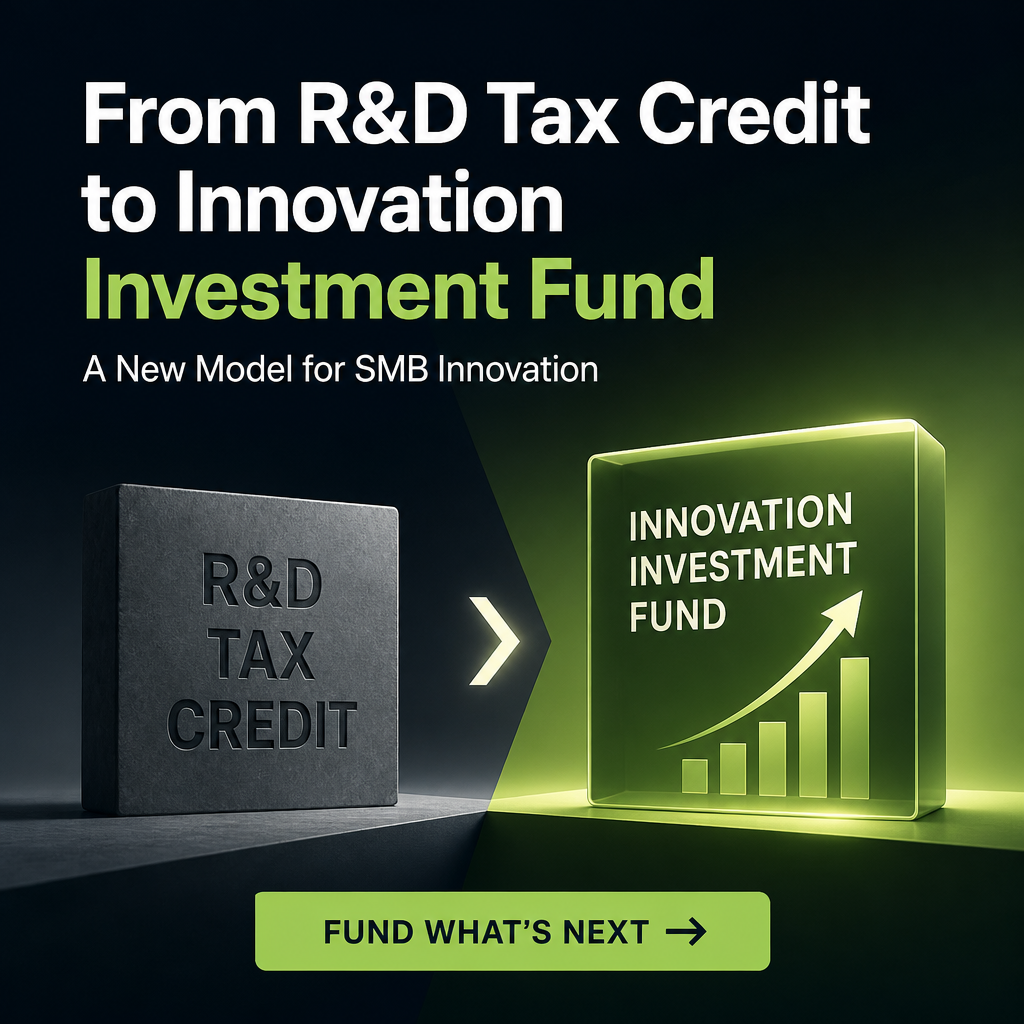
When an annual R&D Tax Credit is treated as recurring innovation capital, it can become an internal Innovation Investment Fund: qualifying R&D → tax credit → improved business cash flow → reinvestment into technical hiring, prototyping, tooling, and experimentation → more qualifying R&D. This is not a one-time tax event; it’s a repeatable funding loop when supported by consistent Innovation Management and documentation discipline.
Research and Development Tax Credits are not reserved for “labs.” Many startups, software companies, manufacturers, engineering firms, and technology businesses perform Qualified Research Activities while building or improving business components (products, processes, software, techniques, or formulas). The challenge is identifying those activities, connecting them to Qualified Research Expenses, and creating an audit-ready R&D Study without disrupting operations.
Where qualifying R&D is hiding in normal SMB workstreams:
SMBs commonly overlook R&D Tax Credit eligibility because project teams don’t label their work “research.” Yet the four-part pattern often exists: a permitted improvement objective, technical uncertainty, a process of evaluating alternatives, and reliance on engineering or computer science principles.
Examples of “normal work” that may contain Qualified Research Activities include:
• Software and SaaS: improving system scalability, reducing latency, hardening security, refactoring architecture to meet performance targets, building new integrations where off-the-shelf approaches fail, or designing data pipelines under strict reliability requirements.
• Manufacturing and physical products: redesigning a component to reduce weight while meeting strength tolerances, developing new fixturing methods, stabilizing a process window to reduce scrap, trialing new materials, or improving yield under variable inputs.
• Engineering services: developing a novel calculation approach, testing alternative designs to meet code constraints, prototyping to achieve vibration or thermal thresholds, or validating a new control strategy.
The key is not whether a project succeeded. It’s whether your team faced technical uncertainty (not just business uncertainty) and used experimentation—prototyping, simulation, test runs, iterative coding, bench testing, design of experiments, or structured troubleshooting—to resolve it.
When you treat the R&D Tax Credit as an Innovation Investment Fund, your goal becomes repeatability: capture and document these workstreams each year so the credit becomes predictable innovation funding rather than a scramble at tax time.
A practical “Innovation Investment Fund” cycle for SMBs:
To turn an R&D Tax Credit into recurring innovation capital, align your finance, technical leadership, and project execution around a simple operating model:
1) Identify candidate initiatives early (not after year-end).
2) Track technical uncertainty, alternatives tested, and outcomes as work happens.
3) Map costs to Qualified Research Expenses with defensible logic.
4) Package the narrative and support into an R&D Study that supports Form 6765 preparation.
5) Reinvest the resulting tax savings into next-quarter technical capacity.
Hypothetical example (software company):
• Technical objective: reduce API response time from 900ms to <200ms under peak load.
• Uncertainty: unknown constraints in concurrency model and database contention.
• Alternatives/testing: benchmark multiple caching strategies, refactor async pipeline, run load tests, evaluate indexing and partitioning.
• Result: stable <220ms with improved fault tolerance.
• Potential Qualified Research Activities: performance engineering, architecture experimentation, and testing tied to a specific business component.
Hypothetical example (manufacturer):
• Technical objective: improve yield by 8% while switching to a new supplier material.
• Uncertainty: how the new material behaves under heat and pressure cycles.
• Alternatives/testing: trial runs, parameter adjustments, tensile testing, inspection data analysis.
• Result: validated parameters and updated work instructions.
• Potential Qualified Research Activities: process experimentation and validation trials.
This is how Small Business Innovation becomes fundable: by consistently converting technical learning into substantiated Research and Development Tax Credits.

“Industrial AI will define who leads in industry in the future.”
– Roland Busch, President and CEO of Siemens AG
Connecting Qualified Research Activities to Qualified Research Expenses:
SMBs often suspect they qualify, but struggle to translate engineering reality into finance-ready numbers. The R&D Tax Credit depends on connecting Qualified Research Activities (QRAs) to Qualified Research Expenses (QREs) in a way that is supportable.
Common QRE categories that may apply when properly tied to qualifying work include:
• W-2 wages: employee time spent directly performing, supervising, or supporting qualified technical activities (e.g., engineers, developers, QA, certain product leadership when directly tied to the technical work).
• Contractors: certain third-party costs for qualifying development or testing, when structured and documented appropriately.
• Supplies: consumables used in experimentation or prototyping (more common in manufacturing and hardware than pure software).
Not every technical cost qualifies, and not every project qualifies. The practical goal of strong Innovation Management is to create a traceable chain: business component → technical uncertainties → experiments/iterations → people and resources engaged → financial records supporting those expenses.
This is where R&D Tax Credit Services and experienced R&D Tax Credit Consultants traditionally spend time: reconstructing time, clarifying project narratives, and building defensible workpapers. The modern shift is toward building that package with less disruption and better contemporaneous evidence.
Documentation reality: what you likely already have (but haven’t assembled):
Most SMBs already generate “good evidence,” but it’s fragmented across systems and conversations. An audit-ready R&D Study typically draws from:
• Technical interviews with engineers, developers, and product owners
• Project records (tickets, commits, release notes, test plans)
• Design docs, architecture diagrams, simulation outputs, lab/test reports
• Prototypes and iteration logs
• Employee activity confirmations or time surveys (even lightweight)
• Financial schedules that map wages/contractors/supplies to initiatives
The pain point is that year-end reconstruction is slow and imprecise. Teams forget the technical uncertainties they solved, and finance teams are left with broad job titles and cost centers. That gap is exactly why eligible companies miss credits—or accept smaller credits—despite conducting Qualified Research Activities all year.
A better approach is to treat documentation as a byproduct of work. Not bureaucracy—just enough structure to capture what happened: what you tried, why you tried it, what changed, and who was involved.
How an AI R&D CTO modernizes R&D Tax Credit preparation:
After the industry case is clear, the next step is modernization. An AI R&D CTO is a new operating layer that combines the mindset of a Virtual CTO with R&D Tax Credit Intelligence—helping smaller companies prepare R&D tax credit claims with far less manual effort.
In practice, an AI R&D CTO (working alongside your CPA and finance team) can help make claiming feasible even for very small teams by focusing on ongoing capture and organization:
• Tracking Qualified Research Expenses by prompting lightweight, recurring employee activity confirmations and time surveys aligned to projects
• Capturing contractor activities and relating them to the same technical uncertainties and experiments as internal teams
• Organizing project timelines and evidence so the R&D Study is built from real-time inputs instead of year-end memory
• Structuring a CPA-ready package that supports Form 6765 preparation and IRS compliance expectations
This is not about changing your products or processes. It’s about reducing the documentation burden of the R&D Tax Credit and improving precision in how QRAs and QREs are substantiated.
Because the AI R&D CTO also functions as an AI Technology Advisor and AI Technical Advisor, the same layer can support higher-quality technical narratives: clearly describing uncertainties, alternatives tested, and technical outcomes in language that aligns with how R&D Tax Credit reviews actually work.
Beyond the credit: Product intelligence that helps you reinvest smarter:
An Innovation Investment Fund is only valuable if reinvestment decisions improve your technical trajectory. This is where the “CTO” side matters.
As an AI Chief Technology Officer capability, the AI R&D CTO can support:
• AI Product Strategy and technology strategy prioritization (what to build next, and what to stop building)
• AI Product Intelligence to clarify competitive gaps and performance targets
• Competitive benchmarking and emerging technology awareness to reduce technology risk
• Innovation Management rhythms that keep experimentation intentional, measurable, and easier to document
For SMBs, this can help break the cycle of reactive development. Instead of viewing the R&D Tax Credit Refund as a windfall, you can plan a quarterly reinvestment policy—hiring, test infrastructure, security hardening, prototyping budgets, or targeted refactors—grounded in what your teams are already proving through experimentation.
Build a self-funding innovation engine with an AI R&D CTO:
If your teams regularly solve technical uncertainties, you may already have the foundation for recurring R&D Tax Credits. The modern model is to treat the R&D Tax Credit as an Innovation Investment Fund: a repeatable loop that strengthens business cash flow and funds the next wave of Product Development.
SHAIN’s positioning is straightforward: the AI R&D CTO democratizes innovation by helping startups, micro businesses, and small companies recover R&D Tax Credits while gaining access to technical leadership and innovation intelligence previously available only to large enterprises.
To learn more about how an AI R&D CTO can enhance knowledge to world class standards while seamlessly gaining R&D tax credits—and to get an estimate of how much your R&D Tax Credit can be—select the button below.