
 - EN
- EN  - EN
- EN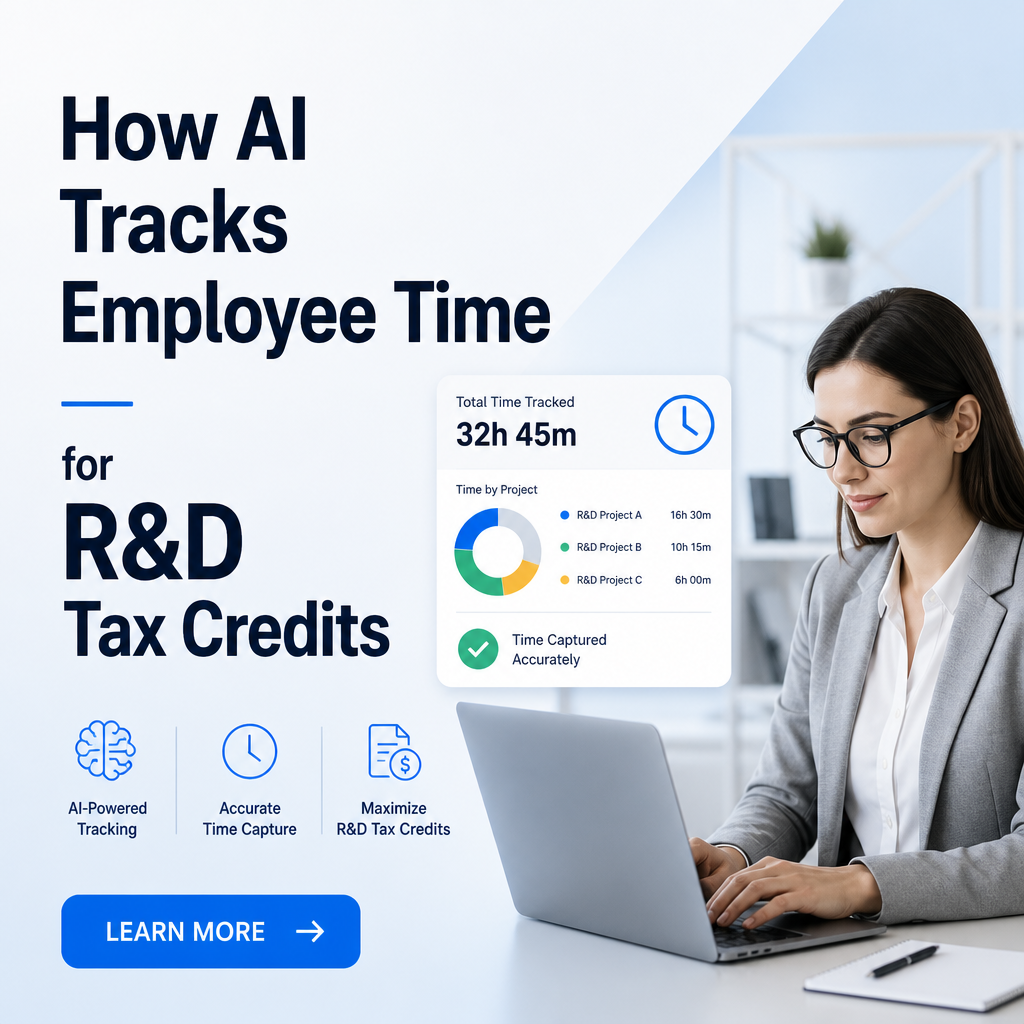
Avoid the Year End Scramble and Create Solid Support Documents:
One of the hardest questions in an R&D Tax Credit study is deceptively simple: how much time did each employee actually spend performing qualified R&D? Traditional R&D Tax Credit Services often rely on a year-end question—“What percentage of last year did you spend on R&D?”—and the engineer, staring back across 12 months, answers “maybe 60%.” It may be directionally reasonable, but it’s weaker than building the allocation from the technical work as it happens.
The goal isn’t to make employees track every minute. It’s to create enough evidence throughout the year to support an accurate allocation of their R&D activity—without turning engineers into documentation clerks. That’s where an AI R&D CTO (often deployed as a Virtual CTO, AI Chief Technology Officer, AI Technology Advisor, and AI Technical Advisor) changes the process. Instead of chasing recollections, the AI R&D CTO helps continuously capture the narrative of technical uncertainty, experimentation, and outcomes needed for Research and Development Tax Credits, then ties that story to payroll and other Qualified Research Expenses (QREs).
When done correctly, “AI tracking” is not surveillance, not minute-by-minute timesheets, and not a replacement for human testimony. It is an Innovation Management system for R&D Tax Credit compliance: employees explain what they worked on; AI organizes the record; humans analyze, review and confirm it.
Identify Qualified Research Activities from technical uncertainty:
To claim R&D Tax Credits, you must identify Qualified Research Activities (QRAs) that meet the IRS 4-part test. Many teams fail here because the work is described in business terms (“we built a new feature”) rather than R&D terms (“we resolved technical uncertainty through experimentation”).
An AI R&D CTO helps bridge that gap by structuring lightweight technical conversations throughout the year. Instead of asking employees to interpret tax terminology, the AI R&D CTO prompts plain-language explanations:
• What did you work on?
• Which project or business component?
• What technical problem or uncertainty were you trying to solve?
• What alternatives did you evaluate?
• What tests, prototypes, simulations, or experiments did you run?
This approach is especially powerful in software, manufacturing, engineering, and technology businesses—where teams routinely iterate on architecture, performance, reliability, integration, materials, or process parameters. Capturing these details contemporaneously strengthens eligibility, supports IRS compliance requirements, and reduces the scramble at year-end.
While the R&D Tax Credit is a tax incentive, the AI R&D CTO perspective also improves AI Product Intelligence and AI Product Development decision-making by clarifying what was attempted, what failed, and what worked—without ever requiring the company to change its products or processes for the sake of documentation.
Replace year-end estimation with a quarterly evidence-supported allocation:
The central distinction is:
• Year-end estimation (“I think I spent 60% on R&D”)
versus
• Continuous evidence-supported allocation (quarterly allocations anchored to real technical work)
A well-run R&D Study doesn’t need obsessive precision. It needs reasonable, supportable allocations tied to the underlying Qualified Research Activities. The AI R&D CTO enables this by organizing work by quarter, project, and activity—so a single annual guess becomes a transparent timeline.
Instead of:
John — 65% R&D (annual)
You can produce a more defensible pattern:
Q1 — 55% (integration uncertainty, test harness development)
Q2 — 70% (performance experiments, scaling constraints)
Q3 — 65% (reliability and failure-mode testing)
Q4 — 45% (release hardening and partial non-R&D support)
This matters because employee wages are usually the largest component of Qualified Research Expenses. Better time allocation means a stronger wage base, better substantiation, and potentially larger Tax Savings—while reducing the risk of over-claiming.
For small companies and startups, stronger allocations also translate into real outcomes: improved Business Cash Flow and, where eligible, an R&D Tax Credit Refund (or payroll tax offset), turning the credit into practical innovation funding.

We’re at the beginning of a golden age of AI. Recent advancements have already led to invention that previously lived in the realm of science fiction — and we’ve only scratched the surface of what’s possible.
– Jeff Bezos, Amazon
Build a Weekly Time & Activity Ledger that connects people → projects → evidence:
R&D Tax Credit Consultants often ask for “supporting documentation,” but teams struggle because records live in many places and don’t naturally align to tax categories. The AI R&D CTO solves this by converting periodic employee testimony and project context into a structured Time & Activity Ledger—organized in reasonable time buckets (weekly or biweekly), not minute-by-minute.
A strong ledger entry looks like:
Employee → Project → Activity → Hours → Evidence
Example structure:
Employee: Software Architect
Project: Distributed transaction consistency
Week: March 9–15
Activity: Tested transactional-outbox architecture under asynchronous failure conditions
R&D Hours: 18
Evidence: ticket references, commit IDs, test results, technical notes
Supporting documents help anchor the employee’s technical testimony. This positioning avoids two common failures: (1) asking engineers to become full-time timesheet clerks, or (2) relying on generic documentation dumps that don’t connect to the claimed work.
This ledger approach becomes the foundation for CPA-ready files and cleaner collaboration between the company, its tax preparer, and any R&D Tax Credit Services team supporting Form 6765.
Corroborate testimony with existing project records—without surveillance:
Companies already create evidence as part of normal operations: project tickets, source control history, design notes, test logs, experiment records, drawings, build reports, meeting notes, and release checklists. The challenge is that these artifacts are rarely organized for an R&D Tax Credit claim.
An AI R&D CTO can map testimony and project activity into an auditable structure:
• By R&D project and business component
• By technical activity category (design, prototyping, testing, iteration)
• By quarter and week
• By linked supporting evidence
This is not employee monitoring. It’s documentation reconstruction and organization—built from periodic employee explanations and available business records. The employee remains the primary source for understanding what technical work was actually performed; AI simply reduces the administrative burden of turning that reality into a coherent R&D Study.
In practice, this improves Innovation Management: teams spend less time arguing about “what counts,” and more time clearly describing technical barriers, alternatives evaluated, and the advancement achieved.
Convert time allocation into Qualified Research Expenses and a defensible R&D Study:
Once QRAs are identified and time is structured, the path to claiming R&D Tax Credits becomes clearer:
• Employee wage allocations supported by the Time & Activity Ledger
• Contractor costs (where eligible) tied to the same projects and activities
• Supply costs (where applicable) linked to experimentation and trials
This is how the AI R&D CTO helps calculate Qualified Research Expenses with less disruption—so the R&D Tax Credit becomes feasible even for smaller teams that can’t afford heavy consulting overhead.
The final deliverable is an R&D Study that is easier to defend because it shows the story behind the numbers: technical uncertainties, experimental approach, timelines, people involved, and corroborating records. From there, your tax team can prepare the R&D Tax Credit claim (including Form 6765 support) with more confidence.
The benefit is not just compliance. It is financial leverage: maximizing available R&D Tax Credits can improve Business Cash Flow, expand runway, and turn past innovation costs into a self-funding innovation engine.
How an AI R&D CTO automates R&D Tax Credit claims compared to manual methods:
Traditional manual approaches often compress a year of innovation into a few stressful interviews, spreadsheets, and retroactive estimates. An AI R&D CTO modernizes that workflow by shifting to continuous capture and structured summaries—reducing the year-end burden while improving precision.
A practical AI-assisted flow looks like:
Voice-style technical conversations → Identify Qualified Research Activities → Assign activity to projects and quarters → Generate Weekly Time & Activity Ledger → Map supporting evidence → Employee review and confirmation → QRE wage calculations → CPA-ready R&D Study
This is where the AI R&D CTO category becomes distinct from a one-time credit calculation. In addition to supporting R&D Tax Credits, the same disciplined structure strengthens AI Product Strategy and AI Innovation Platform decision-making at the leadership level by making technical learning visible and reusable across quarters—without changing how your teams build.
In short: more automation can mean better documentation and less employee work. AI should do the time-allocation organization; employees should validate whether it reflects the R&D they actually performed.
Next steps: estimate your R&D Tax Credit and access AI R&D CTO leadership:
SHAIN’s positioning is simple: the AI R&D CTO democratizes innovation by helping startups, micro businesses, and small companies recover R&D Tax Credits while gaining access to technical leadership and innovation intelligence previously available only to large enterprises.
If you suspect your team has been doing qualifying work—resolving technical uncertainty through experimentation—an AI R&D CTO can help you identify eligibility, document Qualified Research Activities, calculate Qualified Research Expenses, and produce an audit-ready R&D Study that supports your claim and improves cash flow.
To learn more and get an estimate of how much your R&D Tax Credit could be, select the button below.