
 - EN
 - EN
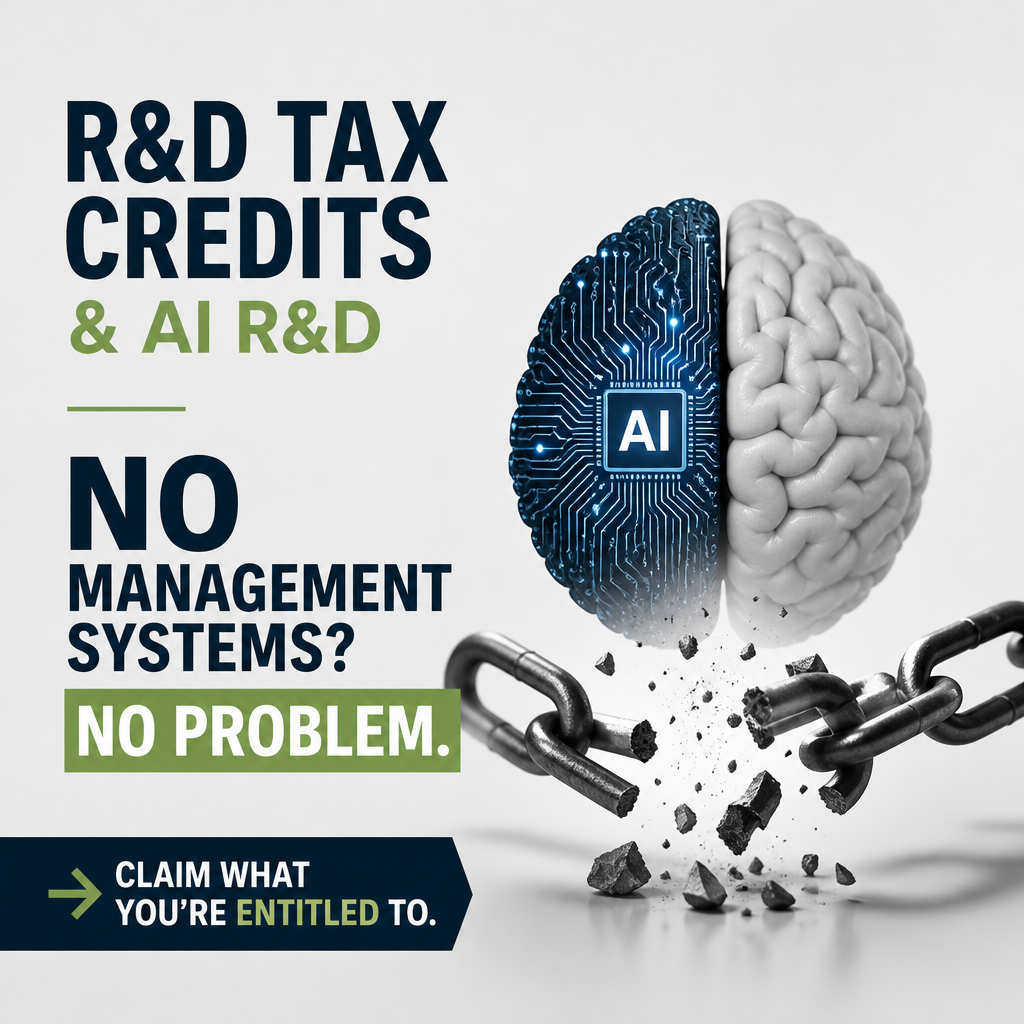
R&D Tax Credits Without Formal Systems: What “Counts” Still Counts:
If you’re building new software, improving a manufacturing process, engineering a prototype, or experimenting to overcome technical uncertainty, you may be performing Qualified Research Activities—even if you have no formal Innovation Management system, no dedicated tax team, and no neat project codes. R&D Tax Credits are not reserved for companies with perfect documentation habits. They’re designed to reward technical risk and iterative problem-solving. Many startups and small businesses qualify but delay filing because they assume they can’t support an R&D Tax Credit claim.
In practice, eligibility is driven by the work performed: technical objectives, uncertainty, experimentation, and results. The challenge for lean teams isn’t doing qualifying work—it’s capturing and explaining it in a way that satisfies expectations while keeping disruption low.
This is where an AI R&D CTO—operating as a Virtual CTO, AI Chief Technology Officer, AI Technology Advisor, and AI Technical Advisor—can help translate real-world engineering activity into an audit-ready narrative and calculation, without requiring you to install heavy management overhead first.
Finding Qualified Research Activities When Your Work Lives in Slack, Git, and Whiteboards:
Many companies assume Qualified Research Activities must look like “lab work.” In reality, day-to-day development and engineering work often qualifies when it is aimed at resolving technical uncertainty and involves a process of experimentation.
Examples commonly seen in software companies, manufacturers, engineering firms, and technology businesses include:
• Building or improving algorithms, performance, scalability, reliability, or security in software systems
• Developing prototypes and running iterative test cycles to meet technical specs
• Designing manufacturing process improvements to reduce scrap, improve yield, or meet new tolerances
• Integrating hardware and firmware under constraints like power, heat, latency, or compliance
• Re-engineering architectures to meet new loads or data requirements
When there is no centralized Innovation Management process, the practical task becomes mapping these real efforts to the “why” and “how” the IRS expects: what technical uncertainty existed, what alternatives were evaluated, and what systematic trial-and-error occurred.
An AI R&D CTO can accelerate this mapping by guiding technical interviews and structuring the results into a consistent framework—so your story doesn’t depend on one employee’s memory at year-end. The outcome is a clearer, more defensible definition of what your team did that meets the intent behind the R&D Tax Credit.
Reconstructing an R&D Study from Imperfect Inputs:
A credible R&D Study doesn’t require perfect project accounting. It requires a reasonable, well-supported approach that connects:
1) projects and technical objectives,
2) experimentation and technical barriers,
3) people and costs, and
4) supporting documentation.
For lean teams, the concern is time: founders and engineers can’t pause Product Development to retroactively build a binder. The solution is to reconstruct an R&D Study using what already exists and then fill gaps through targeted interviews and accurate time allocations.
Common source materials include product requirements, tickets, change logs, design notes, test reports, deployment notes, prototype photos, failure analyses, and customer-driven performance constraints. Even when these artifacts aren’t organized as a “system,” they can still substantiate the technical narrative.
An AI R&D CTO supports this process as both an AI Technology Advisor and R&D documentation quarterback—helping extract the technical substance, align it to Qualified Research Activities, and present it coherently. This reduces rework, lowers employee burden, and improves consistency compared to purely manual, spreadsheet-driven approaches. This means using AI-enabled R&D Tax Credit intelligence to document and support the credit you may already be earning.

“We are bringing the power of next-generation AI to the tools millions of people use every day.”
– Satya Nadella, Chairman and CEO of Microsoft
Estimating Qualified Research Expenses When You Don’t Track Time:
The second major obstacle for companies without management systems is cost substantiation—specifically, identifying and calculating Qualified Research Expenses (QREs).
In most small and mid-sized businesses, the largest QRE bucket is wages: the portion of employee time spent on qualified engineering, design, or technical experimentation. Contractors and certain supplies may also apply depending on your sector and facts.
When time tracking is informal, the goal becomes a defensible methodology rather than a fantasy of precision. Many claims are built using structured time surveys and interviews that allocate qualified percentages by role, project phase, and period.
An AI R&D CTO can engage with Voice AI and document teams building time surveys supported by engineers without the management burden, normalize responses across teams, and identify inconsistencies before they become IRS issues. The result is a clearer QRE calculation that supports Form 6765 preparation while keeping the company focused on its products.
Done correctly, this improves Business Cash Flow through gained Tax Savings and can create a meaningful R&D Tax Credit Refund—especially for startups that may be eligible to apply the credit against payroll taxes, depending on their circumstances.
Replacing Manual R&D Tax Credit Prep with AI R&D CTO-Driven Documentation and Precision:
Traditional R&D Tax Credit Services often rely on manual questionnaires, static templates, and labor-intensive writeups that struggle to capture how modern teams actually build. The next wave of R&D Tax Credit Consultants will be augmented by AI R&D CTOs that bring R&D Tax Credit intelligence to the documentation process—especially valuable when no formal systems exist.
Using sector-specific trained language models, an AI R&D CTO through its Voice AI capabilities, can engage with teams without disruption:
• Identify activities likely to qualify and align them to the four-part test
• Describe technical uncertainties in plain English with engineering accuracy
• Summarize experimentation cycles, alternative evaluations, and outcomes
• Generate stronger contemporaneous-style documentation from existing artifacts
• Increase precision and reduce missed opportunities in QRAs and QREs
This approach is particularly effective in sectors where technical work moves fast (software releases, iterative prototypes, process changes, and testing cycles). Instead of asking your team to “remember everything,” an AI R&D CTO helps create a repeatable system of capture and explanation—without installing heavyweight bureaucracy.
The practical benefit is less time, higher-quality support documents, and a claim that is easier to defend. The strategic benefit is that your R&D Tax Credit becomes more reliable year after year—turning tax savings into a self-funding innovation engine.
Beyond Credits: AI Product Intelligence and AI Product Strategy for Lean Teams:
While the financial upside of R&D Tax Credits is the headline, many companies can also boost technical leadership—without the cost of building a full internal executive team.
An AI R&D CTO can contribute as an AI Chief Technology Officer and AI Product Strategy partner by providing:
• Product strategy insights based on technical feasibility and risk
• Competitive benchmarking and innovation intelligence to avoid blind spots
• Emerging technology awareness to inform build-vs-buy decisions
• Technical barrier resolution approaches to unblock teams faster
• A lightweight AI Innovation Platform mindset—standardizing how teams learn from experiments
This is not about changing your product with AI. It’s about using AI-enabled advisory capacity to raise decision quality, shorten cycles of uncertainty, and strengthen Product Development execution.
For many small businesses, this closes the gap between local team constraints and world-class development practices—helping them compete with larger firms that have entire departments for technology strategy and Innovation Management.
Learn More: Turn Missing Systems into a Captured Credit—and Stronger Technical Leadership:
No management systems doesn’t mean no R&D Tax Credit. It usually means your company needs a smarter, lighter way to identify Qualified Research Activities, document experimentation, calculate Qualified Research Expenses, and produce an R&D Study that supports compliance.
SHAIN’s AI R&D CTO positioning is built around democratizing innovation: helping startups, micro businesses, and small companies recover Research and Development Tax Credits while gaining Virtual CTO-level guidance, AI Product Intelligence, and innovation intelligence that historically only large enterprises could afford.
If you want to see what your R&D Tax Credit could be—and how an AI R&D CTO can enhance knowledge to world-class standards while seamlessly supporting your claim—select the button below to get an estimate.