

 - EN
- EN  - EN
- EN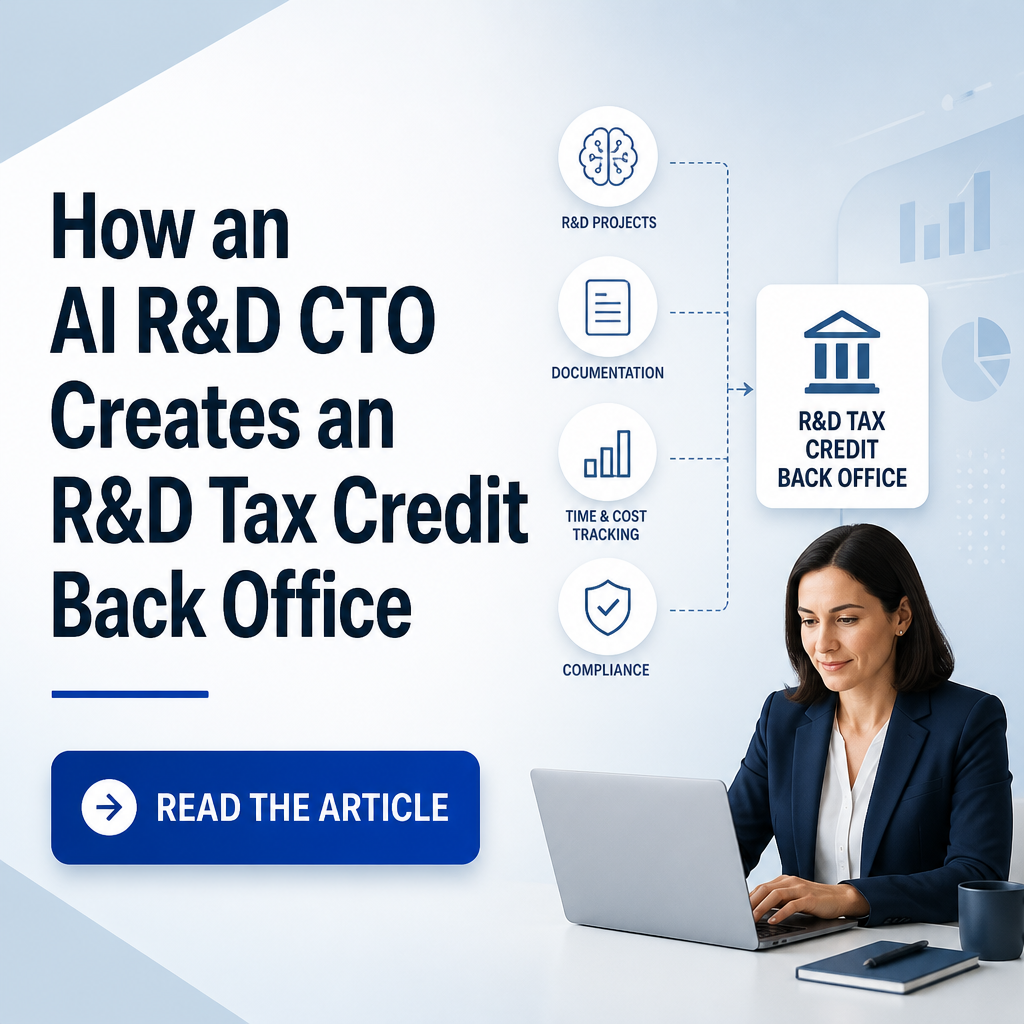
AI R&D CTOs are Assistants for Every R&D Employee :
Most companies don’t fail to claim R&D Tax Credits because they lack innovation—they fail because the back office is fragmented. A conventional R&D Tax Credit engagement requires people to manually schedule interviews, identify projects, apply qualification tests, chase engineers for details, estimate employee time, collect payroll, identify Qualified Research Expenses (QREs), find supporting records, draft technical narratives, reconcile expenses, prepare schedules, assemble the R&D Study, and answer CPA questions. That’s labor-intensive, error-prone, and hard to repeat year after year.
An AI R&D CTO reframes the process. Instead of treating Research and Development Tax Credits as a spreadsheet exercise, it builds an AI-first workflow (with human review) that converts “we performed R&D” into a CPA-ready package. Think of it as an operating layer that coordinates technical intake, documentation, and traceability—so smaller companies can pursue R&D Tax Credit Refund opportunities, improve Business Cash Flow, and achieve real Tax Savings without months of disruption.
This matters most for startups, software teams, manufacturers, engineering firms, and technology businesses doing qualifying work continuously—often without realizing those efforts contain Qualified Research Activities (QRAs) eligible for R&D Tax Credits.
Technical intake without the manual questionnaire bottleneck:
The first job of the back office is capturing accurate technical facts. Traditional R&D Tax Credit Services often start with long questionnaires and scattered meetings. An AI R&D CTO (acting as a Virtual CTO and AI Technical Advisor) replaces that bottleneck with structured technical intake.
Behind the scenes, the workflow centers on guided technical interviews designed to capture the core requirements of an R&D Tax Credit claim: what was being developed, where technical uncertainty existed, what alternatives were evaluated, what failed, and who participated. The system transforms those conversations into structured project records—so engineers spend less time “writing for taxes” and more time building, while the claim gains better consistency.
Crucially, the AI doesn’t decide the tax position on its own. It prepares the intake record; the technical team confirms facts; the tax professional reviews the claim.
Business-component identification that prevents “one big project” claims:
A common failure point in manual studies is lumping an entire year of Product Development into a single generic initiative. That makes qualification analysis vague and makes IRS support harder. An AI R&D CTO organizes work into discrete business components and projects—each with a technical objective, timeline, and supporting activities.
This step is the bridge between technical reality and a defensible R&D Study. Instead of “we improved our platform,” the back office breaks work into meaningful components aligned to how the team actually executed: modules, prototypes, process improvements, performance constraints, design iterations, or manufacturing trials. The result is clearer eligibility analysis, cleaner narratives, and fewer gaps when your CPA requests support.

“A robot will likely be on the cover of time magazine as the best CEO.”
– Jack Ma, founder of Alibaba.
Qualification analysis aligned to Qualified Research Activities and the 4-part framework:
Once business components are identified, the AI R&D CTO prepares a qualification analysis that highlights how activities may meet the standard R&D Tax Credit eligibility framework—without pretending that everything automatically qualifies.
This is where modern R&D Tax Credit Consultants spend substantial time: mapping activities to the concept of Qualified Research Activities, identifying technical uncertainties, and describing the experimental approach used to evaluate alternatives. The AI-first back office prepares this analysis at scale by organizing the underlying record (what uncertainty existed, what experiments occurred, what results were achieved) and flagging areas requiring human review.
A practical trust model emerges:
AI prepares the qualification analysis. Humans review the tax position.
That division of labor is what makes the process both efficient and credible.
Employee time and activity allocation built from the technical record:
Employee time is often the largest driver of Qualified Research Expenses, and it’s also the most painful part of R&D Tax Credit preparation. In traditional engagements, teams reconstruct time months later with rough estimates. An AI R&D CTO shifts the workflow to a repeatable activity-ledger approach.
Instead of asking for a single year-end percentage, the back office links:
employee → project/component → activity type → period → time allocation
Inputs can include interview outputs, quarterly summaries, project logs, and time surveys. The key is that the allocation is grounded in the technical record. The AI builds the R&D activity record; humans confirm it.
This supports stronger workpapers, smoother CPA review, and a clearer path from engineering work to the R&D Tax Credit calculation—especially important when claiming Research and Development Tax Credits consistently across multiple years.
Technical-evidence mapping that explains what each document supports:
A strong claim is not just documentation-heavy—it’s documentation-explained. In manual approaches, files get dumped into folders with no clear tie to specific QRAs. An AI R&D CTO improves readiness by mapping evidence to the underlying activities and components.
Evidence may include project management records, version histories, testing outputs, engineering drawings, prototype iteration notes, experiment logs, and technical communications. The back office doesn’t merely store documents; it associates each artifact with the relevant uncertainty, experimentation steps, and outcome. That creates a navigable support trail—helpful for internal governance, external R&D Tax Credit Consultants, and CPA review.
The benefit is straightforward: better contemporaneous documentation, less scrambling at year-end, and fewer “we can’t find it” moments when substantiation is needed.
QRE analysis that builds a traceable path from activity to expense:
After technical qualification comes financial traceability. An AI R&D CTO connects the technical record to Qualified Research Expenses by building a defensible chain:
R&D activity → employee/contractor → time allocation → wage/contract cost → QRE schedule
This is where many companies lose value. They either under-claim due to missing classifications or over-claim due to weak linkage. The AI-first back office prepares reconciled schedules that help a reviewer understand exactly why an expense belongs in the R&D Tax Credit calculation.
For smaller organizations, this can make the difference between “we think we qualify” and “we can support it.” For growing organizations, it reduces the annual disruption and improves audit posture—while accelerating the impact on Business Cash Flow through innovation incentives.
Technical narratives and the R&D Study assembled from captured facts:
By the time narratives are drafted, the AI R&D CTO has already captured uncertainty, experimentation, failures, results, personnel, and evidence links. That allows the back office to draft technical narratives for each business component that reflect what actually occurred. The AI assembles the story already contained in the technical record.
Those narratives, together with the qualification analysis and QRE schedules, become the foundation of a complete R&D Study and supporting workpapers. Your CPA receives an organized package rather than raw client input, enabling a faster review cycle and a cleaner Form 6765 preparation process.
From people-intensive consulting to an AI-first back office with human review:
Historically, scaling R&D Tax Credit Services meant scaling headcount—more interviews, more spreadsheets, more manual reconciliations. The AI R&D CTO changes the operating model by moving professional time from production to review.
A simple way to visualize the workflow is:
COMPANY R&D → Technical intake → Business components → Qualification analysis → Employee activity → Evidence mapping → QRE analysis → Technical narratives → R&D Study → HUMAN/CPA REVIEW
This is why the “back office” framing matters. It’s not just software that calculates an R&D Tax Credit. It’s the preparation layer that turns messy, real-world innovation work into an organized, review-ready tax credit package.
For small and mid-sized businesses, that translates to more consistent R&D Tax Credit eligibility determination, stronger compliance support, less internal disruption, and improved odds of maximizing available R&D Tax Credits year after year.
Beyond credits: how the AI R&D CTO supports Innovation Management and product intelligence:
While the back office is primarily about R&D Tax Credits, an AI R&D CTO also functions as a Virtual CTO and AI Chief Technology Officer resource—supporting better decisions around Innovation Management without requiring a large internal leadership team.
In practice, that can include AI Product Strategy guidance, AI Product Intelligence, and positioning support as an AI Technology Advisor and AI Technical Advisor—helping leadership teams benchmark technical approaches, understand emerging technology directions, and identify where technical uncertainty is increasing.
Importantly, this support stays focused on technical leadership and innovation intelligence in the context of qualifying R&D work and documentation—helping teams overcome technical barriers while simultaneously building a cleaner record for the next R&D Tax Credit cycle. Over time, this becomes a self-funding innovation engine: improved Tax Savings and cash flow help fund the next wave of AI Product Development and experimentation.
Next step: estimate your R&D Tax Credit and see how an AI R&D CTO modernizes the back office:
If your team is building, testing, prototyping, or iterating to resolve technical uncertainty, you may already have Qualified Research Activities—and may be leaving R&D Tax Credits unclaimed. The AI R&D CTO democratizes innovation by helping startups, micro businesses, and small companies recover Research and Development Tax Credits while gaining access to technical leadership and innovation intelligence previously available only to large enterprises.
To learn how an AI R&D CTO can enhance knowledge to world-class standards while seamlessly gaining R&D tax credits—and to obtain an estimate of how much your R&D Tax Credit Refund could be—select the button below.