

 - EN
- EN  - EN
- EN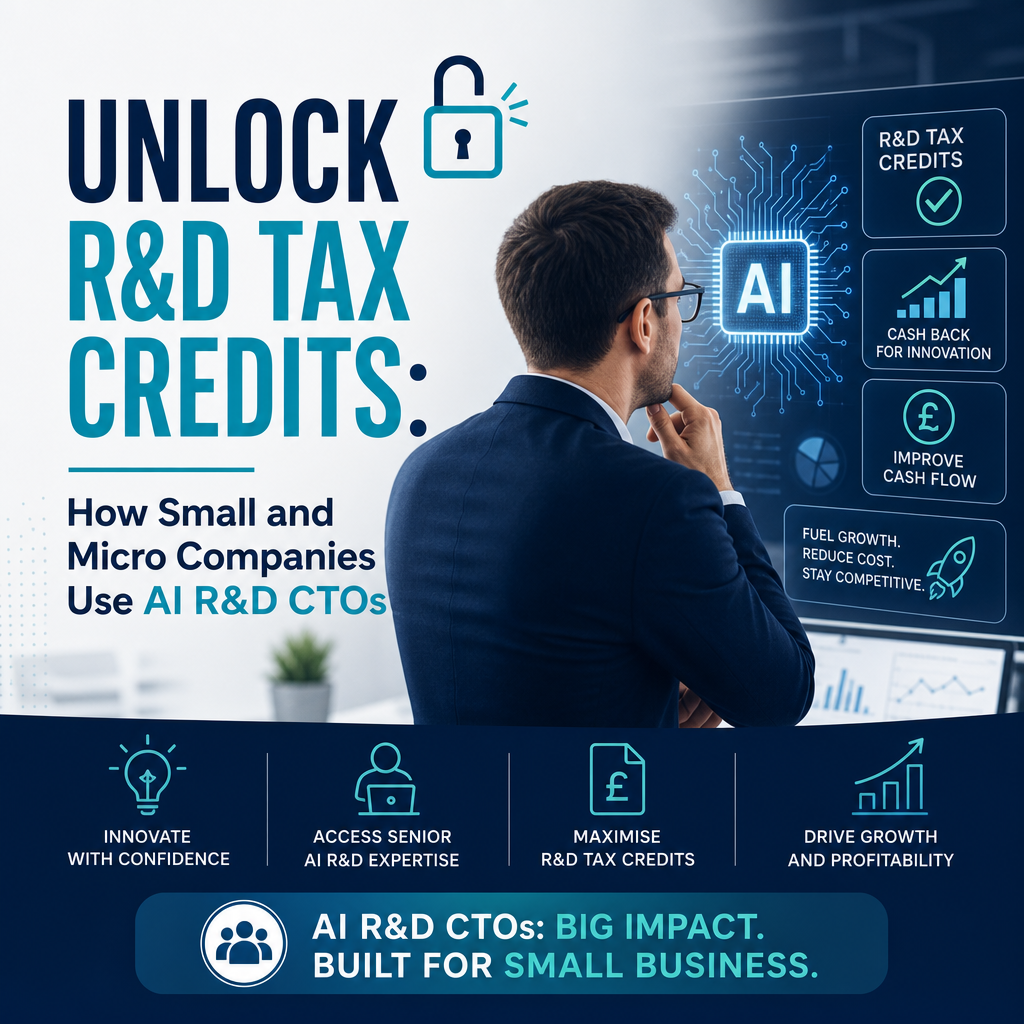
Unlock R&D Tax Credits for Small and Micro Companies:
For small and micro businesses, the federal R&D Tax Credit can feel like it was designed for large enterprises with big accounting teams. In reality, the credit was built to reward innovation at every scale—especially the kind of practical, iterative problem-solving that happens in lean companies every day. The challenge is usually documentation: identifying eligible activities, tying them to wages/contractors/supplies, and producing a defensible technical narrative that clearly meets IRS expectations.
That’s where the idea of an “AI R&D CTO” is changing the conversation. Instead of relying on ad hoc memory, spreadsheet time surveys, and end-of-year scrambling, small and midsize companies can use sector-specific, highly trained large language models (LLMs) as an always-on assistant to keep R&D credit readiness moving throughout the year. Done correctly, it reduces friction, increases precision, and creates a repeatable R&D study process that builds a year-over-year innovation “investment fund” via tax savings.
Turning Day-to-Day Experimentation Into Qualified Research Activities:
Many small companies already perform qualified research activities (QRAs) but don’t label them that way. In practice, QRAs often show up as iterative trials, benchmarking, troubleshooting, and redesign efforts aimed at resolving technical uncertainty. The key is capturing the “why” (uncertainty), the “how” (process of experimentation), and the “what changed” (advancement).
An AI R&D CTO approach helps small teams consistently translate messy, real-world engineering and development work into a structured record of: (1) what technical uncertainty existed, (2) which alternatives were evaluated, (3) what experiments or analyses were performed, and (4) what results were achieved.
For example, if your team is iterating on performance limitations, stability issues, reliability challenges, scaling constraints, data quality problems, or integration failures, those activities may be eligible when they are grounded in engineering principles and a systematic process to resolve uncertainty. The value for small and micro companies is continuity: instead of trying to reconstruct decisions months later, the story can be captured while the work is still fresh.
Meeting the IRS Four-Part Test With Sector-Specific Intelligence:
R&D Tax Credits are not awarded simply because a company “works hard” or “builds something new.” The work must align with the IRS four-part test: permitted purpose, technological in nature, elimination of uncertainty, and process of experimentation.
A sector-trained LLM used as an AI R&D CTO can help small and midsize companies map their actual project work to those four requirements with higher consistency than a purely manual approach. It can prompt the right questions at the right time—such as what technical uncertainties were present at the start, what constraints drove the need for experimentation, what alternatives were considered, and what technical conclusions were reached.
This matters because the strongest R&D credit claims read like clear, technical narratives—not marketing copy. When the claim support is built around engineering facts and a documented experimental approach, it tends to be more defensible and easier to review if questions arise.

It is difficult to think of a major industry that AI will not transform. This includes healthcare, education, transportation, retail, communications, and agriculture. There are surprisingly clear paths for AI to make a big difference in all of these industries.- Andrew Ng, Computer Scientist and Global Leader in AI
Writing Detailed Technical Narratives Without End-of-Year Scrambling:
One of the biggest reasons small companies delay or avoid the credit is the perceived burden of creating technical documentation. Traditional methods often require weeks of interviews, document collection, and back-and-forth revisions to generate the R&D study.
An AI R&D CTO model focuses on assisting with technical write-ups that accurately represent employee activities. Throughout the year, it can help teams capture:
– The initial problem statement and constraints
– The technical uncertainty (what wasn’t known or couldn’t be readily determined)
– Hypotheses and alternative approaches evaluated
– Testing, modeling, analysis, and iterative refinement
– Failures, learnings, and final conclusions
For small teams, this is a practical shift: technical leaders and contributors don’t need to become tax experts. They simply document the work in engineering terms, and the narrative can be shaped into a credit-ready format that aligns with the four-part test and highlights the technological advancement achieved.
Tracking Qualified Research Activities Across Employees and Contractors:
Micro and small businesses often rely on a mix of full-time employees, part-time specialists, and third-party contractors. That creates a common R&D credit issue: eligible work is performed, but the company lacks a consistent way to track who did what, when, and on which qualified project.
A highly trained, sector-specific LLM can assist by organizing qualified research activities around the people doing the work—engineers, developers, product teams, and technical managers—while keeping the emphasis on analytical and experimental activities. The goal is not to create more bureaucracy, but to create a lightweight system of record that supports an accurate allocation of effort to qualified projects.
This can be especially helpful when multiple projects overlap, priorities shift quickly, or contractors contribute to specific experimental trials. The result is a clearer connection between technical work performed and the portion of wages and contractor costs that may qualify.
Building an R&D Study With Strong Support Documentation:
An R&D study is more than a number—it’s the documentation package that explains the work, the uncertainty, and the method. For small and midsize companies, defensibility often hinges on whether you can show contemporaneous support beyond a founder’s memory.
An AI R&D CTO approach strengthens support documentation by helping teams consistently gather and organize artifacts that already exist, such as:
– Project notes and design decisions
– Testing and validation records
– Experiment logs and iteration summaries
– Technical meeting notes and decision rationale
– Requirements changes driven by technical constraints
When these materials are assembled alongside well-written technical narratives, the claim becomes easier to substantiate. The end result is a more accurate R&D study that can be produced with less disruption to the business—important for companies that can’t afford long consulting cycles or repeated interviews.
AI and Automation in R&D Tax Credits for Small Businesses:
Small and micro companies typically feel the pain of R&D tax credit preparation most acutely: fewer staff, less time, and tighter budgets. AI-driven assistance is shifting the process away from a once-a-year, manual reconstruction toward a more seamless, intelligent workflow.
Instead of relying solely on traditional consulting methods that can be time-intensive and costly, an AI R&D CTO model helps companies:
– Identify eligible activities earlier and more consistently
– Maintain a running record of technical uncertainty and experimentation
– Produce clearer, more complete technical narratives
– Create a repeatable R&D study process year after year
The long-term benefit is strategic: when the credit process becomes easier, companies are more likely to claim it annually. That recurring cash flow can act like an internal innovation fund—supporting continued experimentation, hiring, and product development without taking on as much financial risk.
Get an Estimate of Your Potential R&D Tax Credit:
If your company is solving technical problems, testing alternatives, and iterating toward better performance or reliability, you may be closer to qualifying than you think. The next step is to estimate the potential value based on your projects and qualified expenses. To get a fast estimate of how much your R&D Tax Credit could be, select the button below.