
 - EN
- EN  - EN
- EN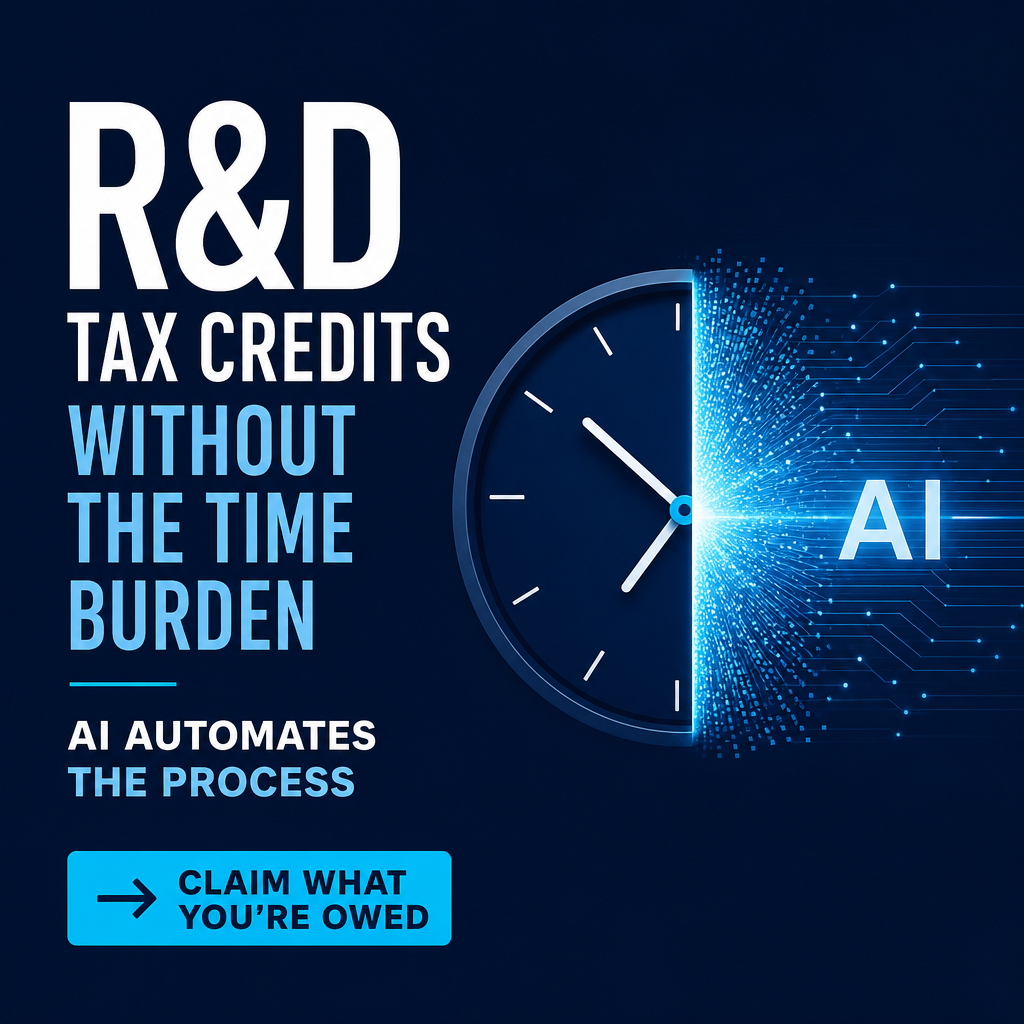
R&D Tax Credits are valuable—traditional preparation can be long:
R&D Tax Credits can generate meaningful value for startups and small to mid-sized companies, yet many leadership teams delay or skip a claim for one reason: the expected time burden. The objection is rational: “The credit may be worth $50,000, but I don’t want my engineers spending 40 hours helping prepare it.”
In practice, the bottleneck is rarely eligibility. It’s the traditional, year-end reconstruction process—weeks of meetings, questionnaires, spreadsheets, developer interviews, and document hunts. The opportunity is to shift from a disruptive R&D Study built after the fact to continuous “R&D capture” that happens while work is underway.
That’s where an AI R&D CTO—functioning as a Virtual CTO, AI Chief Technology Officer, and AI Technology Advisor focused on R&D Tax Credit Services—changes the economics. Instead of asking technical teams to become tax-credit administrators, an AI Technical Advisor helps translate engineering reality into supportable documentation for Research and Development Tax Credits with dramatically less disruption.
Where the time actually goes in a traditional R&D Tax Credit study:
Companies experience the R&D Tax Credit process as disruptive because preparation concentrates work into a short window at year-end. Traditional R&D Tax Credit consultants typically require:
• Management interviews to identify potentially qualifying projects and establish R&D Tax Credit eligibility.
• Technical interviews with engineers and developers to reconstruct what happened and why it was uncertain.
• Employee-time estimates to approximate how much time each person spent on Qualified Research Activities.
• Document searches across Jira, GitHub, emails, test results, specifications, drawings, and project records.
• Expense reconciliation to connect payroll, contractors, supplies, and cloud costs to Qualified Research Expenses.
• Technical narratives that translate engineering work into the “four-part test” language for IRS support.
• CPA coordination to package calculations, supporting schedules, and Form 6765 inputs.
This is why the preparation feels like an interruption: the organization is asked to “remember” 12 months of technical decisions all at once. The fastest R&D Tax Credit study is the one you don’t have to reconstruct at year-end.
Replace reconstruction with continuous R&D capture (the new model):
The core idea behind AI-assisted R&D Tax Credit automation is simple: stop reconstructing R&D at year-end.
Traditional approach:
Year-end kickoff → schedule meetings → questionnaires → developer interviews → search Jira/GitHub/email → estimate employee time → draft narratives → request missing evidence → CPA review.
AI-driven approach with an AI R&D CTO:
Voice conversation → QRA identification → QRE association → technical uncertainty captured → employee activity recorded → support documents mapped → quarterly updates → CPA-ready R&D Study.
This isn’t about eliminating human review. Management and technical personnel still confirm accuracy. The goal is to minimize administrative work while preserving the human technical knowledge needed for IRS-compliant substantiation.
An AI R&D CTO acts as an AI Innovation Platform for the claim: continuously organizing technical facts, evidence, and timelines so that R&D Tax Credit documentation is built gradually—not panic-built after the books close.

“The organizational, operational, and cultural significance of enlisting AI for performance measurement is difficult to overstate.”
– MIT Slan Management Review
How an AI R&D CTO identifies Qualified Research Activities and supports the 4-part test:
Most companies that build or improve software, prototypes, manufacturing processes, or engineering designs perform Qualified Research Activities without labeling them that way. The challenge is translating everyday technical work into the structure required for R&D Tax Credit eligibility.
An AI R&D CTO helps teams quickly surface candidate projects by focusing on the technical signals that matter to the credit:
• Technical uncertainty: what capability, method, or design parameter was unknown at the outset.
• Experimentation: what alternatives were evaluated, tested, simulated, or iterated.
• Technological basis: the engineering or computer science principles involved.
• Process of experimentation + business component linkage: how the work relates to a product, process, or software component.
Sector-specific examples of QRAs the AI R&D CTO can help capture and describe for an R&D Study include:
• Software: improving performance, scalability, reliability, security hardening, new architectures, data pipelines, or novel integrations where solutions were not readily determinable.
• Manufacturing: fixture/tooling iterations, process parameter optimization, yield improvements, material changes, automation tuning, and QA test method development.
• Engineering: prototype iterations, simulation/FEA tradeoffs, tolerance stack changes, embedded systems integration, and design-for-manufacturability experiments.
The result is faster identification of QRAs and clearer narratives aligned to IRS expectations—without forcing engineers to learn tax jargon.
How AI reduces the burden of calculating Qualified Research Expenses (QREs):
Even when companies know they did qualifying work, they often struggle to quantify it. Qualified Research Expenses typically include wages, certain contractor costs, and supplies used in experimentation. The time sink is tying people and costs to qualified projects.
An AI R&D CTO supports the financial side of the claim by organizing QRE inputs in a way that’s easier to validate:
• Employee activity capture: lightweight, periodic prompts reduce the need for massive year-end time estimates.
• Contractor alignment: mapping statements of work and invoices to specific technical uncertainties and iterations.
• Supply tracking: associating prototype materials, test parts, and consumables to experimental trials.
This improves traceability and reduces back-and-forth with R&D Tax Credit Consultants. Importantly, it also strengthens audit readiness because the company can show how costs connect to Qualified Research Activities rather than relying on broad, retroactive percentages.
Automating technical interviews and documentation with “no long meetings—just talk”:
One of the biggest drains in R&D Tax Credit Services is the interview cycle: scheduling, context-setting, follow-ups, and rewriting. An AI R&D CTO changes the workflow by capturing technical facts in shorter, more natural interactions.
A strong practical model is quarterly Voice AI conversations with a technical lead or developer:
• What were you trying to develop or improve?
• What technical problem prevented an obvious solution?
• What alternatives did you test, and what failed?
• What changed in the design, architecture, or parameters?
• Who worked on it, and what records exist?
The AI then structures those answers into documentation components that support the R&D Tax Credit claim: timelines, uncertainty statements, experimentation steps, and evidence pointers. This creates contemporaneous documentation, reduces the need for “memory archaeology,” and shortens the path to a CPA-ready package.
Your engineers should spend their time doing R&D—not documenting R&D for tax consultants.
AI Product Intelligence as the “bonus” layer: better decisions while capturing the credit:
While the main value is reducing friction and maximizing R&D Tax Credits, an AI R&D CTO also functions as an AI Technology Advisor for stronger technical decision-making. This is where AI Product Intelligence and AI Product Strategy support can show up alongside Innovation Management.
Because the AI R&D CTO is already organizing technical obstacles, options tested, and outcomes, leadership can extract clearer signals about:
• Recurring technical barriers and where teams get stuck.
• Which experiments produce the best results.
• Where product roadmaps are absorbing risk without enough validation.
This is not about changing how you build products via AI. It’s about improving technical leadership visibility—so product and engineering leaders can benchmark progress, prioritize uncertainty reduction, and strengthen AI Innovation Management around experimentation discipline. Over time, that can help turn an R&D Tax Credit Refund and associated Tax Savings into a more deliberate, self-funding innovation engine.
A concrete example: a 20-person software company claiming the credit without disruption:
Consider a 20-person software company with six developers participating in AI Product Development and core platform improvements.
Under a traditional R&D Study process, the CTO often must:
• Identify projects after the year ends.
• Explain each project to R&D Tax Credit consultants.
• Coordinate multiple developer interviews.
• Estimate employee time by month or project.
• Locate Jira tickets, GitHub commits, specs, and test results.
• Review technical narratives and answer follow-ups.
That can consume dozens of employee hours and slow delivery.
With an AI R&D CTO approach, each quarter the team completes short Voice AI check-ins. The AI Technical Advisor organizes Qualified Research Activities, flags likely Qualified Research Expenses, and maps supporting records as work occurs. At year-end, the company isn’t reconstructing; it’s validating and finalizing. The result is improved Business Cash Flow, less operational distraction, and a cleaner compliance story.
Next steps: estimate your R&D Tax Credit and modernize your process:
If you’ve hesitated to pursue Research and Development Tax Credits because the process feels invasive, the solution is often not “do less R&D.” It’s to stop reconstructing it at year-end.
An AI R&D CTO—operating as a Virtual CTO, AI Chief Technology Officer, and AI Innovation Platform for R&D capture—can help identify QRAs, calculate QREs, produce R&D Studies, and support IRS-ready documentation with far less burden on your team. The outcome is stronger Innovation Management, better technical clarity, and improved cash flow through innovation incentives.
To learn how an AI R&D CTO can enhance knowledge to world-class standards while seamlessly gaining R&D Tax Credits, and to get an estimate of your potential R&D Tax Credit Refund, select the button below.