

 - EN
 - EN
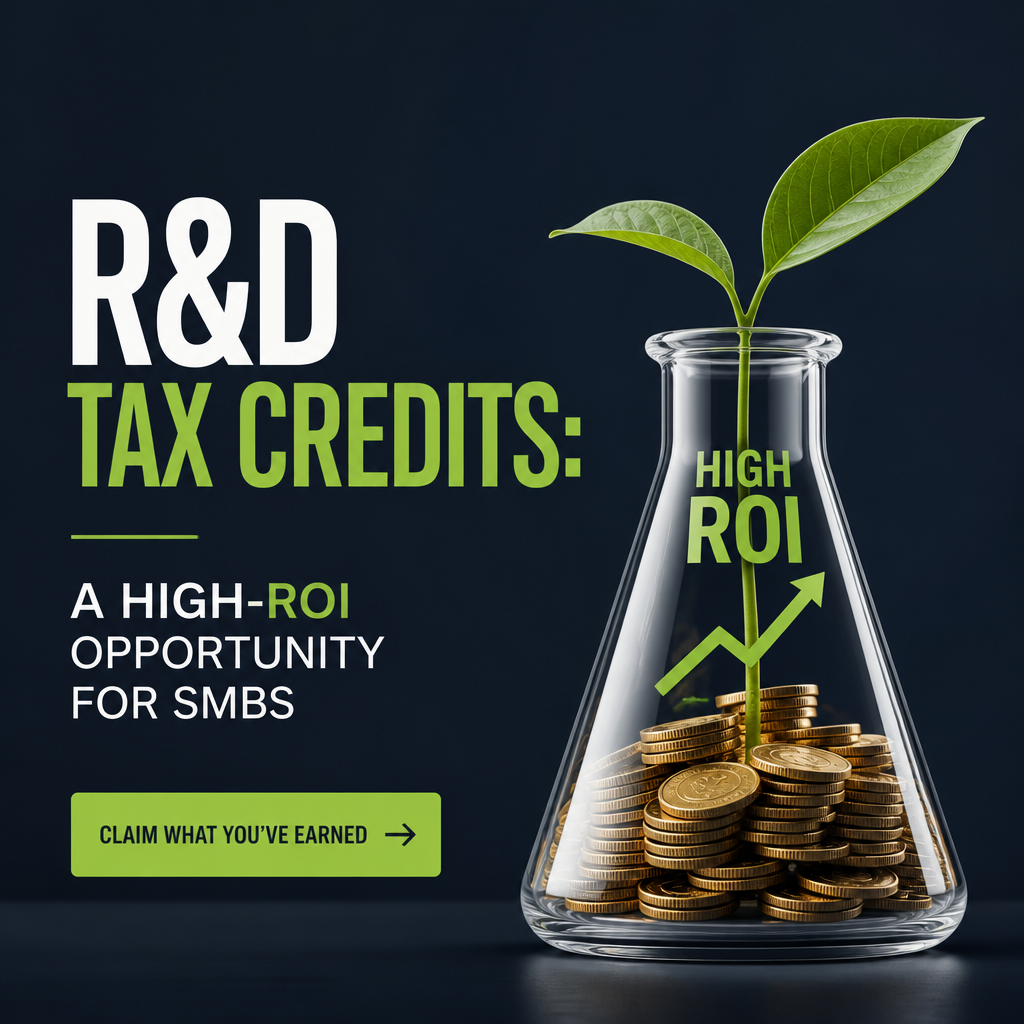
How an AI R&D CTO enables R&D Tax Credits for Small & Mid sized companies:
For small and mid-sized businesses, R&D Tax Credits can be one of the highest-ROI financial opportunities available—when you frame it correctly. The key is to separate the cost of doing R&D from the incremental cost of claiming the credit.
If your company is already building, improving, or scaling technology, the engineers have already been hired. The development work has already occurred. The experiments have already been performed. In that scenario, the incremental investment is not “doing R&D.” The incremental investment is identifying, documenting, calculating, and supporting the available R&D Tax Credit.
That’s why the economics are so compelling for many SMBs: you may be able to pursue a potential tax benefit arising from qualifying R&D already performed. The IRS confirms that the federal research credit is calculated from qualified research expenses and that qualifying research must meet statutory requirements, including the process-of-experimentation test.
A practical way to evaluate this is with a business ROI framework (not the statutory IRS calculation):
R&D Tax Credit ROI = Net Tax Benefit ÷ Incremental Cost of Claiming
This simple lens helps CEOs and CFOs compare R&D Tax Credit preparation against other competing uses of scarce capital.
Comparing Where a $20,000 Budget Can Go:
Imagine an SMB has $20,000 available to deploy this quarter. There are many reasonable options:
• Advertising → uncertain future sales
• Consulting → uncertain future improvement
• Product development → uncertain commercial outcome
• Recruiting → uncertain employee productivity
• R&D Tax Credit preparation → pursue a potential tax benefit from qualifying R&D already performed
The last option is different. It doesn’t guarantee a result, but it often has a clearer line-of-sight because it is tied to historical work already completed—assuming that work qualifies and can be documented.
Here is an illustrative (not representative or guaranteed) example to show the comparison:
• Potential supportable credit: $100,000
• Professional + internal claim cost: $20,000
• Gross benefit/cost: 5×
• Net economic benefit: $80,000
• Illustrative net ROI on incremental claim cost: 400%
The point is that, for companies already conducting Qualified Research Activities, the incremental investment in an R&D Study, documentation, and compliance support will compare much more favorably to other uses of $20,000.
Identifying Qualified Research Activities That SMBs Commonly Miss:
Many startups, software companies, manufacturers, engineering firms, and technology businesses perform Qualified Research Activities every year without realizing it. The issue is rarely a lack of innovation—it’s a lack of structured identification and evidence.
To qualify for Research and Development Tax Credits, activities generally need to align with the statutory requirements, including the process-of-experimentation test. In practical terms, the strongest claims typically reflect:
• Technical uncertainty (capability, method, design)
• A systematic evaluation of alternatives
• Testing, iteration, and analysis
• A technological objective tied to product or process improvement
Common SMB examples include building new software architectures, improving system performance, developing prototypes, improving manufacturing tolerances, integrating hardware/software, creating new data pipelines, or refining algorithms. The challenge is mapping day-to-day Product Development work into a credit-ready narrative that demonstrates uncertainty and experimentation rather than routine implementation.

“I’m predicting today that every company will become an AI company—not because they can, but because they must.”
– Arvind Krishna, Chairman and CEO of IBM
Calculating Qualified Research Expenses Without Crushing Your Team:
Once eligibility is established, the next ROI lever is calculating Qualified Research Expenses (QREs) efficiently and defensibly. QREs often include a portion of wages for employees directly performing or supporting qualified research, certain contractor costs, and supplies used in experimentation.
For SMBs, the “hidden cost” of claiming is often internal time:
• Engineering time spent explaining projects
• Finance time pulling payroll and general ledger detail
• Project managers reconstructing timelines
• Leadership review cycles
• Back-and-forth to assemble contemporaneous documentation
This is why the incremental cost of claiming is more than a consultant fee. It is professional fees plus the operational burden placed on your best people. Reducing that burden can materially improve your effective ROI—even when the credit amount stays the same.
Building a Defensible R&D Study and Compliance-Ready Documentation:
A supportable R&D Tax Credit claim typically rises or falls on documentation quality. An R&D Study should do more than list projects—it should connect each project to the technical uncertainties, the alternatives considered, and the testing performed.
Strong support often includes:
• Technical narratives showing the process-of-experimentation
• Technical interview notes
• Time surveys or other time-tracking substantiation
• Design artifacts, tickets, test results, build logs, or release notes
• Evidence mapping that ties activities to QREs
This is where many SMBs leave money on the table: they either don’t claim, under-claim due to incomplete QRE capture, or create a weak record that increases audit risk. High-quality R&D Tax Credit Services focus on capturing the story of innovation in a way that matches how the IRS evaluates qualified research.
How an AI R&D CTO Replaces Manual Claim Prep With R&D Tax Credit Intelligence:
An AI R&D CTO represents the next wave of Innovation Management for SMBs that want both stronger R&D Tax Credit claims and stronger technical decision-making. Think of it as a modern R&D service model that combines tax credit execution with AI R&D Intelligence—without requiring a large internal staff.
In the tax credit context, an AI R&D CTO can help reduce the administrative friction that drives up the incremental cost of claiming. Compared to traditional manual approaches, an AI R&D CTO can help teams:
• Identify Qualified Research Activities (QRAs) more consistently across engineering, product, and operations
• Conduct and organize technical interviews with clearer prompts tied to the 4-part test and process-of-experimentation
• Generate draft technical documentation and evidence maps for review
• Produce time surveys and organize substantiation with less disruption to engineering
• Assemble inputs that support Form 6765 preparation as part of a documented R&D Study
• Improve IRS compliance readiness by standardizing how uncertainty and experimentation are captured
This approach is especially valuable in sectors where project records are fragmented across tickets, docs, code repositories, and finance systems. The goal is not to replace human expertise—it’s to reduce repetitive manual work so human experts can focus on accuracy, risk management, and final review.
Beyond credits, an AI R&D CTO can also function as a Virtual CTO layer—providing AI Product Intelligence and AI Product Strategy guidance, acting as an AI Technology Advisor and AI Technical Advisor to help leadership benchmark competitors, spot emerging technical approaches, and clarify technology strategy. The result is a more level playing field: SMBs can access enterprise-level innovation capabilities without building an enterprise-sized team.
In other words, the AI R&D CTO helps turn the tax credit into a self-funding innovation engine—by improving both the probability of capturing available credits and the efficiency of doing so.
Turning R&D Tax Credit Refunds Into Business Cash Flow for Growth:
R&D Tax Credits are ultimately a financial tool. When claimed correctly, they can reduce tax liability and, in some scenarios, generate an R&D Tax Credit Refund effect through payroll tax offsets or other mechanisms depending on company facts.
For SMBs, the strategic outcome is often Business Cash Flow: more liquidity to extend runway, reinvest in Product Development, fund hiring, or absorb the cost of technical experimentation. While the credit is not guaranteed and must be supported, the structure creates a powerful opportunity: cash freed up by Tax Savings can be redeployed into new cycles of innovation.
When leaders treat the credit as a recurring program—supported by repeatable documentation and a consistent Innovation Management workflow—the benefit can compound year over year. The SMB that systematizes eligibility identification, QRE capture, and R&D Study preparation often gains not just a credit, but a durable financial capability.
Learn More and Estimate Your Potential R&D Tax Credit:
If your company is already performing qualifying R&D, the most important comparison isn’t the cost of R&D—it’s the incremental cost required to claim a supportable credit from work you already did. That is why Research and Development Tax Credits can be a high-ROI opportunity for SMBs.
An AI R&D CTO—working as a Virtual CTO and AI Chief Technology Officer capability—can help you modernize how you identify Qualified Research Activities, calculate Qualified Research Expenses, and produce a defensible R&D Study, while also strengthening AI Product Strategy and AI Product Intelligence.
To learn more about how an AI R&D CTO can enhance knowledge to world-class standards while seamlessly gaining R&D tax credits, and to obtain an estimate of how much your R&D Tax Credit can be, select the button below.