

 - EN
- EN  - EN
- EN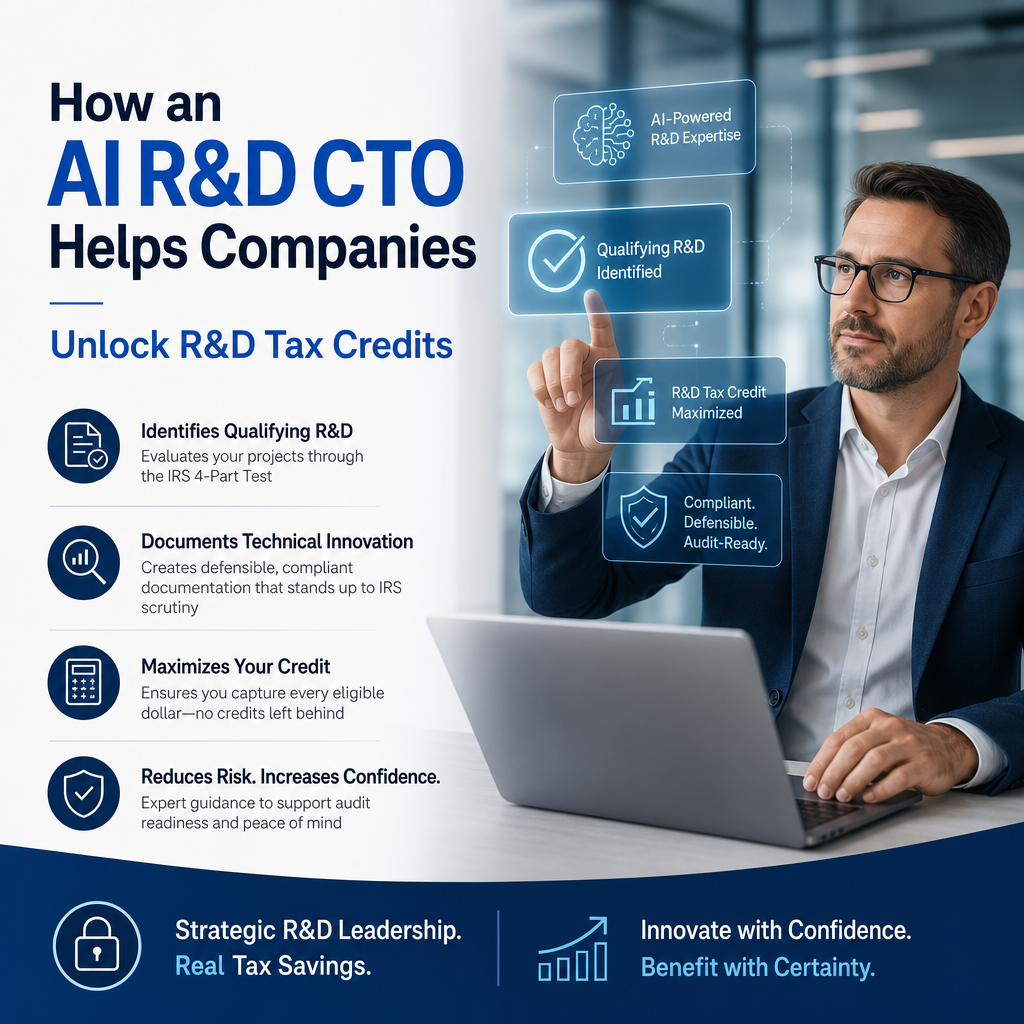
Why Small and Mid-Sized Innovators Miss Out on R&D Tax Credits:
Many small and medium-sized companies perform qualifying R&D every year but never claim the federal R&D Tax Credit. The most common reason isn’t lack of innovation—it’s friction. Traditional R&D studies can feel too complex, too time-consuming, and too expensive, especially for micro teams where engineers and operators already wear multiple hats.
An AI R&D Chief Technology Officer (AI R&D CTO) changes that equation by pairing AI-driven organization with expert guidance. The result is a streamlined, compliant way to capture Qualified Research Activities (QRAs) and Qualified Research Expenses (QREs) without disrupting day-to-day work. When done well, the credit becomes an Innovation Investment Fund you can rely on year after year—supporting hiring, tooling, product iteration, or long-term financial security.
Documenting Technical Uncertainty and Advancement in Product Development:
To qualify, R&D work must generally address technical uncertainty and aim for technological advancement—often in product development where teams are pushing beyond known capabilities. For SMBs, the challenge is that this reality lives in engineers’ heads and informal discussions, not in audit-ready narratives.
An AI R&D CTO helps teams translate real engineering work into clear, contemporaneous documentation: what performance targets were unknown, what constraints existed, and what advancement was sought. This can include resolving uncertainty around reliability, throughput, accuracy, durability, integration, or scalability. Importantly, documentation is captured in a way that aligns with the 4-part test—while maintaining a Human in the Loop review process so technical descriptions and tax positions remain accurate, complete, and ready for CPA and human review.
Capturing Experimentation: Prototypes, Iterations, and Trial Runs:
In many qualifying environments, experimentation is continuous: prototypes are built, tested, revised, and tested again. Technicians and operators may run trial batches or controlled production tests to validate settings and reduce failure rates. Engineers may iterate designs to meet performance requirements or integrate subsystems.
These iterative cycles are often the strongest evidence of qualified research—yet they’re rarely packaged as such. An AI R&D CTO supports consistent capture of what was tried, what changed, and why. This includes recording the hypothesis (what the team expected), the test conditions (what variables were adjusted), and the results (what was learned). Over time, that creates a defensible story of systematic experimentation rather than a scattered collection of notes and emails.
For SMBs, the biggest win is reducing the “end-of-year scramble.” Instead of reconstructing months of work, teams can build an R&D study seamlessly as the work happens, with expert R&D consultants available at every step to ensure the documentation remains on track.

Our intelligence is what makes us human, and AI is an extension of that quality.
– Yann LeCun, VP and Chief AI Scientist at Facebook
Tracking Engineering Time, Contractor Work, and Supply Usage Without the Administrative Burden:
The R&D Tax Credit is powered by QREs—typically wages for employees performing or directly supporting qualified activities, qualified contractor costs, and qualifying supplies consumed in experimentation. The operational problem for smaller companies is that tracking these costs can become intrusive and unpopular, especially when it relies on manual time studies, spreadsheets, and after-the-fact estimates.
An AI R&D CTO can reduce that burden by using a non-intrusive approach to capture activity signals. Voice AI check-ins and lightweight prompts can help employees confirm what they worked on and whether it involved experimentation or resolving technical uncertainty—without forcing them into rigid timekeeping habits. Contractor invoices and supply purchases can be organized to align with experimental trials, helping substantiate why costs were necessary for qualified work.
This approach helps micro, solo, and growing teams access benefits that historically favored larger organizations with dedicated finance resources—while still maintaining a Human in the Loop guard rail so classifications and final calculations receive professional review.
Building a CPA-Ready R&D Study and Audit-Resilient Support Package:
A common misconception is that claiming the credit requires writing a PhD-level thesis. In reality, the goal is a clear, substantiated, and consistent R&D study: project narratives tied to uncertainties, experimentation steps, and calculated expenses—supported by reasonable documentation.
An AI R&D CTO helps assemble a turnkey, CPA-ready package by organizing project lists, mapping roles to qualified activities, and aligning costs to the work performed. Sector-specific trained LLMs (used strictly for R&D tax credit preparation—not for your product or process) can help draft technical narratives that reflect what engineers, technicians, and operators actually did, using terminology consistent with IRS expectations.
Critically, expert R&D consultants remain involved to validate eligibility, confirm the 4-part test alignment, and ensure the final deliverable is accurate and defensible. That blend—AI speed plus expert judgment—can reduce cost and complexity, making high-quality R&D studies accessible to SMBs year after year.
AI and Automation for R&D Tax Credits: Replacing Manual Methods with Human-in-the-Loop Precision:
Traditional R&D tax credit workflows often depend on long interviews, spreadsheet-based time estimates, and manual document requests that interrupt technical teams. AI-driven R&D credit preparation modernizes that workflow by continuously organizing the evidence trail.
A trained, sector-specific LLM can help identify potentially eligible activities, structure technical uncertainty narratives, and prompt for missing support—while connecting the dots between project work, employee roles, contractor contributions, and supplies used in trials. Voice AI can capture quick confirmations from busy teams, and automation can keep timelines moving through email-based requests and reminders.
The key safeguard is Human in the Loop: AI accelerates collection and drafting, while experienced professionals review eligibility decisions, refine technical descriptions, and confirm QRE calculations before anything reaches your CPA. The outcome is a seamless, lower-friction process that helps SMBs treat the R&D tax credit as an annual Innovation Investment Fund rather than a one-time event.
Estimate Your Potential R&D Tax Credit:
If your team is developing new products or improving performance, reliability, or scalability, you may be qualifying every year—without realizing how much is available. Use the button below to get an estimate of your potential R&D Tax Credit and see how it can fund next year’s innovation.