
 - EN
- EN  - EN
- EN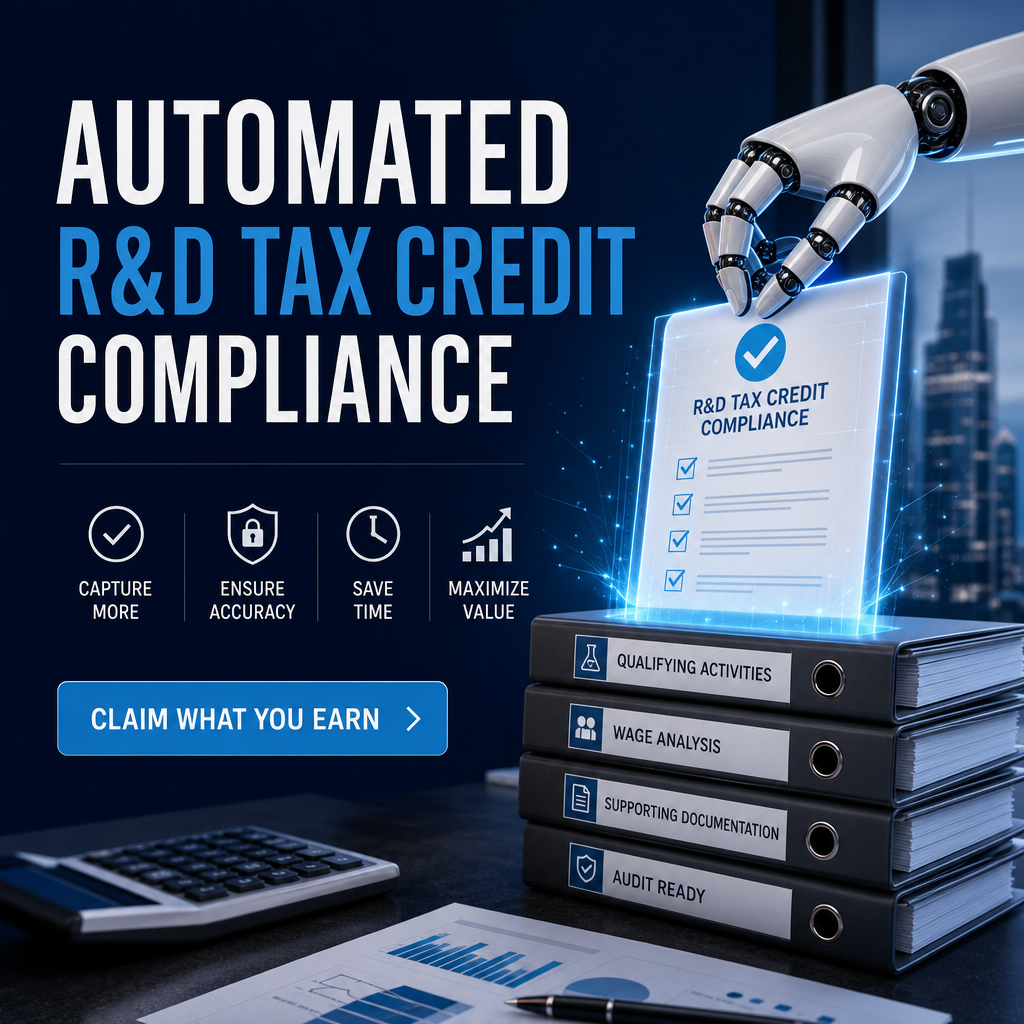
For small and mid-sized businesses, claiming R&D Tax Credits often feels like a tradeoff: spend weeks pulling documentation together, or pay for traditional R&D Tax Credit Services that can be expensive relative to the benefit. Meanwhile, the underlying work—engineering, software development, manufacturing trials, prototype iterations—keeps moving.
That gap is why the AI R&D CTO is emerging as a practical new standard for Research and Development Tax Credits. Think of an AI R&D CTO as a modern blend of Virtual CTO + AI Technical Advisor focused on R&D Tax Credit intelligence and IRS-ready documentation. Instead of forcing teams to “recreate history” at year-end, an AI R&D CTO supports Innovation Management by capturing the right narrative and evidence as the work progresses—without discussing or slowing down products or processes.
The outcome is straightforward: stronger compliance, minimal disruption, and better Business Cash Flow through faster, more defensible Tax Savings and potential R&D Tax Credit Refund outcomes.
Identify Qualified Research Activities (QRAs) earlier—before the year-end scramble:
Many companies perform Qualified Research Activities without labeling them that way. They’ll say, “We’re just fixing performance,” “We’re integrating new components,” or “We’re trying to make it scale.” Those are often the exact situations where the IRS expects a clear explanation of technical uncertainty, experimentation, and advancement.
An AI R&D CTO helps smaller teams spot QRAs while work is still fresh. This is especially valuable for startups, software companies, manufacturers, engineering firms, and technology businesses where experimentation is continuous.
Examples of QRAs that frequently qualify include:
• Software: resolving uncertainty in architecture, performance, reliability, data integrity, or deployment constraints.
• Manufacturing: trial runs, process parameter testing, yield improvement experiments, tooling iterations, and material substitutions.
• Engineering: prototyping, design iterations, lab testing, integration challenges, and verification/validation activity.
By framing activities against eligibility expectations early, companies can establish R&D Tax Credit eligibility with fewer surprises and less retroactive digging.
Convert project reality into an IRS-ready R&D Study without slowing teams down:
The R&D Study is where many SMB claims break down—not because the work didn’t qualify, but because the documentation is thin, inconsistent, or created too late. Traditional approaches often rely on after-the-fact interviews, scattered artifacts, and a narrative written under deadline pressure.
An AI R&D CTO supports the creation of an R&D Study in a way that is more natural for smaller organizations: documentation is generated as the technical work unfolds. Using sector-specific trained LLM assistance, the AI R&D CTO can help structure the story around the 4-part test, including:
• What technical uncertainties existed.
• What alternatives were considered.
• What experiments or analyses were performed.
• What technological advancement was sought (and what was learned).
This approach reduces the time burden on founders and engineers and improves the consistency of technical narratives across multiple projects—critical when you want a repeatable annual process rather than a one-time scramble.

“Firms that understand how to use AI as a new tool in the broader context of process reengineering will arguably get the most from AI in the long run.”
– Harvard Business Review
Capture Qualified Research Expenses (QREs) with less manual effort and fewer missed costs:
Even when companies identify Qualified Research Activities, they often underclaim because Qualified Research Expenses are hard to track precisely. Smaller companies rarely have a dedicated tax department, and project accounting might not map cleanly to R&D categories.
An AI R&D CTO helps organize QRE capture so the claim is both more accurate and easier to support. This includes guiding the collection and categorization of:
• Wages for staff directly performing, supervising, or supporting qualified research.
• Contractor costs that meet the requirements.
• Supplies used in experimentation and testing.
Reduce compliance risk with contemporaneous documentation and streamlined support for Form 6765:
R&D Tax Credit compliance is not just about finding expenses. It’s about supporting the position if questions arise. SMBs are most exposed here because documentation frequently lives in informal channels, and memory fades quickly.
An AI R&D CTO helps strengthen IRS compliance requirements by standardizing documentation practices and producing organized support files that align with how claims are reviewed.
This may include:
• Contemporaneous documentation that links technical uncertainties to experiments and outcomes.
• Structured technical write-ups suitable for an R&D Study.
• Project-level summaries that map activities to expenses.
• A clean package that supports Form 6765 preparation.
Compared to purely manual methods, this approach is faster to assemble, easier to update annually, and typically more consistent—especially when multiple teams or locations contribute to R&D.
Automate and facilitate the claim—replacing traditional manual methods:
Traditional R&D Tax Credit Consultants can add value, but SMBs often face two constraints: the cost can be high, and the process can still be disruptive because employees must stop work to reconstruct timelines, write narratives, and justify percentages.
The AI R&D CTO model modernizes R&D Tax Credit Services by making compliance a living process rather than a year-end event. The AI R&D CTO can:
• Conduct technical interviews in a structured, repeatable way.
• Produce time surveys with less friction and better consistency.
• Generate technical documentation aligned to Qualified Research Activities.
• Support an R&D Study that evolves alongside the work.
The practical advantage is that smaller companies can maximize available R&D Tax Credits without sacrificing weeks of leadership attention. Over time, the R&D Tax Credit can become a self-funding innovation engine—improving cash flow while funding the next wave of experimentation.
Add AI R&D CTO product intelligence without building an expensive team:
While the biggest near-term win is better access to Research and Development Tax Credits, the AI R&D CTO also brings lightweight technology leadership benefits that SMBs typically can’t staff internally.
In addition to tax credit execution, an AI R&D CTO can support:
• AI Product Strategy alignment—ensuring technical efforts connect to measurable business goals.
• AI Product Intelligence—clearer understanding of where technical uncertainty is highest and where learning loops are fastest.
• Competitive benchmarking and innovation intelligence—staying aware of emerging approaches and industry movement.
• Technical barrier resolution—helping teams frame, brainstorm, and think outside the box.
This is not about building your products with AI; it’s about improving decision-making around innovation and capturing the R&D value you’re already creating.
Learn more and estimate your R&D Tax Credit benefit:
The AI R&D CTO democratizes innovation by helping startups, micro businesses, and small and medium companies recover R&D Tax Credits while gaining access to technical leadership and innovation intelligence previously available only to large enterprises.
If your team is doing AI Product Development, software experimentation, engineering prototyping, manufacturing trials, or any work involving technical uncertainty, you may have Qualified Research Activities and Qualified Research Expenses you’re not capturing.
To learn how an AI R&D CTO can enhance knowledge to world-class standards while seamlessly gaining R&D tax credits—and to obtain an estimate of how much your R&D Tax Credit could be—select the button below.