
 - EN
- EN  - EN
- EN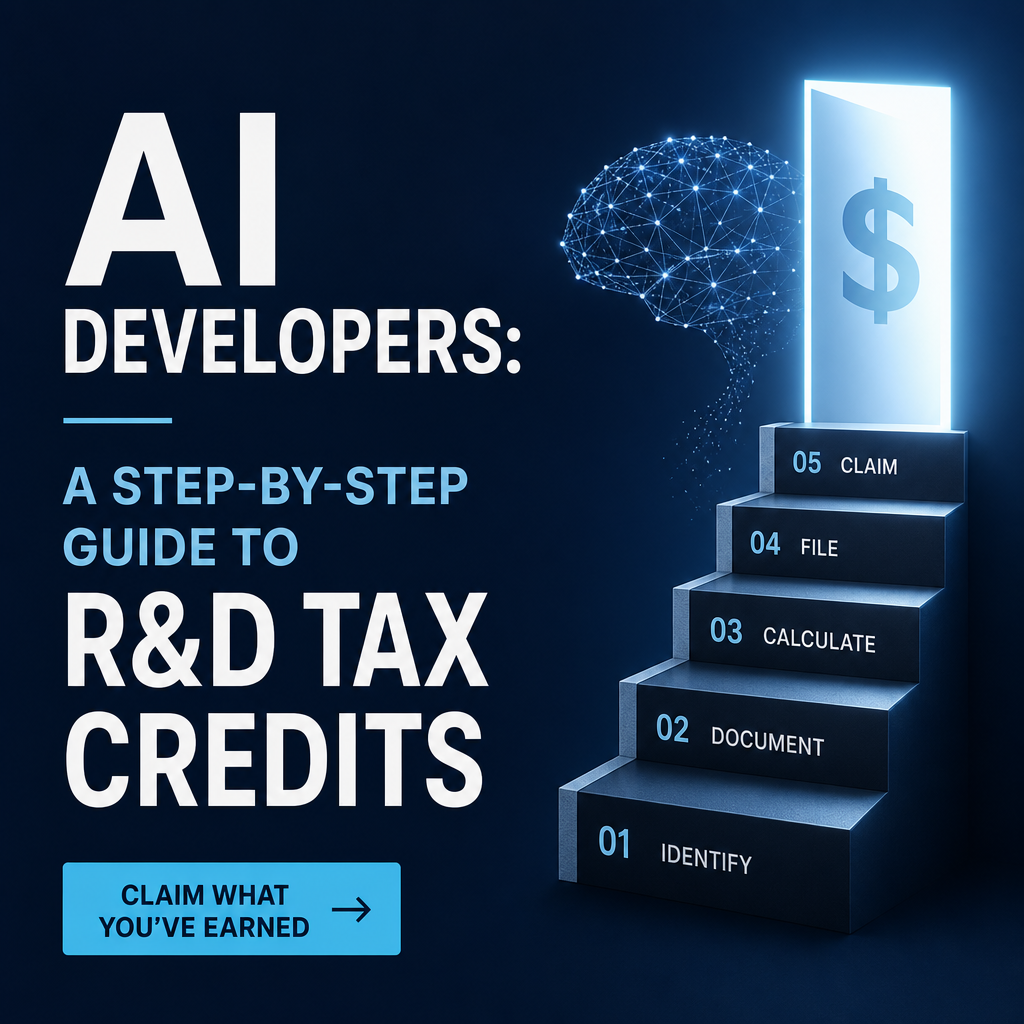
If AI is Doing the Coding, then What Qualifies as R&D?:
AI development can involve substantial technical experimentation, but building an AI product does not automatically qualify for R&D Tax Credits. The difference is whether your team pursued a process of experimentation to resolve technological uncertainty—and whether you can tie that work to Qualified Research Activities (QRAs), Qualified Research Expenses (QREs), and credible technical evidence.
This step-by-step guide is written for U.S. and Canadian companies and technical founders building AI/ML products and systems (not just using AI coding tools). It also reflects a modern delivery model: an AI R&D CTO (often delivered as a Virtual CTO) who pairs R&D Tax Credit Services with structured, evidence-based Innovation Management. The goal is simple: turn your R&D Tax Credit into a self-funding innovation engine that improves Business Cash Flow and funds the next iteration of AI Product Development.
An AI Chief Technology Officer or AI Technology Advisor can help you separate “AI development” into specific business components, document uncertainty, track experimentation, and produce a CPA-ready R&D Study—without relying on end-of-year guesswork.
Step 1 — Identify AI business components (make your claim technically credible):
Start by breaking “AI development” into clear business components. This is foundational for Research and Development Tax Credits because it forces you to describe what you built, why it required technical work, and where experimentation occurred.
Examples of AI business components that commonly map to QRAs include:
• RAG architecture (retrieval + generation system design)
• model optimization and fine-tuning approaches
• agent orchestration and tool-use reliability
• computer vision pipelines and edge deployment constraints
• training pipelines, MLOps automation, and dataset curation methods
• inference infrastructure (latency, scaling, GPU utilization)
• evaluation systems (benchmarks, safety tests, regression suites)
This step is also where an AI Product Strategy lens matters. An AI Technical Advisor can help ensure the components are defined at the right level: not too vague, not too granular. In practice, an AI R&D CTO uses AI Product Intelligence to standardize component definitions so your R&D Tax Credit claim reads like engineering—not marketing.
Step 2 — Identify the technological uncertainty (the core of qualification):
The strongest R&D Tax Credit claims clearly state what your team could not readily determine at the outset. A good example is:
“We could not readily determine how to maintain retrieval accuracy as the document corpus increased while keeping response latency below the required threshold.”
Other common uncertainties in AI product development:
• hallucination reduction under real-world prompt variance
• retrieval accuracy versus latency tradeoffs
• GPU memory constraints during fine-tuning or inference
• model reliability across edge cases and noisy inputs
• multi-agent coordination stability and tool-call error handling
• evaluation design: what metrics correlate with user outcomes
This step is also the first filter for eligibility: some work is innovative but not qualified research; other work is qualified but poorly articulated. An AI R&D CTO (or Virtual CTO) helps translate engineering reality into the language needed for R&D Tax Credit eligibility while staying faithful to what actually happened.

“Smart companies are viewing the introduction of AI as the rationale for a new look at end-to-end processes.”- Harvard Business Review
Step 3 — Document experimentation (alternatives → tests → results):
Qualified Research Activities require a process of experimentation. The strongest AI R&D Tax Credit story is not the final model. It is the experimental path that produced it.
For a RAG system, capture what alternatives you actually tested:
• embedding models compared for retrieval quality
• chunking strategies (size, overlap, semantic vs. fixed)
• hybrid search (keyword + vector) vs. pure vector
• reranking options and tradeoffs
• query transformation, prompt routing, context compression
• caching and retrieval optimization to reduce latency
Then document the sequence:
Alternative → test → result → failure → adjustment → next experiment.
This is where many teams lose value: they did the experiments, but they didn’t preserve a coherent record. An AI R&D CTO supports Innovation Management by creating a repeatable format for recording technical obstacles and outcomes, making the R&D Study faster to draft and far easier to defend.
Step 4 — Identify who performed the R&D with proper time allocations:
Next, identify the people who performed qualified activities. Common roles include AI/ML engineers, software developers, data scientists, AI architects, MLOps engineers, technical founders, and certain QA or DevOps staff when their work is directly tied to experimentation.
A critical credibility point for IRS compliance requirements: working at an AI company does not automatically make 100% of an employee’s time qualified R&D. Time must align to Qualified Research Activities.
A practical approach is to map each business component to the individuals who:
• designed experiments
• built prototypes
• ran tests and evaluated results
• iterated based on failures
R&D Tax Credit Consultants often see claims weakened by “blanket allocations.” A disciplined approach—supported by an AI R&D CTO—creates clean allocations and reduces audit risk.
Step 5 — Determine employee R&D time with less burden (ongoing evidence beats year-end memory):
This is where smaller teams struggle: year-end estimates are painful and unreliable. Modern R&D Tax Credit Services work better when time and activity tracking is continuous.
Instead of asking at year-end, “What percentage of last year was R&D?” build supportable allocations using:
• technical conversations and structured interview notes
• quarterly activity summaries
• Jira tickets, GitHub/Bitbucket commits, PR descriptions
• test records, model evaluations, benchmark dashboards
• project milestones and change logs
A practical principle is: employees explain the R&D; AI builds the activity record; humans confirm it. In the AI R&D CTO model, a Virtual CTO helps conduct technical interviews, create time surveys, and turn project artifacts into organized, contemporaneous documentation.
Step 6 — Identify potential QREs and avoid common AI-cost mistakes:
Once activities and time are defined, identify Qualified Research Expenses. Typically, QREs include eligible portions of:
• W-2 wages for employees performing or directly supporting qualified research
• certain contractor costs (subject to rules and documentation)
• qualifying supplies used in experimentation (more common in hardware, robotics, or lab settings)
Be careful not to assume every AI-related cost is a QRE. For example, AI subscriptions, model API charges, general cloud costs, and software licenses should not be labeled qualified simply because they supported development. The key is whether the expense is eligible under the tax rules and tied to Qualified Research Activities.
A well-built R&D Study connects: Business Component → Qualified Activity → Employee → Time → Expense. This traceability is exactly what improves Tax Savings while protecting credibility.
Step 7 — Capture technical evidence and build a CPA-ready R&D Study package:
AI projects generate excellent evidence—if you preserve it with intent. Useful evidence includes:
• architecture diagrams and design notes
• Git commit history and pull requests tied to experiments
• benchmark results and evaluation reports
• prompt experiments and comparison logs
• latency measurements, load tests, and GPU utilization metrics
• failure logs, incident reports, and regression findings
Organize evidence around: uncertainty → experiment → result, rather than dumping files into a folder.
From there, the R&D Study can follow a simple narrative structure:
Technical objective → Technological uncertainty → Alternatives investigated → Experiments performed → Failures and results → Technical conclusion.
A complete, CPA-ready package for Form 6765 support often includes:
• Business Component Summary and qualification analysis
• technical narratives for each component
• employee allocations with supporting rationale
• QRE schedules and calculation support
• support-document mapping for audit readiness
This is also where an AI R&D CTO model replaces traditional manual methods. Instead of weeks of back-and-forth, a Virtual CTO plus AI-driven R&D Tax Credit Intelligence can help identify QRAs, calculate QREs, generate documentation, and produce an R&D Study that’s consistent, repeatable, and easier for your CPA to review—often accelerating the path to an R&D Tax Credit Refund and improved Business Cash Flow.
Learn more: turn R&D Tax Credits into a self-funding innovation engine:
SHAIN’s AI R&D CTO democratizes innovation by helping startups and small companies recover R&D Tax Credits while gaining access to technical leadership and innovation intelligence previously available mainly to large enterprises. If you’re building AI/ML systems, you may be farther along toward eligibility than you think.
To learn how an AI R&D CTO can enhance knowledge to world-class standards while seamlessly gaining R&D tax credits—and to get an estimate of how much your R&D Tax Credit could be—select the button below.