
 - EN
 - EN
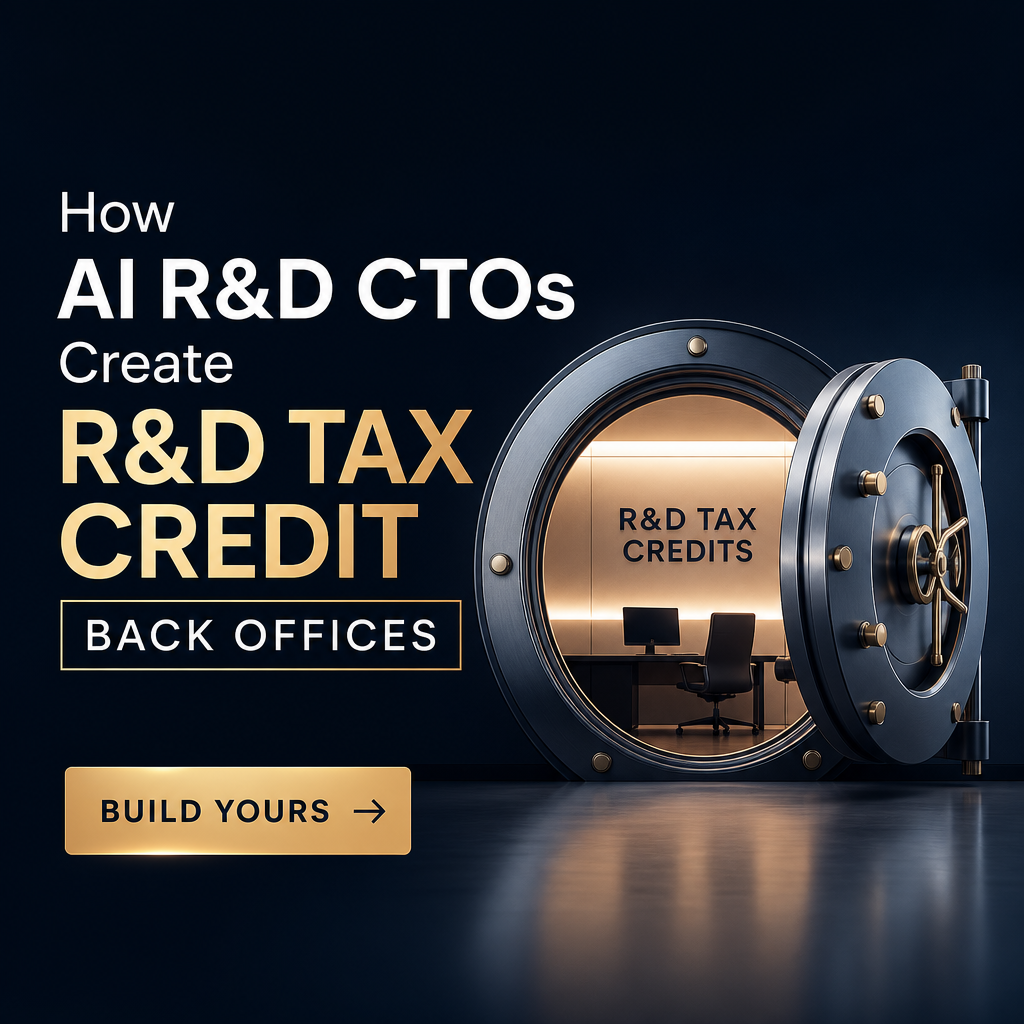
How to create an R&D Tax Credit “back office”:
For many small and mid-sized companies, the biggest barrier to capturing R&D Tax Credits isn’t a lack of innovation—it’s the lack of an internal system to consistently identify, document, and defend eligible work. A modern R&D Tax Credit “back office” is the operational layer that makes Research and Development Tax Credits repeatable: it connects engineering reality to finance records, translates technical progress into IRS-ready narratives, and maintains compliance-grade documentation over time.
This is where an AI R&D CTO—working as a Virtual CTO and AI Technology Advisor—changes the equation. Instead of relying on manual year-end scrambles, scattered spreadsheets, and memory-based interviews, an AI Chief Technology Officer approach builds a durable process that continuously captures Qualified Research Activities and the supporting evidence behind them. The result: a more defensible R&D Study, more complete Qualified Research Expenses tracking, faster preparation for Form 6765, and improved business cash flow through predictable tax savings.
A well-designed back office doesn’t replace your CPAs or tax team. It equips them. With the right AI Product Intelligence and AI Innovation Platform capabilities focused strictly on R&D Tax Credit support, smaller companies can operate with enterprise-level rigor—without building a large internal department.
Designing eligibility workflows that consistently surface Qualified Research Activities:
The first job of an R&D Tax Credit back office is to avoid missed opportunities. Many startups, software companies, manufacturers, engineering firms, and technology businesses perform qualifying work every week—yet only a fraction is captured because no one is operationally responsible for translating technical work into Qualified Research Activities.
An AI R&D CTO helps implement a repeatable “eligibility workflow” that routes the right signals into a review loop. Practically, this means creating lightweight intake prompts for project leads and technical owners so potential Qualified Research Activities are flagged when they happen—not months later. The workflow is structured around the IRS four-part test: permitted purpose, technological in nature, elimination of uncertainty, and process of experimentation.
Sector examples of activities often captured through these workflows include: iterative software architecture changes to improve performance or scalability; prototyping and testing in manufacturing to achieve tighter tolerances; engineering experimentation with materials, sensors, or firmware; and data pipeline redesigns to improve reliability under real-world constraints. The purpose is not to claim “everything,” but to consistently find and document the projects that truly represent technical uncertainty and experimentation.
Because an AI Technical Advisor lens is applied across teams, the workflow also reduces internal debate about what qualifies. Leaders get clearer guardrails, and finance gets earlier visibility—key to accurate R&D Tax Credit forecasting and better tax planning.
Building documentation systems that withstand compliance scrutiny and reduce rework:
A common failure mode in R&D Tax Credit claims is not the existence of innovation—it’s the absence of contemporaneous documentation. When support is reconstructed after the fact, narratives become vague, project scopes blur, and technical uncertainties are hard to prove.
An AI R&D CTO back office is built to generate and organize documentation continuously. That includes structured technical interview notes, decision logs, milestone summaries, experiment results, and versioned project narratives that explain what was uncertain, what alternatives were evaluated, and what was learned.
Done correctly, this documentation becomes the backbone of the R&D Study and supports IRS compliance requirements without placing an unrealistic burden on engineers. It also improves internal Innovation Management by making technical decisions searchable and reusable—turning prior experimentation into organizational learning.
Importantly, the documentation focus is claim-centered, not product-centered: it captures how teams applied engineering principles and systematic experimentation, and why that work rose above routine development. This reduces the risk of under-documenting key projects or over-claiming routine tasks—both of which can be costly.

“The rate of innovation and the speed of diffusion is unlike anything we’ve seen.”
– Satya Nadella, Chairman and CEO of Microsoft
Tracking Qualified Research Expenses with operational discipline (not spreadsheets):
Even when companies clearly perform Qualified Research Activities, they often underestimate Qualified Research Expenses because costs are hard to allocate. W-2 wage allocations may be imprecise, contractor work may not be categorized properly, and supply costs can be overlooked—especially in prototyping environments.
An AI R&D CTO approach to the back office introduces a practical cost-tracking discipline: clear rules for which roles and workstreams map to qualified efforts, consistent time-survey rhythms, and a repeatable approach for contractor classification and nexus to qualifying projects. Over time, this produces more complete QRE capture while reducing the year-end scramble.
This is one of the biggest drivers of improved business cash flow. When QREs are captured accurately, the R&D Tax Credit calculation becomes more reliable, and companies can plan for tax savings rather than treating the credit as a surprise. For qualified small businesses, the ability to pursue an R&D Tax Credit Refund (or apply credits against payroll taxes when eligible) can materially extend runway and fund additional Product Development.
Operationalizing R&D Studies as a repeatable annual cycle—not a one-time event:
Many businesses treat the R&D Study as a one-off project purchased from R&D Tax Credit consultants. The result is often a static deliverable that doesn’t improve the company’s internal capability. An R&D Tax Credit back office flips that model: it turns the R&D Study into an annual operating cycle.
With a Virtual CTO-style cadence, project teams know when and how technical interviews occur, what artifacts are needed, and how experimentation should be summarized. Finance knows what payroll and vendor datasets are required and when. The back office creates a “single source of truth” that is carried forward year to year, so each cycle becomes faster, cheaper, and more defensible.
This structure also supports better collaboration with external R&D Tax Credit Services and R&D Tax Credit Consultants when needed. Instead of paying for discovery from scratch, the company arrives prepared—with organized project lists, clear QRA rationales, and cleaner QRE support—reducing professional fees and increasing confidence in the final claim.
Adding AI Product Strategy and product intelligence without building a large leadership team:
While the back office is primarily about R&D Tax Credits, an AI R&D CTO also functions as an AI Technology Advisor and AI Product Strategy partner—helping smaller organizations access “enterprise-grade” product intelligence.
In practice, this looks like: clarifying technical roadmaps around risk and uncertainty; identifying where experimentation should be prioritized to remove the biggest technical barriers; and strengthening decision-making through competitive benchmarking and emerging-technology awareness. This is not about building or changing your product with AI. It’s about strengthening technical leadership so R&D efforts are better targeted and easier to defend as Qualified Research Activities.
When companies improve how they define uncertainties, run experiments, and document results, they don’t just improve credit outcomes—they improve execution. That creates a flywheel: better experimentation produces better documentation; better documentation supports stronger claims; stronger claims improve cash flow; improved cash flow funds more disciplined innovation.
How AI R&D CTOs automate and facilitate R&D Tax Credit claims—replacing manual methods:
Traditional R&D Tax Credit preparation is labor-intensive: collecting project lists by email, holding ad hoc interviews, reconstructing timelines, and manually translating engineering work into tax-ready language. This approach is expensive, slow, and often incomplete.
An AI R&D CTO modernizes the back office by applying sector-aware intelligence to the claim process itself. Instead of starting from a blank page at year end, the system supports ongoing capture of qualifying work and claim evidence. It can:
• Identify likely Qualified Research Activities earlier by prompting teams for uncertainty, alternatives, and experimentation evidence
• Standardize technical interviews so project narratives consistently meet the four-part test
• Improve time-survey adoption and reduce friction for engineers
• Organize contemporaneous documentation into an audit-ready structure
• Streamline R&D Study drafting by converting structured inputs into clear, consistent technical descriptions
• Support collaboration with tax preparers for Form 6765 readiness
The key benefit is precision with less disruption. The company spends less time chasing information and more time innovating—while strengthening IRS defensibility. This is how the R&D Tax Credit becomes a repeatable, self-funding innovation engine instead of a once-a-year scramble.
Next steps: turn your R&D Tax Credit back office into a self-funding innovation engine:
An AI R&D CTO democratizes innovation by giving startups and small businesses access to R&D Tax Credits and technical leadership capabilities historically reserved for large enterprises. You gain a practical back office for identifying Qualified Research Activities, capturing Qualified Research Expenses, producing an audit-ready R&D Study, and improving business cash flow through predictable innovation incentives.
To learn more about how an AI R&D CTO can enhance knowledge to world-class standards while seamlessly gaining R&D Tax Credits—and to get an estimate of how much your R&D Tax Credit could be—select the button below.