
 - EN
 - EN
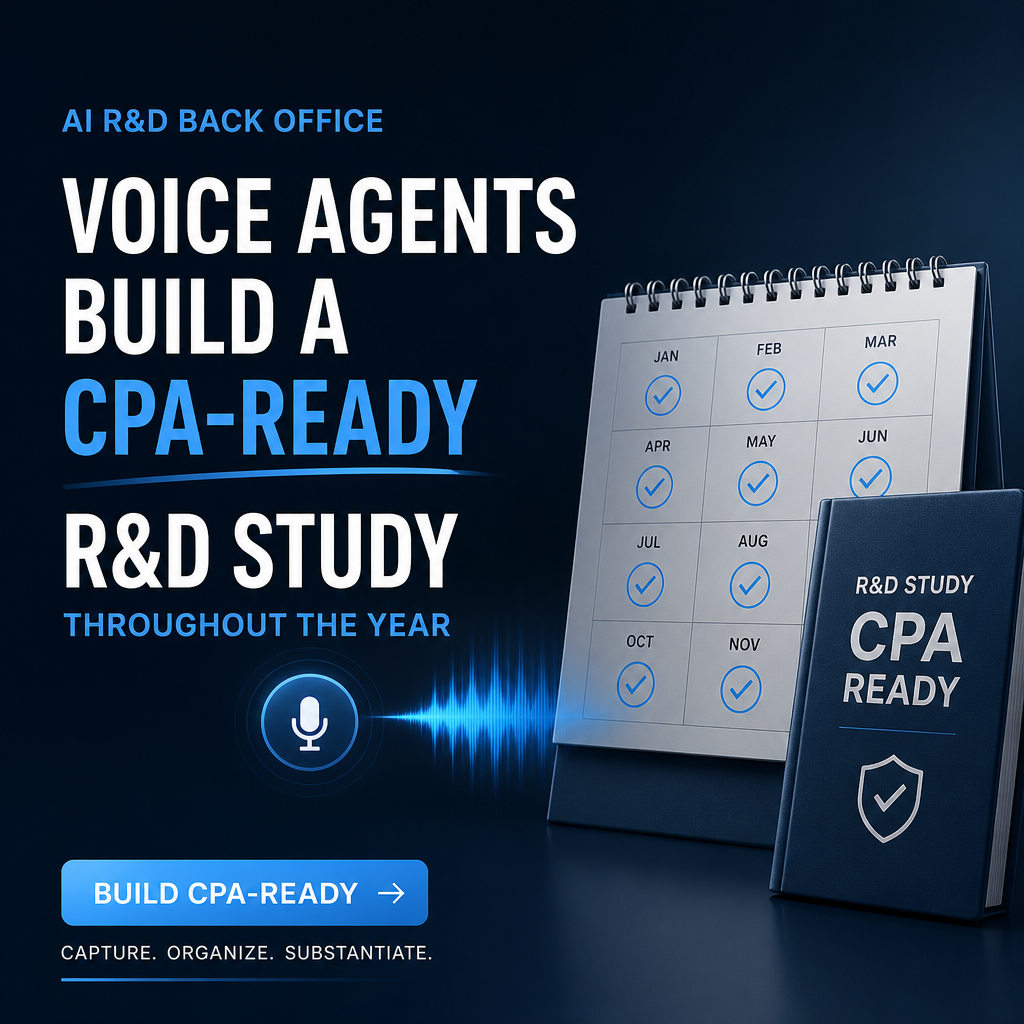
AI R&D Back Office: Turning “normal records” into a defensible R&D evidence trail:
A CPA-ready R&D Study is rarely blocked by a lack of files. The real challenge is proving what happened, why it was technically uncertain, what was tested, who participated, and how each supporting record ties to the R&D Tax Credit claim. For most teams, the last thing you want is turning engineers into documentation clerks or chasing timesheets at year-end.
An AI R&D Back Office—guided by an AI R&D CTO or Virtual CTO—solves this by continuously building the evidence chain throughout the year. The goal isn’t “more documents.” It’s Evidence Mapping: organizing records so each technical activity and each dollar of Qualified Research Expenses (QREs) can be supported, traced, and explained in a way R&D Tax Credit Consultants, your CPA, and (if needed) the IRS can follow.
This approach modernizes R&D Tax Credit Services by combining R&D Tax Credits capture with AI Product Intelligence and Innovation Management discipline—without forcing your technical team into spreadsheets, extra meetings, or end-of-year fire drills.
Continuous voice capture: how voice agents replace year-end memory hunts:
The most fragile part of many Research and Development Tax Credits claims is relying on memory months later: “What exactly did we test?” “Which alternative did we abandon?” “Who spent time on the uncertainty?” Voice agents change the operating model by capturing technical facts when they’re fresh.
A lightweight cadence (for example, brief monthly or milestone-based voice check-ins) can collect:
– The business component being improved (software module, manufacturing process, prototype, algorithm, control system)
– The technical objective (performance, scalability, reliability, yield, latency, tolerance)
– The technical uncertainty (unknown method, capability, or design parameters)
– The experiment or alternatives evaluated (A/B approaches, simulations, test runs, design iterations)
– The result (what worked, what didn’t, what changed)
– Who participated (employees, contractors) and when
The output becomes structured inputs for an R&D Study instead of a pile of transcripts. Technical employees still confirm the engineering facts, but the capture burden drops dramatically—especially for startups and small teams where Business Cash Flow and time are tight.
Build the evidence chain: from technical uncertainty to Qualified Research Expenses:
A defensible R&D Tax Credit claim connects engineering reality to tax rules. The Evidence Mapping logic looks like this:
business component → technical objective → technical uncertainty → experiment or alternative evaluated → result → employee activity → Qualified Research Expense → supporting document.
This is how you turn everyday records into substantiation. Examples of what each record can corroborate (and what it cannot) include:
– Technical interviews / voice check-ins: establish intent, uncertainty, experiments, and outcomes; they do not prove costs by themselves.
– Project records (tickets, change logs, commit notes, build logs): corroborate chronology and iteration; they may not clearly state the uncertainty or experimental method unless mapped.
– Employee activity confirmations (light attestations): confirm who did what and when; they don’t replace payroll records.
– Financial schedules (payroll, contractor invoices, cloud/testing supplies): quantify QREs; they don’t establish Qualified Research Activities (QRAs) without technical linkage.
– R&D Study workpapers: synthesize the above into a coherent narrative and QRA/QRE structure supporting Form 6765.
R&D Tax Credits are strongest when the claim reads like a traceable story—supported by anchors—rather than an after-the-fact summary.

“AI is now a profit generator. AI is now a GDP generator.”
– Jensen Huang, founder and CEO of NVIDIA
Evidence Mapping vs. “documents in a folder”: what CPAs actually need:
Dropping files into a shared drive is not the same as substantiation. Evidence Mapping assigns each artifact a job in the claim.
For example, a single pull request might corroborate that iterative work occurred, but it doesn’t automatically prove the 4-part test elements were met. By mapping that pull request to (1) the business component, (2) the technical uncertainty, and (3) the experiment performed, it becomes a reliable support-document anchor.
A practical mapping approach used in R&D Tax Credit Services:
– Define the business components (the “what”)
– For each component, define uncertainties (the “why”)
– For each uncertainty, list experiments/alternatives (the “how”)
– Attach document anchors (the “proof”)
– Link participating roles/time bands (the “who/when”)
– Connect costs to activities (the “dollars”)
This is the difference between “we did R&D” and “we can prove QRAs and QREs with a clean, reviewable chain.”
Operational workflow: voice check-ins → mapping → QRA/QRE schedules → CPA-ready R&D Study:
A well-run AI R&D Back Office doesn’t wait for tax season. It runs a simple, repeatable workflow that produces CPA-ready outputs.
1) Voice check-ins or low-friction prompts: short, guided collection of technical objectives, uncertainties, and tests (no spreadsheets, no logins, no meetings).
2) Project/activity capture: key milestones are associated to workstreams using existing artifacts (tickets, lab notes, test summaries, design reviews). The goal is not to change how engineers work—just to capture evidence around it.
3) Employee confirmation: engineers or project owners quickly confirm key statements: what uncertainty existed, what experiments occurred, what result was achieved.
4) Support-document mapping: each claim statement gets one or more anchors (e.g., test report, build log, design review notes), organized by business component.
5) QRA/QRE organization: the mapped technical activities are aligned to Qualified Research Activities, while payroll/contractor/supplies are aligned to Qualified Research Expenses.
6) Technical narrative drafting: a first draft narrative is assembled for each business component, describing the systematic process.
7) R&D Study and CPA-ready schedules: the output becomes an R&D Study package with workpapers and schedules suitable for your CPA’s review and Form 6765 preparation.
Human review remains essential: technical leaders verify accuracy; R&D Tax Credit Consultants or tax professionals review eligibility, methodology, and compliance.
Title-specific scenario: a year-long evidence trail built while R&D happens:
Consider a growing engineering team that performs iterative development and testing throughout the year. Instead of reconstructing the year in January, the AI R&D Back Office continuously builds the claim file.
– January–March: A voice check-in captures the technical objective (improve performance under load), the technical uncertainty (unknown architecture constraints), and the alternatives evaluated (multiple designs tested). Project records corroborate iterations. A short employee confirmation ties the activity to roles involved.
– April–June: Another check-in documents new uncertainties discovered during testing, additional experiments run, and results. Test summaries become anchors. The evidence chain stays intact as the work evolves.
– July–September: Contractor work is captured with statements of technical purpose and mapped to the same business component. Contractor invoices are linked as QRE support, while the narrative clarifies what technical uncertainty the contractor helped resolve.
– October–December: Final outcomes are summarized: what worked, what was abandoned, and what advancement was achieved. The R&D Study draft is substantially complete before year-end.
By tax season, the company isn’t “starting the study.” They’re finalizing it—unlocking faster Tax Savings, improved Business Cash Flow, and potentially an R&D Tax Credit Refund when applicable.
Where the AI R&D CTO fits: precision, consistency, and world-class R&D Tax Credit Intelligence:
An AI R&D CTO (or Virtual CTO / AI Technology Advisor) provides the operating system for this process: consistent definitions, strong evidence hygiene, and an Innovation Management rhythm that smaller companies rarely have time to build.
In R&D Tax Credit Intelligence terms, the AI R&D CTO helps smaller companies:
– Identify Qualified Research Activities (QRAs) earlier and more reliably
– Calculate and organize Qualified Research Expenses (QREs) with fewer gaps
– Establish R&D Tax Credit eligibility with clearer technical narratives
– Create R&D Studies that are structured, consistent, and audit-resilient
– Generate technical documentation drafts tied to support-document anchors
– Conduct technical interviews via voice workflows and confirmations
– Produce time-survey substitutes where appropriate, supported by activity evidence
– Support IRS compliance requirements with a traceable evidence chain
– Maximize available R&D Tax Credits while reducing disruption
Beyond compliance, the same discipline strengthens AI Product Strategy and AI Product Intelligence around how technical barriers are discovered, tested, and resolved—without discussing or altering your actual products or processes. The outcome is a more level playing field: stronger claims, clearer technical leadership signals, and better financial outcomes for Small Business Innovation.
From FUND to SOLVE to GUIDE: turning the R&D Tax Credit into a self-funding innovation engine:
When your R&D documentation is built continuously, your R&D Tax Credit becomes less of a once-a-year scramble and more of an operating advantage.
– FUND: Improved cash flow through properly captured Research and Development Tax Credits.
– SOLVE: Better articulation of technical barriers and experiment tracking, strengthening your evidence and your execution discipline.
– GUIDE: AI R&D CTO support—AI Technical Advisor guidance, competitive benchmarking, and innovation intelligence—so smaller teams can make higher-quality technical decisions without adding heavy internal overhead.
This is how modern R&D Tax Credit Services can reduce friction: less time spent chasing records, more time spent building, testing, and advancing.
Learn more: get an estimate and see how an AI R&D CTO keeps your R&D Study CPA-ready year-round:
If you want to stop rebuilding your R&D story at year-end, an AI R&D CTO–led AI R&D Back Office can help you maintain a clean evidence trail, strengthen IRS-ready documentation, and translate everyday technical work into a CPA-ready R&D Study.
To learn how SHAIN’s AI R&D CTO approach can enhance knowledge to world-class standards while seamlessly gaining R&D Tax Credits—and to get an estimate of your potential R&D Tax Credit—select the button below.