

 - EN
 - EN
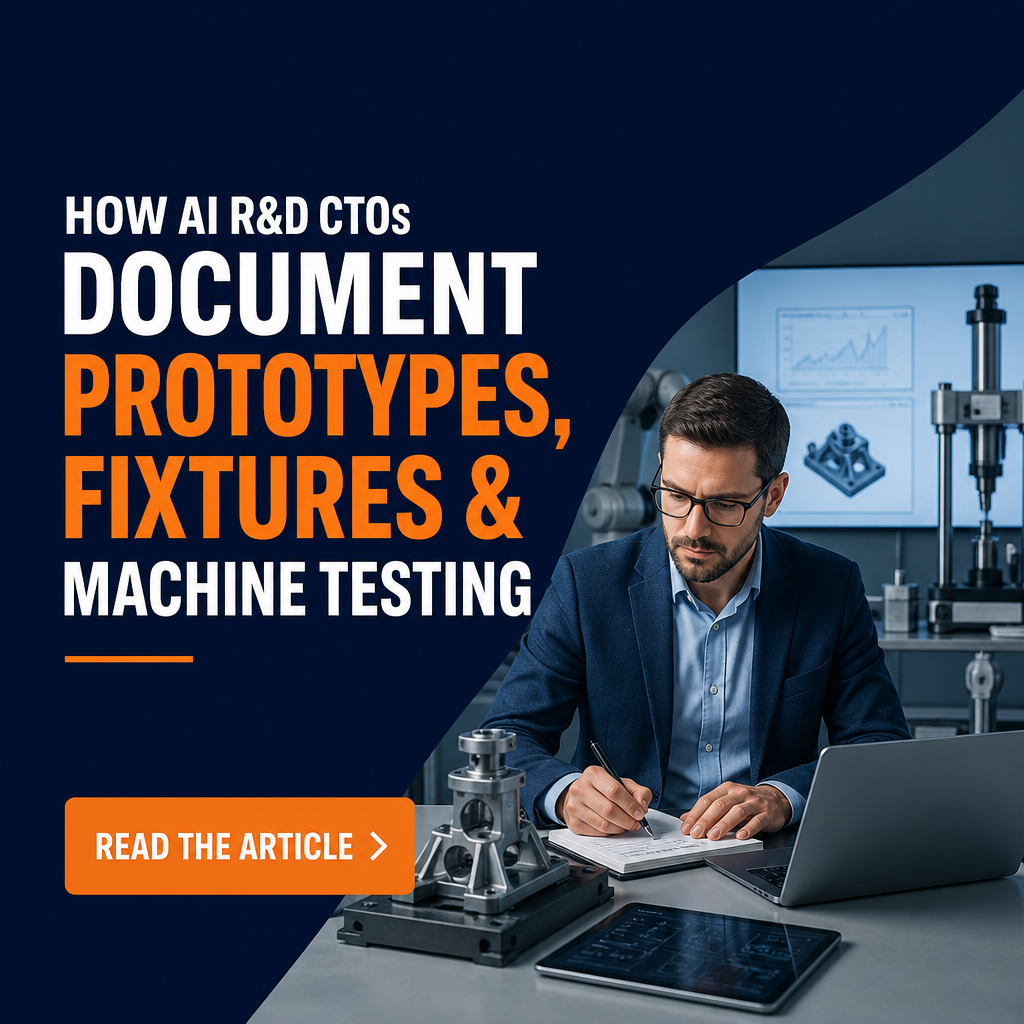
Why prototypes, fixtures, and machine tests are prime R&D Tax Credit evidence:
In industrial machinery and automation, the biggest missed opportunity in R&D Tax Credits is rarely the work—it’s the evidence trail. Many manufacturers, engineering firms, and machine builders run iterative prototype builds, fixture redesigns, and machine testing every week. Those activities often qualify as Qualified Research Activities under the Research and Development Tax Credits rules, yet the supporting records are scattered across engineering notebooks, PLC repositories, test-run spreadsheets, commissioning notes, and emails.
The hook: the problem is not simply “having documents.” The real problem is proving what happened, why it was technically uncertain, what was tested, who participated, and how the supporting records connect to the R&D Tax Credit claim. A defensible claim doesn’t come from a folder of files—it comes from an organized evidence chain that can be reviewed and explained.
This is where an AI R&D CTO (or Virtual CTO / AI Chief Technology Officer) becomes a practical R&D Tax Credit accelerator: not by changing how you engineer, but by continuously capturing, mapping, and organizing what you already do so it becomes audit-ready support for Form 6765 and a CPA-ready R&D Study.
Build the evidence chain (from machine problem to Qualified Research Expenses):
To convert normal technical records into a defensible R&D evidence trail—without turning engineers into documentation clerks—use a repeatable logic model:
business component → technical objective → technical uncertainty → experiment or alternative evaluated → result → employee activity → Qualified Research Expense → supporting document.
Example (custom machine):
– Business component: high-speed carton indexing station
– Technical objective: achieve 60 cycles/min with ±0.2 mm placement repeatability
– Technical uncertainty: whether the actuator/guide/fixture stack-up can maintain stiffness and timing under load
– Experiments evaluated: alternate fixture materials, ribbing pattern, clamp geometry, servo tuning profiles
– Results: version A hit rate issues; version B improved stiffness but introduced vibration; version C met target after controls and fixture changes
– Employee activity: mechanical design, controls programming, test execution, data analysis
– Qualified Research Expenses: W-2 wages, contractor costs (if applicable), and supplies consumed in prototypes/iterations
– Supporting documents: drawing revisions, BOM changes, PLC commits, test logs, failure reports, inspection data
This chain is the core of R&D Tax Credit Services done well: it links Qualified Research Activities and Qualified Research Expenses to contemporaneous documentation in a way that can withstand IRS scrutiny.
Evidence Mapping vs. “document dumping” for compliance defensibility:
Most teams can produce artifacts—CAD files, code, and test results. The differentiator is Evidence Mapping: explicitly tying each artifact to the technical uncertainty it supports.
Document dumping looks like: “Here’s a folder with drawings and test spreadsheets.” That rarely proves the 4-part test elements clearly.
Evidence Mapping looks like:
– Drawing Rev C supports: “fixture deflection reduction experiment” (uncertainty: stiffness under load)
– BOM revision supports: “material change trial” (uncertainty: wear rate vs cycle-time)
– PLC/controls commit supports: “repeatability improvement” (uncertainty: timing jitter)
– Test-run dataset supports: “cycle-time validation” (uncertainty: throughput under constraints)
– Inspection report supports: “tolerance conformance after change” (uncertainty: dimensional stability)
An AI Technology Advisor functioning as an AI Technical Advisor can help structure this mapping so each file has a job to do in the narrative. Human review remains essential—engineers confirm facts; R&D Tax Credit Consultants review eligibility, substantiation, and compliance.

“There will be billions of these agents, across every company and in every imaginable field.”
– Andy Jassy, President and CEO of Amazon
What each record type can corroborate (and what it cannot):
For prototypes, fixtures, and machine testing, these records are especially valuable—when properly anchored:
Engineering drawings & revisions: Strong evidence of iterative design and alternatives considered. By themselves, they may not prove testing occurred or that uncertainty was present—pair them with test notes or failure logs.
BOM revisions & ECO/ECN records: Corroborate material or component substitution during experimentation (supplies and prototype iterations). Alone, they may not show the technical “why”—attach the objective/uncertainty statement.
PLC/controls code history (commits, change logs): Strong evidence of experimentation in machine behavior—timing, repeatability, interlocks, tuning. Alone, code doesn’t prove results—pair with test-run data.
Test-run data (cycle-time, scrap rate, torque curves, vibration readings): Excellent for proving evaluation and outcomes. Alone, spreadsheets can look like production monitoring—tie the dataset to the specific experimental trial.
Commissioning notes & punch lists: Great for demonstrating troubleshooting and iterative fixes during startup (often qualifying when resolving technical uncertainty). Alone, they can read like routine installation—add context on alternatives evaluated.
Failure logs & nonconformance records: Powerful evidence of a technical problem and resolution path. Alone, they may not show experimentation—connect to prototypes, fixture changes, or controls modifications.
Prototype build records & traveler sheets: Corroborate builds, rework, and consumed supplies. Alone, they don’t prove uncertainty—pair with engineering rationale and test outcomes.
When R&D Tax Credit Consultants review claims, they’re not only looking for volume of documentation—they’re looking for coherence: an evidence trail that explains the engineering story.
Scenario: cycle-time miss on a custom machine and how to document it correctly:
Consider a custom automated assembly cell that cannot hit contractual cycle-time targets.
1) Technical objective: reduce cycle-time from 4.2s to 3.5s without increasing defects.
2) Technical uncertainty: whether fixture rigidity, part presentation, and servo acceleration can be increased without deflection, misalignment, or vibration.
3) Experiments/alternatives:
– Fixture redesign: add ribs, change clamp location, switch aluminum to steel insert
– Controls experimentation: servo tuning profiles, motion curves, dwell time adjustments
– Part handling: alternate gripper pads and vacuum settings
4) Results:
– Test A: faster acceleration causes mis-picks
– Test B: fixture stiffening reduces misalignment but increases vibration
– Test C: combined fixture + motion profile meets cycle-time and defect goals
Evidence trail (what you keep):
– Drawings Rev A/B/C and FEA snapshots (if used) to support fixture alternatives
– BOM/ECO notes showing material changes and prototype parts ordered (supplies)
– PLC commit hashes or change logs for tuning iterations
– Test-run datasets with timestamps and configuration labels (A/B/C)
– Failure logs indicating mis-pick frequency during Test A
– Commissioning notes summarizing why each change was attempted
This structure makes it far easier to support an R&D Study and to compute Qualified Research Expenses with confidence.
Scenario: fixture redesign to control deflection and prove experimentation:
Fixture work is frequently qualifying, but often poorly substantiated.
If your fixture is redesigned to control deflection (e.g., a weld fixture causing dimensional drift), your documentation should show:
– The measurable problem (inspection reports, CMM results, SPC charts)
– The uncertainty (unknown whether stiffness, clamp force distribution, or heat distortion dominates)
– Alternatives evaluated (new datum scheme, clamp layout, material changes, ribbing)
– The test method (trial weld runs, measurement plan, repeatability checks)
– Outcome (improved tolerance hold; reduced rework)
When tied back to employee activity and QREs, those records strengthen the R&D Tax Credit claim. They also prevent the common pitfall of the IRS viewing fixture updates as routine tooling—your evidence must demonstrate a process of experimentation and technical uncertainty resolution.
How an AI R&D CTO modernizes R&D Tax Credit documentation (without changing your engineering):
Traditional R&D Tax Credit Services often rely on after-the-fact interviews and manual collection—time-consuming for engineering teams and prone to missing details. An AI R&D CTO approach modernizes the “R&D back office” so documentation is built continuously.
Using sector-informed workflows, an AI R&D CTO can:
– Run structured voice or text interviews with engineers and technicians to capture technical objectives, uncertainties, and experiments while memories are fresh
– Create time-survey prompts that align to projects and iterations, reducing year-end scramble
– Organize and label support-document anchors (drawing revs, PLC commits, test runs, inspection reports) so each artifact is mapped to a specific QRA
– Draft technical narratives for an R&D Study that align to the evidence chain and the 4-part test
– Produce CPA-ready schedules that connect employee activities to Qualified Research Expenses
This is where AI Product Intelligence and an AI Innovation Platform concept can add value specifically for R&D substantiation: not by influencing your products, but by improving how R&D evidence is captured and structured for compliance. The AI Product Strategy lens also helps leadership frame projects with clearer technical objectives and measurable outcomes—making both engineering and R&D Tax Credit claims cleaner.
Importantly, human review remains essential. Engineers validate the technical truth; R&D Tax Credit Consultants validate what qualifies, how QREs are calculated, and whether the final R&D Study is consistent, complete, and defensible.
Turning R&D Tax Credits into a self-funding innovation engine:
When prototype iteration, fixture experimentation, and machine testing are documented with Evidence Mapping, companies can more reliably:
– Identify Qualified Research Activities embedded in daily engineering work
– Calculate Qualified Research Expenses (wages, supplies, and eligible contractor costs)
– Support IRS compliance requirements with contemporaneous documentation
– Increase the likelihood of capturing the full R&D Tax Credit available
For many small and mid-sized manufacturers and automation firms, the payoff is immediate: improved Business Cash Flow through an R&D Tax Credit Refund (where applicable) or reduced tax liability—turning engineering effort into Tax Savings that can be reinvested into AI Product Development planning, talent, and lab/testing capacity. That is the practical promise of Innovation Management tied to funding: FUND your next iteration with the credits generated by the last.
Next step: get world-class R&D evidence discipline with an AI R&D CTO:
SHAIN’s AI R&D CTO positioning is simple: democratize innovation by helping startups and small companies recover R&D Tax Credits while gaining access to technical leadership and innovation intelligence previously available only to large enterprises.
If you want to document prototypes, fixtures, and machine testing in a way that is organized, defensible, and far less disruptive to engineers—learn how an AI R&D CTO can help you build an evidence trail, support your R&D Study, and estimate your potential R&D Tax Credit. Select the button below to get an estimate.