
 - EN
 - EN
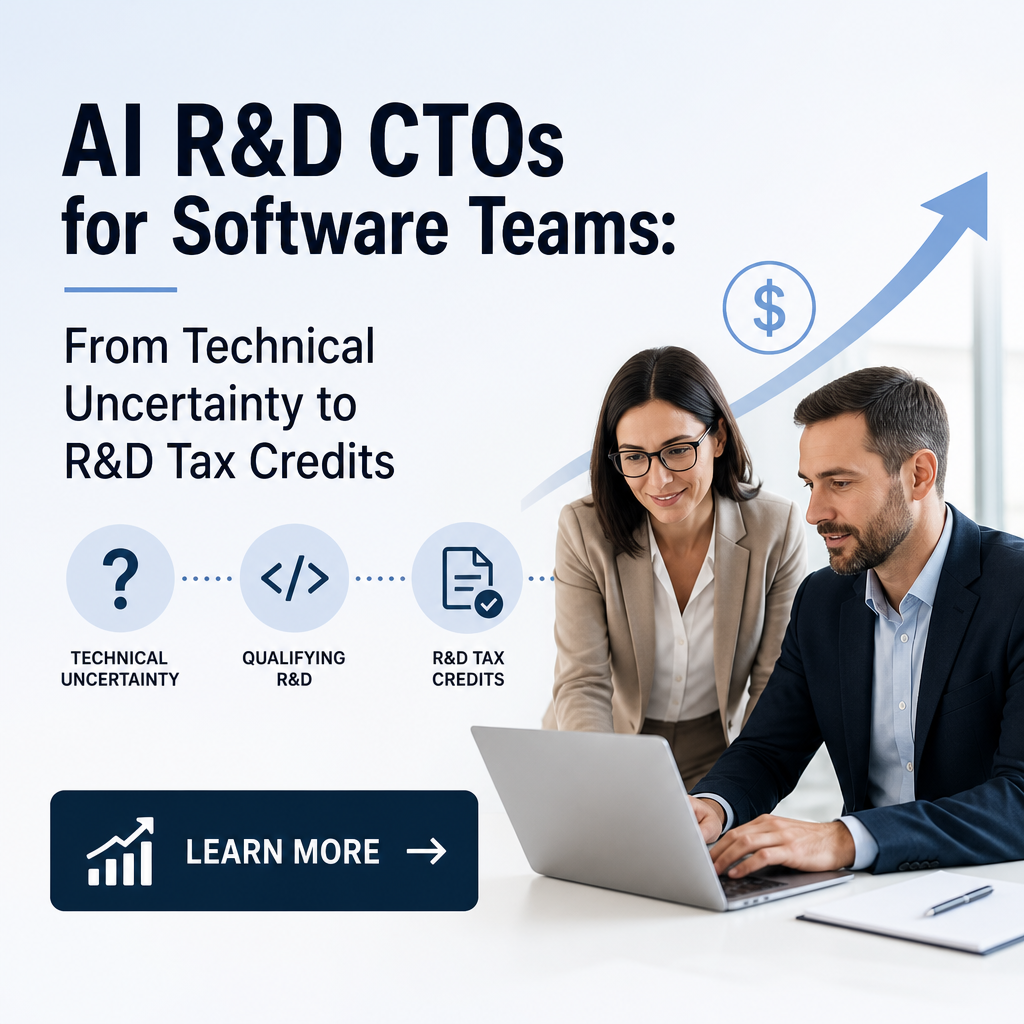
AI R&D CTOs for Software Teams: Turning “We’re Not Sure” Into Fundable Engineering Evidence:
Software teams live in technical uncertainty: will a new architecture actually scale, will an integration remain reliable under real traffic, can an algorithm hit accuracy targets without exploding compute cost, or can security controls be added without breaking performance? An AI R&D CTO operating model is designed for this exact environment—where discovery work is continuous, outcomes are not guaranteed, and experiments happen across sprints.
For many teams, that same uncertainty is also the foundation of R&D Tax Credits. The challenge is rarely whether qualifying work occurred; it’s whether the organization captured it in a way that supports an R&D Tax Credit claim. Historically, companies relied on interviews, after-the-fact narratives, and manual time tracking. Today, an AI R&D CTO—working alongside tax professionals—creates a modern R&D layer that helps software organizations FUND innovation (through R&D Tax Credits), SOLVE technical barriers (through structured technical intelligence), and GUIDE future development (through competitive and technology awareness).
This matters most for startups, SaaS companies, and small-to-mid sized engineering teams that can’t afford a large internal tax department or full-time technical strategy function. The goal is not to replace a CTO, CPA, or R&D Tax Credit consultants. The goal is to reduce the administrative burden, improve precision, and create stronger contemporaneous documentation so accurate R&D Tax Credit eligibility is easier to establish and defend.
1) Capture technical uncertainty in real time across sprints and incidents:
Software R&D rarely looks like lab work; it looks like tickets, pull requests, proofs of concept, benchmark results, incident retrospectives, and architecture decision records. An AI R&D CTO helps teams continuously capture “what we tried, why it was uncertain, and what we learned” so that Qualified Research Activities (QRAs) don’t get lost between releases.
Consider common QRA patterns in software development:
– A SaaS platform redesign to reduce latency and support multi-tenant scale.
– An API and systems integration where data contracts changed repeatedly and required iterative testing to achieve interoperability.
– A cybersecurity engineering initiative to implement new authentication flows, encryption, or threat detection without degrading user experience.
– Data-processing improvements where pipeline consistency, idempotency, and failure recovery required experimentation.
In each case, the technical uncertainty is real: performance thresholds, reliability targets, security constraints, and data correctness may not be achievable with known methods. The AI R&D CTO creates a structured record of hypotheses, constraints, test runs, and outcomes—so the narrative aligns with the reality of engineering work rather than a retroactive summary months later.
This is where the AI Chief Technology Officer mindset differs from traditional documentation. Instead of treating R&D as an annual event, the AI R&D CTO treats it as an always-on operating system that makes R&D Tax Credits easier to support with credible evidence.
2) Map software engineering work to Qualified Research Activities without slowing product delivery:
Software leaders often ask, “Which of our tasks actually qualify?” The answer depends on facts and documentation, but a practical rule is that qualifying work is usually tied to resolving technical uncertainty through a process of experimentation.
An AI R&D CTO (often delivered as a Virtual CTO capability) helps engineering and finance teams translate day-to-day work into QRA-ready categories such as:
– Architecture changes and scalability work (load testing, database sharding decisions, caching strategies).
– Performance tuning and reliability engineering (profiling, concurrency handling, queue backpressure experiments).
– Algorithm development (ranking, matching, anomaly detection) when performance, accuracy, or compute cost required iterative trials.
– Workflow automation and ERP enhancement via integration engineering where edge cases and data reconciliation required repeated testing.
The key is not to label everything “R&D.” It’s to isolate the subset of software development that meets the expectation of technical uncertainty and iterative evaluation. By doing this continuously, teams avoid the year-end scramble where managers try to remember what was experimental versus routine.
This is also where AI Product Intelligence and AI Product Strategy become relevant: as the AI R&D CTO learns patterns of uncertainty across features and subsystems, it becomes easier to forecast where engineering risk will recur—and to create better technical plans, not just better tax documentation.

“We are at the beginning of a very big transition in technology. I think AI is a generation of change.”
– Cristiano Amon, President and CEO of Qualcomm
3) Organize Qualified Research Expenses with an AI-native workflow:
Even when Qualified Research Activities are clear, many companies underclaim because Qualified Research Expenses (QREs) are hard to assemble. Small businesses often skip claims entirely because manual time surveys, contractor allocations, and supply tracking are disruptive. This is where AI has an immediate operational payoff: a trained LLM workflow can help track and organize QREs so claiming becomes feasible without draining engineering time.
Practical ways an AI R&D CTO supports QRE capture include:
– Managing lightweight time survey prompts tied to projects and sprints, reducing reliance on end-of-year estimates.
– Tracking contractor activity against experimental workstreams (integration testing, prototyping, performance benchmarking).
– Aligning eligible cloud, hosting, and test environment usage (where applicable) with the experimental phases and documented trials.
– Regularly engaging teams through structured email or voice-style interview prompts to confirm what changed, what was tested, and who performed the work.
For larger or more complex organizations, this can extend to connecting with project management, ERP, and accounting systems to flag potentially eligible activity in near real time—then routing it for human review. The result is a cleaner bridge between technical work and finance records, which improves accuracy and reduces friction.
Importantly, this doesn’t replace CPAs or R&D Tax Credit Services; it creates a more complete and auditable package that professionals can validate.
4) Produce an audit-ready R&D Study package that matches software reality:
An R&D Study is where engineering facts become a defensible claim. The strongest studies don’t sound like marketing copy; they read like engineering—clear uncertainties, constraints, alternatives evaluated, and results.
An AI R&D CTO helps teams assemble documentation that typically supports R&D Tax Credit claims, including:
– Technical narratives aligned to projects, releases, and major experiments.
– Contemporaneous evidence anchors (design notes, benchmark summaries, test results, change logs).
– Interview outputs and confirmations from technical leads.
– Draft support for Form 6765 inputs (with tax professionals completing and filing).
Below is a simple workflow that makes the process tangible:
| Engineering reality | AI R&D CTO capture layer | R&D Tax Credit output |
|—|—|—|
| A scaling redesign hits latency limits | Voice or written technical interview captures uncertainty, hypotheses, test results | QRA narrative + evidence index |
| API integration fails on edge cases | Iteration log tied to tickets and test runs | Documented experimentation trail |
| Algorithm can’t reach target accuracy | Trial summaries and constraint notes recorded | Technical uncertainty and alternatives |
| Finance needs numbers | QRE organization by people/projects/period | CPA-ready summaries and schedules |
This approach helps smaller companies pursue an R&D Tax Credit Refund (where applicable) or income tax offset with more confidence—while improving Business Cash Flow and Tax Savings outcomes tied to legitimate innovation work.
5) Add the SOLVE and GUIDE layer: technical intelligence that improves product decisions:
R&D Tax Credits are the FUND layer, but software teams also need help breaking through technical barriers and avoiding blind spots.
An AI R&D CTO acts as an AI Technology Advisor and AI Technical Advisor to complement engineering leadership by:
– Surfacing implementation patterns for scalability, data consistency, and reliability.
– Highlighting security and compliance engineering approaches that reduce risk.
– Providing competitive benchmarking signals so teams can compare capabilities, performance expectations, and architecture trends.
– Creating a lightweight “technology radar” so teams don’t stay trapped in their day-to-day bubble.
For SaaS teams, this can mean identifying architectural approaches to reduce operational load, spotting integration standards that lower partner friction, or recognizing testing strategies that reduce regressions. This is not about changing the company’s products through AI. It’s about using AI as an intelligence layer that helps leaders make better technology strategy decisions while the same workflow supports Innovation Management and documentation discipline.
How AI R&D CTOs replace manual R&D Tax Credit preparation without replacing professionals:
Traditional R&D Tax Credit preparation often depends on annual interviews, spreadsheets, and memory. An AI R&D CTO replaces the most failure-prone parts—continuous capture, organization, and drafting—so humans can focus on validation and judgment.
A practical sequence looks like this:
Technical work occurs → AI voice interview or integrated capture records uncertainty and experiments → potential QRA is identified → evidence is anchored to real artifacts → employee activity is confirmed → QRE data is organized → technical barrier themes are analyzed → relevant methods are surfaced for human consideration → R&D Tax Credit Consultants and tax professionals review and finalize.
This is the modernization opportunity: less disruption to engineering, stronger documentation quality, and a clearer line from technical uncertainty to a compliant R&D Tax Credit claim.
Next step: estimate your R&D Tax Credit and level up to world-class execution:
The AI R&D CTO democratizes innovation by helping startups, micro businesses, and small companies recover R&D Tax Credits while gaining access to technical leadership and innovation intelligence previously available only to large enterprises. If your software team is doing architecture changes, algorithm development, integration engineering, data-processing improvements, or cybersecurity work, you may already have Qualified Research Activities and Qualified Research Expenses—you just need a better operating model to capture them.
To learn more about how an AI R&D CTO can enhance knowledge to world-class standards while seamlessly gaining R&D tax credits, and to get an estimate of how much your R&D Tax Credit could be, select the button below.