

 - EN
 - EN
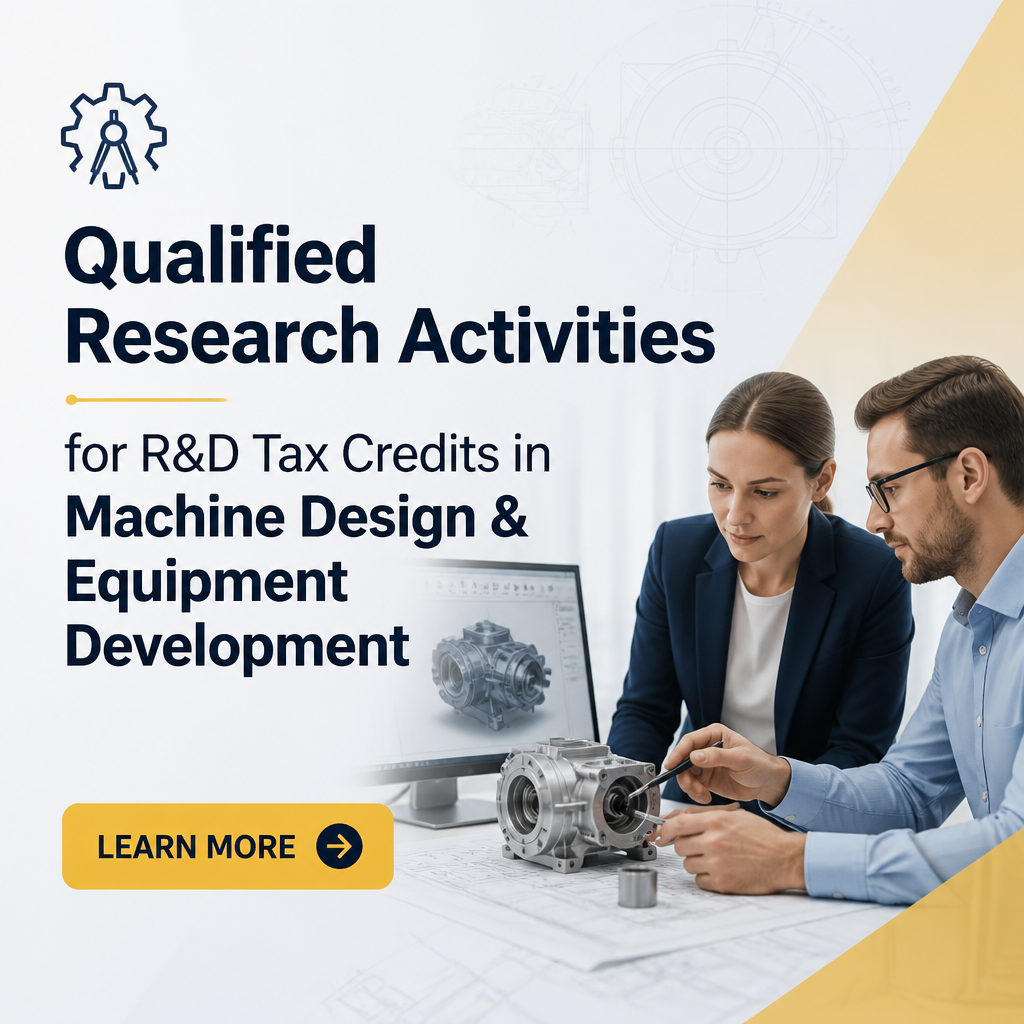
Qualified Research Activities in machine design are identified at the activity level:
For manufacturers, integrators, and engineering firms, Qualified Research Activities (QRAs) aren’t determined by your job title or whether you call a project “R&D.” They’re identified at the activity level and must tie to a specific business component (a machine, subassembly, fixture, controls program, or production cell) and a process of technical experimentation.
In machine design & equipment development, the most valuable Research and Development Tax Credits often come from the engineering work you already do to hit cycle-time targets, improve repeatability, reduce scrap, increase reliability, or integrate automation under real-world constraints. The key is proving the work meets the R&D Tax Credit Four-Part Test—and separating it from routine production or ordinary troubleshooting.
Below are machine-design-specific examples of potentially qualifying activities, the boundary lines where work commonly fails to qualify, and the documentation that supports an compliance-ready R&D Study. We’ll also show how an AI R&D CTO (or Virtual CTO / AI Chief Technology Officer) helps smaller teams capture QRAs and Qualified Research Expenses (QREs) with far less year-end reconstruction.
QRA example: Custom machine that could not meet cycle-time and yield targets:
A classic machine-development QRA is a custom machine that initially cannot achieve required throughput, uptime, or quality metrics. What matters is the technical uncertainty and iterative experimentation—not merely building to a known design.
If your team is experimenting with motion profiles, servo sizing, mechanical stiffness, sensor placement, and PLC logic to achieve a target cycle time, you may have eligible QRAs. Where companies miss the credit: they describe the project as “built a new line” instead of describing the experiments (what failed, what variables changed, what data proved the improvement). R&D Tax Credit Services focus on the activity narrative that explains the technical method.
QRA example: Fixture, jig, and tooling redesign to control deflection and repeatability:
Fixtures and jigs can generate significant QRAs when you are resolving uncertainty about part location, clamping deformation, tolerance stack-up, thermal growth, vibration, or tool wear. The experimentation might include:
– Redesigning clamp geometry to reduce deflection while maintaining access and ergonomics
– Testing alternative materials, surface treatments, or stiffness strategies
– Iterating datum schemes and gauging to improve repeatability
– Running measurement studies to validate improvements (Cpk, GR&R, repeatability)
Four-Part Test mapping:
– Qualified Purpose: improved quality and consistency of a manufacturing process via improved tooling (business component).
– Technical Uncertainty: uncertainty about how to achieve tolerances without distorting the part.
– Process of Experimentation: prototype fixtures, test cuts, inspection results, revisions.
– Technological in Nature: mechanical engineering and manufacturing engineering principles.
Boundary reminder: duplicating an existing fixture, simple resizing without uncertainty, or routine replacement due to wear typically does not qualify as Qualified Research Activities.

“AI is only a technology. The value comes from reinvention of how we work, our workforces and the tools we use.”
– Julie Sweet, Chair and CEO of Accenture
QRA example: Controls, PLC logic, and automation experimentation to improve repeatability:
Controls work can qualify when it goes beyond routine configuration and involves experimentation to overcome technical uncertainty—especially in automation, robotics, and safety-constrained systems.
Potentially qualifying activities include:
– Developing and testing PLC logic to reduce cycle-time variability
– Experimenting with sensor fusion, filtering, debounce strategies, or vision triggers to improve repeatability
– Tuning servo loops or robot paths where the optimal parameters are not known in advance
– Implementing and validating fault-recovery logic that improves uptime without introducing safety or quality risk
This is often where “ordinary debugging” gets confused with experimental development. Debugging qualifies when it’s part of a broader uncertain technical effort (e.g., achieving stable performance under noisy sensor conditions). It usually does not qualify when it’s routine commissioning, standard IO mapping, or applying a known recipe.
If you pursue Research and Development Tax Credits for controls work, your technical narrative should emphasize hypotheses, test conditions, and measured outcomes—not just that “we programmed the PLC.”
QRA example: Mechanical redesign for reliability engineering and harsh environments:
Reliability-driven redesign can qualify when you face uncertainty about failure modes and must experiment to reach durability targets. Common machine-design scenarios include:
– Redesigning a mechanism after fatigue cracks or bearing overheating under real duty cycles
– Experimenting with lubrication methods, seals, cooling, or materials to survive contamination
– Iterating structural members to reduce resonance and vibration-induced failures
– Prototyping and testing guarding or enclosures that must balance safety, maintainability, and thermal constraints
Four-Part Test mapping:
– Qualified Purpose: improved reliability or performance of the equipment.
– Technical Uncertainty: uncertainty about the root cause and best design path to resolve it.
– Process of Experimentation: failure analysis, prototype redesigns, test stands, accelerated life testing.
– Technological in Nature: engineering sciences (mechanical/materials).
These activities frequently produce strong support for an R&D Study because they generate failure logs, inspection reports, and test-run data—exactly the kind of evidence that anchors the story.
Shorter machine-design QRAs that often qualify (when uncertainty + experimentation are present):
In industrial machinery and equipment development, additional Qualified Research Activities may exist in:
– Throughput improvements: experimenting with buffer sizing, conveyor accumulation logic, or pick-and-place timing where the optimal design is not known.
– Prototype equipment builds: early-stage prototypes used to validate kinematics, stiffness, heat, or control stability.
– Commissioning under novel constraints: experimentation to achieve stable operation with new materials, higher speeds, or tighter tolerances.
– Sensor and metrology integration: trialing measurement methods to achieve in-line inspection accuracy.
– Safety + performance tradeoffs: experimenting to meet functional safety while maintaining cycle time.
The pattern is consistent: technical uncertainty, iterative testing, and measurable evaluation tied to a business component.
The boundary: Activities in equipment development that should not automatically be treated as QRAs:
A strong R&D Tax Credit claim draws a clear line between experimental development and routine work. Common non-qualifying or higher-risk activities (depending on facts) include:
– Routine production and standard fabrication after the design is finalized
– Simple configuration using vendor manuals without uncertainty (standard drive setup, known recipe deployment)
– Cosmetic or aesthetic changes that don’t affect performance (paint, covers, branding)
– Ordinary maintenance, repairs, and replacement-in-kind
– Routine QA inspection not tied to experimentation
– Basic troubleshooting that resolves known issues without iterative testing
This doesn’t mean these tasks are “bad”—only that they usually don’t satisfy the Four-Part Test. The easiest way to lose Tax Savings is to over-include routine time, which can weaken an otherwise strong R&D Study.
Evidence should follow the activity: Documentation that strengthens your R&D Study:
Support documents don’t replace the technical explanation, but they make it credible and auditable. For machine design and equipment development, useful contemporaneous documentation often includes:
– Engineering drawings and revision histories
– BOM revisions and change orders tied to test outcomes
– PLC/controls code change logs (or version history) and commissioning notes
– Test-run data: cycle-time studies, yield/scrap reports, downtime logs
– Failure logs, inspection reports, NCRs, and root-cause analysis summaries
– Prototype build notes, photos, and trial records
– Supplier quotes and material substitutions linked to experimentation
In an IRS-ready R&D Study, these artifacts are mapped to specific QRAs and business components, then connected to Qualified Research Expenses—employee wages, contractor costs (where eligible), and supplies consumed during prototyping and trials.
From QRAs to QREs: Turning engineering work into an R&D Tax Credit Refund:
Once QRAs are identified, the claim must quantify Qualified Research Expenses. For machine builders, this usually means:
– Wages: the time engineers, designers, controls specialists, and technicians spend on qualifying experimentation
– Supplies: materials consumed in prototypes, test articles, and trial builds (not depreciable capital equipment)
– Contractors: certain third-party engineering or testing costs (subject to rules)
A disciplined approach ties time and costs to each business component and its experimental activities. This reduces friction in preparing Form 6765 and helps substantiate the R&D Tax Credit.
For many small and mid-sized businesses, the outcome is meaningful Business Cash Flow improvement—sometimes as a current-year offset, sometimes as an R&D Tax Credit Refund (including payroll tax offsets for qualified startups), depending on facts. Done well, these incentives can become a recurring source of Innovation Funding that supports ongoing equipment development.
How an AI R&D CTO replaces manual year-end reconstruction:
Traditional R&D Tax Credit Services often rely on year-end interviews and retroactive project reconstruction. That approach can miss QRAs, weaken narratives, and burden engineers.
An AI R&D CTO—operating as a Virtual CTO, AI Technology Advisor, and AI Technical Advisor—acts as the capture mechanism throughout the year. Using sector-aware prompts and structured intake, the AI R&D CTO helps teams:
– Identify Qualified Research Activities closer to when they occur (while details are fresh)
– Map activities to business components and the Four-Part Test
– Conduct technical interviews consistently across mechanical, controls, and automation disciplines
– Generate draft technical narratives and organize supporting documents into an audit-ready structure
This is also where AI Product Intelligence and an AI Innovation Platform conceptually support better Innovation Management: by standardizing how technical uncertainty, experiments, and outcomes are recorded, leadership gains clearer visibility into what engineering is learning and where technical barriers persist—without changing the company’s products or processes. In parallel, the same structured records improve precision when calculating Qualified Research Expenses and assembling an R&D Study.
Learn more: Turn your R&D Tax Credit into a self-funding innovation engine:
SHAIN’s AI R&D CTO positioning is built around democratizing innovation for startups and small to mid-sized companies: stronger technical leadership and AI Product Strategy guidance paired with high-precision R&D Tax Credits capture.
If you design machines, fixtures, automation, or prototype equipment, you may be conducting qualifying R&D every year without realizing it. To learn how an AI R&D CTO can enhance knowledge to world-class standards while seamlessly gaining R&D tax credits—and to obtain an estimate of how much your R&D Tax Credit can be—select the button below.