

 - EN
 - EN
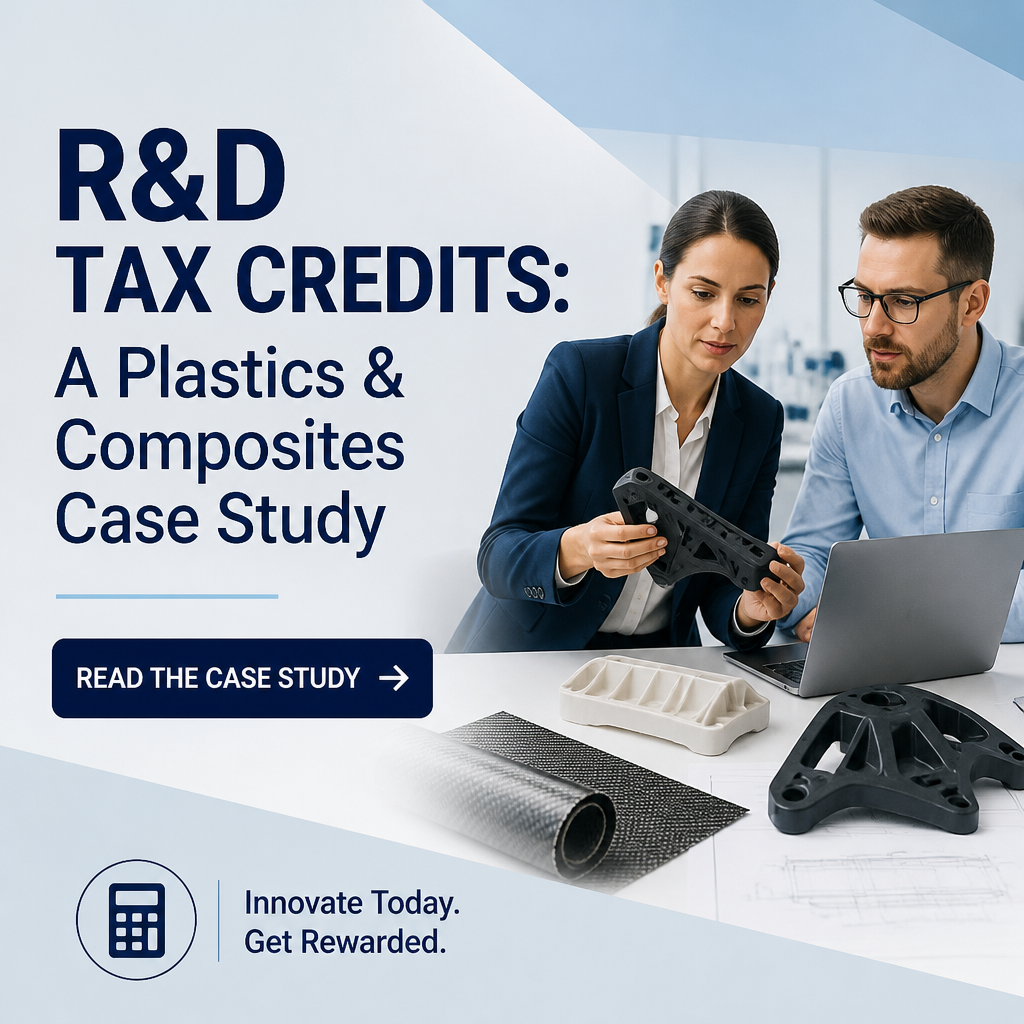
Here’s how Plastics & Composite Manufacturers Qualify:
Plastics and composites companies often perform real experimentation in the course of solving manufacturing and material-science problems—yet many still miss Research and Development Tax Credits because the work isn’t documented or classified correctly. This case study-style walkthrough shows how a typical plastics/composites manufacturer may generate eligible R&D Tax Credits when projects involve technical uncertainty, systematic testing, and measurable technological advancement.
A common misconception is that “R&D” only happens in a lab. In reality, composite layup changes, resin system trials, tooling modifications, and cycle-time optimization can qualify as Qualified Research Activities when the statutory requirements are met. The goal is not perfection in paperwork—it’s a defensible story supported by evidence, expenses, and a clear link between the work performed and the technical uncertainty resolved.
This is also where an AI R&D CTO (including a Virtual CTO or AI Chief Technology Officer) increasingly supports smaller organizations: combining Innovation Management discipline with R&D Tax Credit Services that make the claim easier to prepare, easier to support, and more likely to be maximized.
Identifying Qualified Research Activities in Plastics & Composites Manufacturing:
Consider a mid-sized manufacturer developing a lightweight composite enclosure for industrial equipment. The business objective is a 30% weight reduction while maintaining structural strength, impact resistance, dimensional stability, and surface finish. The team cannot readily determine the appropriate material formulation and manufacturing process combination using existing knowledge. That gap is the starting point for Qualified Research Activities.
In plastics and composites, qualifying work frequently appears in:
• Material formulations (resin systems, additives, reinforcement content)
• Fiber orientation, layup schedules, and reinforcement placement
• Molding parameters (temperature, pressure, injection speed, hold time)
• Curing conditions (cure temperature/time profiles, post-cure processes)
• Warpage, shrinkage, delamination, bonding, and surface finish challenges
For R&D Tax Credits, the work must be tied to resolving uncertainty through a process of experimentation, generally aimed at improving function, performance, reliability, or quality of a business component (product, process, technique, formula, or invention). When a manufacturer is iterating prototypes, scrapping failed test parts, running trials, and analyzing results, the core pattern often aligns with the intent of the credit—if captured correctly.
Documenting Technical Uncertainty and the Process of Experimentation:
In this case, the initial technical uncertainty is clear: the team cannot predict whether the target weight reduction can be achieved without unacceptable warpage, surface defects, or failed impact testing.
A credible R&D narrative usually reads like engineering reality—failures included:
• Test 1: Weight target achieved, but warpage after cooling exceeds tolerance.
• Test 2: Warpage reduced by adjusting cooling rates, but cycle time becomes commercially impractical.
• Test 3: Alternative resin/fiber ratio improves dimensional stability but causes surface defects.
• Test 4: Revised tooling geometry improves surface quality but fails impact resistance.
• Test 5: Modified fiber orientation + adjusted cure profile meets combined performance targets.
This sequence matters because it demonstrates alternatives evaluated and learning over time. In an R&D Study, the strongest support comes from contemporaneous technical evidence such as mold parameter sheets, material specifications, test reports, failure analysis notes, photos of defects, prototype build records, CAD changes, and meeting notes that show decisions made based on test results.
For many claimants, the missing step is not the engineering—it’s organizing the evidence into a coherent, audit-ready story that shows how the project meets eligibility requirements.

“Thirty years of change is being compressed into three years!”
– Satya Nadella, Chairman and CEO of Microsoft
Separating Routine Production from Qualified Research for Compliance:
A high-quality R&D Study clearly distinguishes qualified experimentation from routine manufacturing. Plastics and composites operations often contain both in the same facility, so the boundary must be explicit.
Potential Qualified Research Activities may include:
• Developing or significantly improving material formulations
• Trialing molding and curing parameter sets to resolve performance uncertainty
• Prototyping, piloting, and iterative testing of alternative tooling designs
• Failure analysis (root cause of warpage, delamination, surface defects)
• Mechanical and environmental testing tied to design decisions
Activities that are commonly non-qualifying (depending on facts) include:
• Standard production runs after uncertainty is resolved
• Routine quality inspections and standard machine setup
• Ordinary customer customization that does not require experimentation
• Replicating an existing product/process without technological uncertainty
This separation is more than theory: it impacts what costs can be included as Qualified Research Expenses. Many companies overclaim by including routine production costs; others underclaim by excluding legitimate prototype trials and testing time. R&D Tax Credit Consultants and well-scoped R&D Tax Credit Services focus on building a defensible claim—not just a big number.
Calculating Qualified Research Expenses: Wages, Supplies, and Contractors:
Once Qualified Research Activities are identified, the next step is measuring Qualified Research Expenses. In plastics and composites, QREs often extend beyond engineering wages because experimentation consumes real materials.
Typical QRE categories include:
• Wages: engineers, process engineers, quality engineers, technicians directly supporting experimentation, and some supervisory support when directly connected to qualified work
• Supplies: resins, fibers, reinforcement materials, additives, prototype components, test specimens, and scrapped experimental parts used in trials
• Contract research: outside labs for mechanical testing, specialized material analysis, or prototype tooling support (when structured appropriately)
This is where many companies either miss value (by failing to track supplies used in trials) or create risk (by claiming standard production materials). A strong approach ties each expense category back to specific experimentation phases and supporting records, making the R&D Tax Credit Refund more sustainable.
Done correctly, R&D Tax Credits can become a practical source of Tax Savings that improves Business Cash Flow—especially important for manufacturers balancing capex, tooling costs, and fluctuating material prices.
How an AI R&D CTO Replaces Manual R&D Tax Credit Preparation in This Sector:
Traditional R&D Tax Credit preparation can be heavily manual: interviews, spreadsheets, after-the-fact narratives, and document hunts. In plastics and composites—where parameter changes and trial outcomes move fast—manual methods often miss key details.
An AI R&D CTO supports a modern workflow that is purpose-built for R&D Tax Credit claims while also acting as an AI Technology Advisor and AI Technical Advisor to strengthen technical clarity. Using sector-aware R&D Tax Credit Intelligence, the AI R&D CTO helps smaller companies:
• Identify Qualified Research Activities by mapping real shop-floor experimentation to eligibility criteria
• Calculate Qualified Research Expenses by structuring wage, supply, and contractor inputs around experimental phases
• Create time surveys and conduct technical interviews with repeatable prompts that capture uncertainty, alternatives, and results
• Generate an R&D Study with consistent language that aligns to compliance expectations and documentation standards
• Support IRS compliance requirements with an evidence map that ties people, projects, tests, and files together
Because this support is focused on the R&D Tax Credit—not the company’s proprietary products or processes—it helps teams capture the “why” behind technical decisions (uncertainty and experimentation) without disrupting Product Development. The same structure also strengthens Innovation Management by giving leaders a clearer view of where technical barriers occurred, what was tried, and what worked.
For organizations without a full-time CTO, the AI R&D CTO can also function as a Virtual CTO or AI Chief Technology Officer layer—improving technical decision-making and keeping projects aligned to an AI Product Strategy mindset: define the uncertainty, test the alternatives, capture the learning, and translate it into both better outcomes and stronger credit support.
Turning R&D Tax Credits into a Self-Funding Innovation Engine for Plastics & Composites:
In this case study, the manufacturer’s experimentation produced a viable enclosure and also created a strong foundation for a defensible R&D Tax Credit claim. The larger takeaway is strategic: when credits are captured consistently, the refund (or offset) can be reinvested into tooling iterations, testing capacity, and faster AI Product Development cycles across future projects.
This is how smaller firms level the playing field. Large manufacturers have tax departments, documentation processes, and technical leadership bandwidth. With an AI R&D CTO and an AI Innovation Platform approach to structuring evidence and decision trails, smaller teams can access similar discipline without building a large internal function.
The result: improved Business Cash Flow, reduced effective innovation cost, and more confidence pursuing higher-value technical challenges.
See How an AI R&D CTO Can Maximize Your Credit and Upgrade Technical Leadership:
If your team is iterating material formulations, adjusting molding or curing parameters, redesigning tooling, or running prototype trials, you may already have Qualified Research Activities—and unclaimed R&D Tax Credits.
Learn more about how an AI R&D CTO can enhance knowledge to world-class standards while seamlessly gaining R&D Tax Credits, and get an estimate of how much your R&D Tax Credit could be by selecting a button below.