

 - EN
- EN  - EN
- EN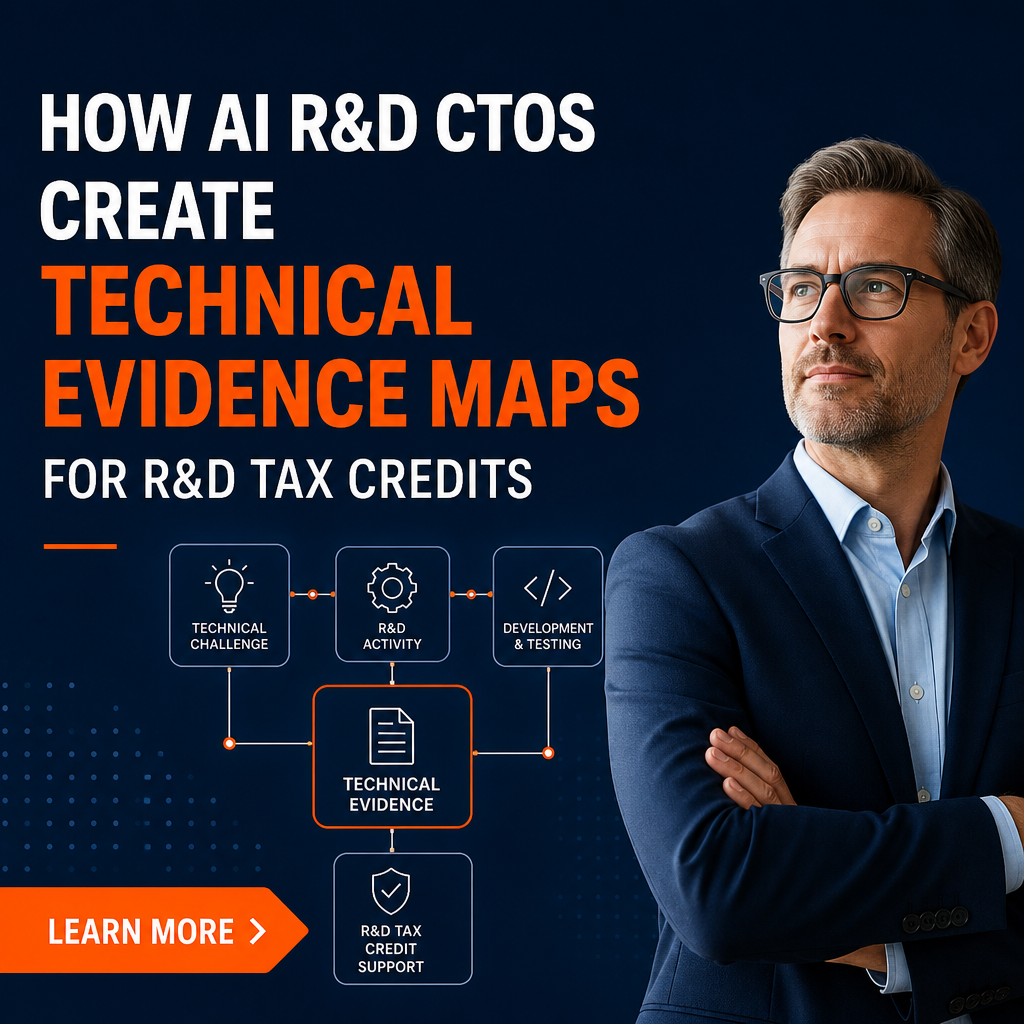
Technical Evidence is a Key Part of R&D Tax Credit Claims:
Most companies don’t fail to claim R&D Tax Credits because they lack innovation—they fail because they can’t prove it efficiently. By year-end, teams often face a familiar problem: plenty of artifacts exist (Jira tickets, Git commits, test results, drawings, prototypes, emails, experiment logs, specifications, and technical reports), but the R&D Study still becomes a scramble. The issue isn’t evidence volume; it’s evidence linkage.
That’s why SHAIN formalizes the Evidence Map: a repeatable structure that connects real technical work to a compliant Research and Development Tax Credits narrative. Rather than handing an advisor “500 documents from our engineering folder,” an Evidence Map answers a more important IRS-ready question: what does this document support?
An AI R&D CTO supports this process continuously—improving R&D Tax Credit readiness while strengthening Innovation Management and AI Product Strategy decisions without building a large internal team.
Define the SHAIN Evidence Map (Don’t Collect R&D Documents—Connect Them):
SHAIN’s Evidence Map is built around a simple idea: every piece of technical evidence should trace back to a specific technological uncertainty and experimental path.
For each R&D business component, the Evidence Map connects:
Technical uncertainty ↓ Experimental activity ↓ Employee / technical team ↓ Date or development period ↓ Supporting evidence ↓ Test/result ↓ R&D Tax Credit narrative
This approach improves both speed and precision in R&D Tax Credit Services because it turns scattered artifacts into a coherent story. It also supports stronger compliance requirements by showing contemporaneous documentation—what was tried, who did it, when, and what was learned.
Crucially, the philosophy is compliance-first: AI shouldn’t determine eligibility from documents alone. A Jira ticket or Git commit does not automatically equal Qualified Research Activities. Instead, employees explain the R&D; the AI R&D CTO structures the activity record; evidence corroborates it; and humans confirm the final R&D Tax Credit position.
Identify Qualified Research Activities with the 4-Part Test Anchored to Uncertainty:
The fastest way to miss R&D Tax Credit eligibility is to start with documents instead of uncertainties. Effective R&D Tax Credit Consultants begin by clarifying what technical uncertainty the team faced and what advancement was sought.
An AI R&D CTO supports smaller companies by systematically surfacing potential Qualified Research Activities (QRAs) across engineering, software, manufacturing, and applied science workstreams, then organizing interviews and prompts around the 4-part test (permitted purpose, technical uncertainty, process of experimentation, and technological in nature).
This is especially valuable for startups and small businesses where Product Development happens fast and documentation is created for delivery—not for tax. The Evidence Map approach makes the R&D narrative easier to verify: each claimed activity ties to a specific uncertainty, an experimental plan, iterations, failures, and learnings.

“Firms that understand how to use AI as a new tool in the broader context of process reengineering will arguably get the most from AI in the long run.”
– Harvard Business Review
Map Qualified Research Expenses to People, Time, and Experimentation:
Once QRAs are identified, the next challenge is building defensible Qualified Research Expenses (QREs). Many businesses underclaim because tracking time and effort feels too burdensome, while others overreach because they approximate without support.
An AI R&D CTO strengthens Business Cash Flow outcomes by helping teams:
– Separate qualifying versus non-qualifying workstreams
– Organize wage allocation logic tied to roles and experiments
– Capture contractor and supply usage linked to experimental trials
– Maintain consistent time surveys supported by project artifacts
This approach can materially improve Tax Savings and the likelihood of an R&D Tax Credit Refund (where applicable), because QREs are no longer detached spreadsheets—they’re supported by mapped evidence and verified by technical interviews.
Create a Defensible R&D Study Using Evidence Maps :
A traditional R&D Study often looks like this: year ends → interview engineers → search folders → reconstruct what happened → write narratives → hope the support exists.
Evidence Mapping flips the workflow: R&D occurs → activity is captured → evidence is connected → results are logged → humans confirm throughout the year.
In practice, that means your R&D Tax Credit Services process produces a study where each claim element is backed by a clear chain of support. Instead of asking, “Can we find evidence supporting what happened 11 months ago?” you ask, “Is the Evidence Map we’ve been building complete?”
For companies using R&D Tax Credit Consultants, this structure reduces interviews, reduces rework, and increases confidence that narratives align with real work performed.
Sector-Specific Evidence Maps (Software, Electronics, Manufacturing, Medical Devices):
The Evidence Map is not software-specific; the structure stays the same (Uncertainty → Experiment → Evidence → Result), but the artifacts differ by industry.
Software / AI:
Jira → GitHub/Bitbucket → architecture diagrams → benchmark results → test logs → model evaluations.
PCB / Electronics:
PCB revisions → stencil parameters → X-rays → inspection results → reflow profiles → test reports → failure analysis.
Machining / Industrial:
CAD/CAM revisions → CNC programs → tooling changes → CMM results → scrap records → parameter sheets → test parts.
Medical devices:
Prototype revisions → design inputs → test protocols → verification results → failure reports → engineering change records.
This is where an AI Technology Advisor perspective matters: the AI R&D CTO helps teams translate technical work into consistent claim-ready evidence—without forcing every department into a one-size-fits-all template.
Concrete Example: From Distributed Systems Experiment to IRS-Ready Evidence:
Consider a software company working on distributed transaction consistency.
– Technical barrier: Maintaining consistency across asynchronous services.
– Experiment: Implementing a transactional outbox architecture.
– Employee: Senior developer and supporting QA engineer.
– Period: March–April 2026.
– Evidence: Jira ticket, architecture diagram, Bitbucket commits, load-test logs, and engineering discussion.
– Result: Reduced one failure mode but introduced unacceptable processing latency.
– Next experiment: Alternative event-processing architecture.
Notice what changed: the documents aren’t just attachments. They tell a coherent technical story that supports Qualified Research Activities, clarifies which employees contributed, and substantiates why the work reflects experimentation rather than routine development.
How an AI R&D CTO Automates and Facilitates R&D Tax Credit Claims:
An AI R&D CTO modernizes the R&D Tax Credit workflow by building Evidence Maps continuously and reducing manual reconstruction. When paired with a Virtual CTO model, the organization gains ongoing technical leadership plus structured tax credit readiness.
R&D Tax Credit Intelligence support includes:
– Identifying Qualified Research Activities (QRAs)
– Calculating Qualified Research Expenses (QREs)
– Establishing R&D Tax Credit eligibility
– Conducting technical interviews and producing time surveys
– Producing R&D Studies and supporting Form 6765 preparation
– Creating contemporaneous documentation aligned to compliance expectations
– Maximizing available R&D Tax Credits to improve Business Cash Flow
At the same time, the AI R&D CTO brings selective “CTO-grade” capability—AI Product Intelligence, AI Innovation Platform thinking, and AI Product Strategy framing—so teams can benchmark approaches, overcome technical barriers, and strengthen Innovation Management decisions. The outcome is a more level playing field: smaller companies gain both innovation incentives and stronger technical direction without the cost of building large internal teams.
Turn Your R&D Tax Credit into a Self-Funding Innovation Engine:
R&D Tax Credits can do more than reduce tax—they can fund the next cycle of Product Development. SHAIN’s position is clear: the AI R&D CTO democratizes innovation by helping startups, micro businesses, and small companies recover R&D Tax Credits while gaining access to technical leadership and innovation intelligence previously available only to large enterprises.
If you want to see how an AI R&D CTO can enhance knowledge to world-class standards while seamlessly gaining R&D tax credits, request an estimate of how much your R&D Tax Credit could be by selecting a button below.