

 - EN
- EN  - EN
- EN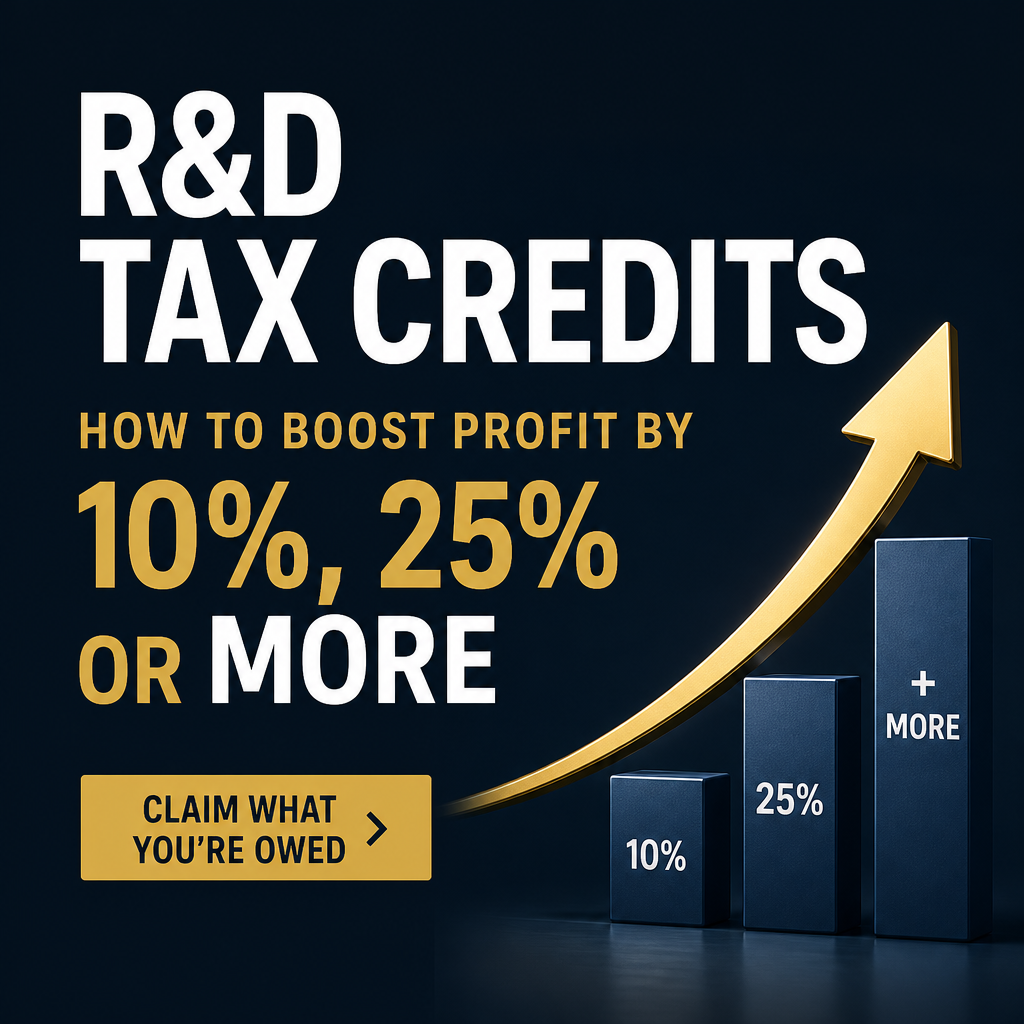
Attention CFOs: One of the Most Advantageous Ways to Boost Profits by 10%, 25%, or 100%:
R&D Tax Credits are often described as a percentage of spending recovered. That framing is true—but it misses the more practical CFO question: “What does this do to my bottom line?”
Here’s the key insight: the same economic tax benefit can have radically different significance depending on your existing profit base. A $50,000 R&D Tax Credit is always $50,000 of potential tax savings (subject to limitations), but its *relative* impact is determined by a simple relationship:
R&D Tax Credit benefit ÷ existing profit = potential impact on profitability.
Consider this illustrative economic comparison:
• Company A: Profit before benefit = $500,000; Benefit = $50,000 → potential incremental effect = 10% of starting profit.
• Company B: Profit before benefit = $200,000; Benefit = $50,000 → potential incremental effect = 25%.
• Company C: Profit before benefit = $50,000; Benefit = $50,000 → potential incremental effect = 100%.
The credit didn’t change. The company’s profit base did. This is why smaller and mid-sized businesses—often reinvesting heavily into Product Development, engineering, prototypes, and testing—can feel a disproportionately large boost from Research and Development Tax Credits.
To capture that benefit, you need a defensible claim rooted in Qualified Research Activities, supported by Qualified Research Expenses, and packaged as a well-documented R&D Study. The rest of this article outlines the claim-building activities that most directly drive profitability impact.
Identify Qualified Research Activities (QRAs) that actually meet the 4-part test:
Most missed R&D Tax Credits aren’t missed because companies “didn’t do R&D.” They’re missed because qualifying work was never translated into eligible-aligned language and structure.
A practical way to start is to inventory initiatives that involved technical uncertainty and a systematic process to resolve it. For many software companies, manufacturers, engineering firms, and technology businesses, Qualified Research Activities commonly include:
• Designing or improving performance, reliability, scalability, or security of software or systems
• Developing prototypes, pilot builds, or new production methods
• Experimenting with materials, tolerances, or manufacturing parameters
• Building and testing algorithms, data pipelines, or novel technical architectures
• Iterative testing to achieve measurable improvements (speed, cost, yield, accuracy, uptime)
Strong Innovation Management matters here: you’re not just listing projects—you’re showing the “why” (uncertainty), the “how” (experimentation), and the “what changed” (technological advancement). That narrative discipline is what turns real engineering work into defensible eligibility.
Calculate and substantiate Qualified Research Expenses (QREs) to unlock real Tax Savings:
Once eligibility is established, profitability impact comes from measuring the right cost base. Qualified Research Expenses generally include:
• Wages: the portion of employee time spent performing, supervising, or supporting qualified research
• Contractor costs: eligible portions of third-party research under appropriate arrangements
• Supplies: tangible items used in experimentation or prototyping (where applicable)
The most common profit-leak is undercounting wages because time was never tracked in a credit-friendly way. If your organization is busy, you may default to rough estimates. The result: smaller credits, less Business Cash Flow, and reduced capacity to reinvest.
A disciplined QRE approach aligns technical work with cost documentation: role-by-role mapping, project-by-project breakdown, and support that can withstand questions later. When the claim is well measured, an R&D Tax Credit Refund (or a reduction in tax liability) becomes less speculative and more plan-able—something leadership can factor into hiring, runway, and product roadmap decisions.

“Data extraction automation from unstructured data and conversion into structured and usable data, AI has tangibly amplified extracting data with high accuracy.” -Dr. Jeremy Nunn – Forbes Technology Council
Build an R&D Study that connects technical uncertainty to financial benefit:
An R&D Study is where engineering reality becomes tax-credit reality. It typically synthesizes:
• Project narratives describing technical uncertainties and experimentation
• How the work meets the 4-part test (permitted purpose, uncertainty, process of experimentation, technological in nature)
• The cost methodology for QREs and supporting schedules
• Contemporaneous documentation references (tickets, test results, design reviews, repo notes, lab logs, build sheets)
Well-built R&D Tax Credit Services don’t treat the R&D Study as a generic report. They treat it as the bridge between your technical team and IRS expectations.
This is also where the “10%, 25%, or more” profit concept becomes operational. If your business is operating on thinner margins, a properly supported R&D Tax Credit can create an outsized relative improvement—because the credit reduces taxes and can improve cash position. And improved cash position can extend runway, reduce dilution pressure, or accelerate the next development cycle.
Separate accounting profit from cash flow—and plan for the R&D flywheel:
Profitability impact is real, but it’s important to distinguish:
• Tax savings / cash benefit: The R&D Tax Credit generally offsets income tax liability. Certain eligible qualified small businesses may be able to make a payroll tax election, which can turn the credit into a more immediate cash-flow benefit.
• Financial-statement profit: The accounting presentation can differ from cash impact, depending on your tax situation, valuation allowances, and timing.
What matters for operators is how the credit changes decision-making capacity. When claimed consistently, Research and Development Tax Credits can support a compounding “innovation flywheel”:
R&D investment → R&D Tax Credit → improved cash position → more R&D investment → better products → growth → more R&D.
This is why the same credit amount can be “nice” for a high-margin company but “transformative” for a reinvesting business. The smaller the existing profit base, the larger a meaningful R&D Tax Credit can appear relative to the bottom line—even though the credit itself didn’t grow.
How an AI R&D CTO replaces manual claim prep with R&D Tax Credit Intelligence:
Traditional R&D Tax Credit claims can be manual, interview-heavy, and dependent on after-the-fact reconstruction—especially when documentation wasn’t created with credits in mind. This is where an AI R&D CTO model changes the workflow.
An AI R&D CTO—working as a Virtual CTO and AI Technology Advisor—focuses specifically on R&D Tax Credit Intelligence and claim readiness. The goal is not to change your products or processes, but to streamline how you identify, describe, and support qualified work for tax purposes.
In practice, an AI R&D CTO can help smaller companies:
• Identify Qualified Research Activities (QRAs) with higher precision by mapping initiatives to the 4-part test
• Calculate Qualified Research Expenses (QREs) with clearer wage, contractor, and supply allocation logic
• Establish R&D Tax Credit eligibility with consistent definitions across teams
• Create R&D Studies with stronger technical narratives and tighter linkage to documentation
• Generate technical documentation packages that align with IRS compliance expectations
• Conduct technical interviews more efficiently and consistently across stakeholders
• Produce time surveys and reduce administrative drag on engineers
• Support Form 6765 preparation by ensuring inputs are organized, traceable, and review-ready
Beyond the credit, this same AI R&D CTO posture supports AI Product Strategy and AI Product Intelligence at a leadership level—helping teams benchmark technical approaches, surface technical barriers, and improve decision quality through better Innovation Management. The role also acts as an AI Technical Advisor and AI Technology Advisor, complementing leadership without the cost of building large internal teams.
For many businesses, the result is straightforward: less time spent reconstructing the past, stronger support for the claim, and a more repeatable annual process that turns the R&D Tax Credit into a self-funding innovation engine.
Next steps: estimate your R&D Tax Credit and level up with an AI R&D CTO:
If you’re investing in AI Product Development, engineering iteration, prototyping, testing, or technical problem-solving, there’s a strong chance you have Qualified Research Activities you’re not capturing—or you’re capturing them below their true value.
SHAIN’s positioning is simple: the AI R&D CTO democratizes innovation by helping startups, micro businesses, and small companies recover R&D Tax Credits while gaining access to technical leadership and innovation intelligence previously available only to large enterprises.
To learn how an AI R&D CTO, Virtual CTO, or AI Chief Technology Officer approach can enhance knowledge to world-class standards while seamlessly gaining R&D tax credits, request an estimate of how much your R&D Tax Credit could be by selecting the button below.