

 - EN
- EN  - EN
- EN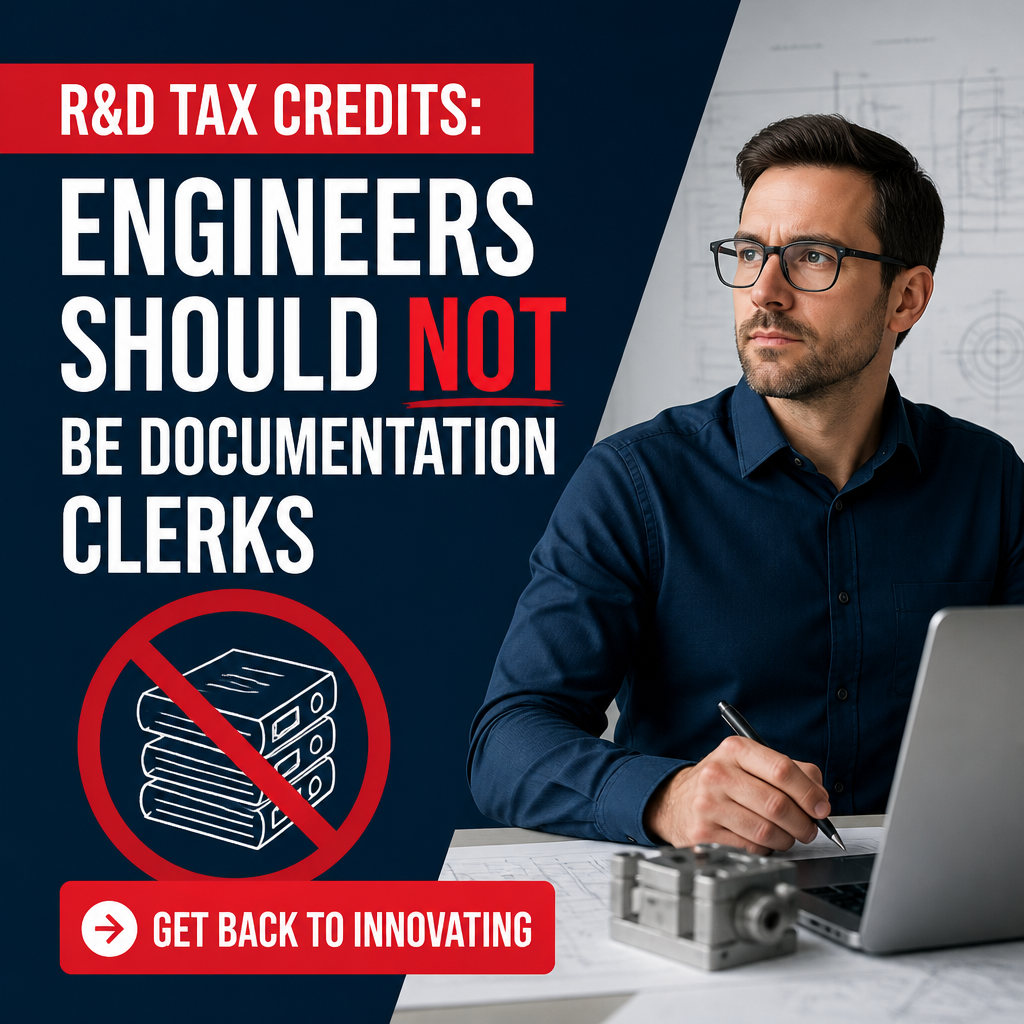
Engineers should explain the engineering—not become tax-credit administrators:
Engineers should spend their time designing, testing, debugging, and solving technical problems—not reconstructing months of R&D activity for a tax-credit study. That is the central argument behind better R&D Tax Credits outcomes for modern teams.
The issue is not that documentation is unimportant. In fact, strong documentation is essential for Research and Development Tax Credits, IRS compliance, and maximizing an R&D Tax Credit Refund. The issue is who is doing the documentation and how much high-value engineering time it consumes.
Here’s the distinction many companies miss: engineers must provide technical facts, context, and validation. But they should not have to perform the administrative work of turning those facts into an R&D Study—chasing records, filling repetitive questionnaires, and estimating time allocations from memory.
A strong business reality follows: the cost of an R&D Tax Credit study isn’t only the consultant’s fee. It can also be the engineering hours consumed preparing it. Those hours directly compete with Product Development velocity, Innovation Management priorities, and technical barrier resolution.
The traditional year-end R&D study workflow quietly drains engineering capacity:
A conventional year-end approach used by many R&D Tax Credit Consultants tends to look like this:
Consultant schedules meeting → Engineer explains project → Engineer completes follow-up questionnaire → Engineer searches Jira/GitHub/files → Engineer reconstructs failed experiments → Engineer estimates employee time → Consultant drafts narrative → Engineer reviews narrative → More questions arrive.
Multiply that across five engineers, ten projects, and four quarters, and the hidden cost becomes substantial—especially for small and mid-sized teams where each technical contributor is a critical path resource.
This traditional model also creates documentation risk. When teams document late, the narrative leans on year-end memory and incomplete evidence. That can weaken how Qualified Research Activities (QRAs) and Qualified Research Expenses (QREs) are supported, even when the underlying work clearly qualifies for the R&D Tax Credit under the four-part test.
In other words, the “manual reconstruction” approach can be inefficient for engineers and inconsistent for compliance.
Continuous R&D capture: stop treating R&D documentation as a year-end event:
The best way to reduce R&D documentation work is to stop treating documentation as a year-end event. A better operating model is continuous R&D capture: capturing what happened while it happens.
For R&D Tax Credits, continuous capture means the technical story is preserved closer to the moment of uncertainty and experimentation. That improves accuracy in describing:
• Technical uncertainties that prevented an obvious solution
• Hypotheses and alternatives evaluated
• Experimentation, prototyping, simulation, and testing cycles
• Failures and iterations that drove technical advancement
• The roles of employees and contractors
• Supporting documents that corroborate the work
This approach supports IRS expectations for substantiation without asking engineers to become clerks. It also makes it easier to identify Qualified Research Activities across software, manufacturing, engineering, and technology teams that often under-claim because the effort to document feels too heavy.

“It is difficult to think of a major industry that AI will not transform. This includes healthcare, education, transportation, retail, communications, and agriculture. There are surprisingly clear paths for AI to make a big difference in all of these industries.”- Andrew Ng, Computer Scientist and Global Leader in AI
Where an AI R&D CTO changes the documentation burden:
This is where an AI R&D CTO becomes practical—not as a replacement for engineers’ judgment, but as an administrative force multiplier for R&D Tax Credit Services.
An AI R&D CTO (operating alongside your CPA and finance team) can reduce the time engineers spend on repetitive administrative tasks while improving the precision of claim support. Think of it as a modern Virtual CTO + AI Technology Advisor capability focused on R&D Tax Credit Intelligence and documentation workflow.
The improved model looks like:
Engineer talks → AI captures → AI structures → AI maps evidence → AI drafts → Engineer validates.
That is fundamentally better than “engineer documents everything manually.” Engineers should explain the engineering. AI should do the clerical work around it.
Practically, a sector-specific trained LLM (guided by an AI Chief Technology Officer / AI Technical Advisor approach) can help organize technical facts into the framework needed for Research and Development Tax Credits—supporting the four-part test structure, identifying QRAs, and drafting technical narratives with consistent terminology and clear linkage to evidence.
Voice-led technical interviews: capture facts once, then reuse them for the R&D Tax Credit claim:
Instead of sending a 20-question form that engineers dread, an AI R&D CTO can use voice-led capture to gather the technical truth in natural engineering language. For example:
• What were you trying to develop or improve?
• What technical problem prevented an obvious solution?
• What alternatives did you test, and what failed?
• What changed after testing and iteration?
• Who worked on it, and in what capacity?
• What records exist (tickets, commits, test logs, drawings, specs, emails)?
From those short conversations, the AI R&D CTO can structure outputs that are immediately useful for an R&D Study:
• Technical uncertainty and capability gaps
• Experimentation steps and iterations
• Project activity summaries by quarter
• Employee involvement for time allocation support
• Supporting-document mapping
Engineers remain essential—but their role becomes Confirm → Correct → Approve, rather than generate everything from scratch. That shift protects engineering throughput while strengthening documentation consistency.
From QRAs to QREs: turning real work into an organized, compliant R&D Tax Credit package:
When done correctly, the R&D Tax Credit is not just a tax form—it’s a structured story connecting technical effort to eligible costs.
An AI R&D CTO supports smaller companies by helping:
• Identify Qualified Research Activities (QRAs) hidden inside normal Product Development cycles
• Calculate Qualified Research Expenses (QREs) tied to qualified wages, contractors, and supplies (where applicable)
• Establish R&D Tax Credit eligibility and align facts to the four-part test
• Create R&D Studies with clear, evidence-backed narratives
• Generate technical documentation and contemporaneous records
• Conduct and summarize technical interviews
• Produce time surveys with less disruption to engineering schedules
• Support IRS compliance requirements through organized substantiation
• Maximize available R&D Tax Credits to improve Business Cash Flow
This matters because many startups, software companies, manufacturers, engineering firms, and technology businesses conduct qualifying work every year without realizing it—or they under-claim because documentation is too painful.
The outcome is straightforward: better documentation in less time can drive greater Tax Savings, a larger R&D Tax Credit Refund, and a repeatable process your CPA can rely on year after year.
Better documentation can mean fewer engineer hours—and stronger substantiation:
Reducing engineer workload does not have to mean weaker documentation. Often, it produces the opposite.
Traditional documentation is frequently built from:
• Few interviews
• Year-end memory
• Manual reconstruction
A continuous capture model supported by an AI R&D CTO is built from:
• Shorter, more frequent capture moments
• Structured project records
• Evidence mapping to real artifacts
That difference improves audit readiness and reduces the scramble when finance needs answers quickly. It also reduces the friction that causes teams to skip or delay R&D Tax Credit claims.
From an economics perspective, the argument is simple: if an engineer costs $150,000–$200,000 per year, their highest-value time belongs in architecture, experimentation, testing, and problem solving—not in compiling spreadsheets and chasing old tickets. Every hour an engineer spends doing unnecessary R&D Tax Credit administration is an hour not spent doing R&D.
Beyond tax: AI R&D CTO support for product intelligence and technical leadership:
While the primary value is stronger, more efficient R&D Tax Credit execution, an AI R&D CTO also supports the leadership gap many smaller companies face.
As a Virtual CTO and AI Technology Advisor, the AI R&D CTO can provide AI Product Strategy and AI Product Intelligence inputs that help teams:
• Overcome technical barriers faster
• Benchmark competitors and alternatives
• Improve decision-making around technology direction
• Strengthen AI Innovation Management practices
This is not about changing your products with AI. It’s about giving smaller organizations access to enterprise-level technical leadership patterns and innovation intelligence—without having to build a large internal staff.
The result is a more level playing field: additional innovation funding through R&D Tax Credits, improved cash flow, and better technical guidance that supports smarter execution.
Turn your R&D Tax Credit into a self-funding innovation engine:
R&D Tax Credits are one of the most underused forms of Innovation Funding available to U.S. businesses, largely because the documentation burden lands on the wrong people.
SHAIN’s positioning is clear: the AI R&D CTO democratizes innovation by helping startups, micro businesses, and small companies recover R&D Tax Credits while gaining access to technical leadership and innovation intelligence previously available only to large enterprises.
If you want engineers focused on engineering—and you want an R&D Study that is better organized, more consistent, and easier to support—learn how an AI R&D CTO approach can enhance knowledge to world-class standards while seamlessly gaining R&D tax credits.
To get a fast estimate of how much your R&D Tax Credit could be, select the button below.