

 - EN
- EN  - EN
- EN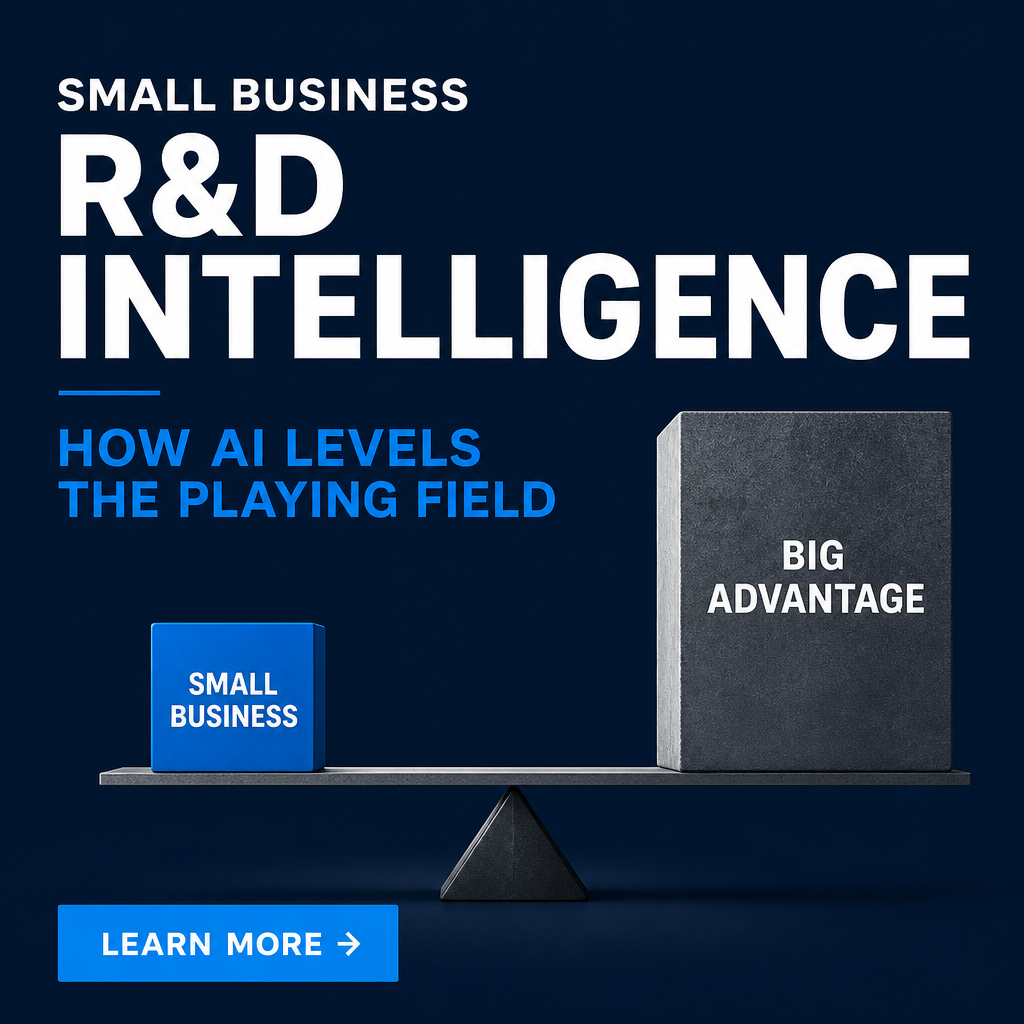
Why the Playing Field Has Never Been Level for Small Businesses:
Large companies don’t just have bigger R&D budgets—they have the surrounding infrastructure that turns spending into momentum: a CTO organization, dedicated engineering leadership, competitive intelligence analysts, market researchers, and teams that know how to capture Research and Development Tax Credits. Small businesses usually don’t. They may have one developer instead of 50, one engineer instead of an R&D department, or a founder making technology decisions without a true technology leadership bench.
That’s why the challenge for small companies often isn’t a lack of innovation. It’s a lack of resources surrounding innovation: the ability to see what’s coming, choose the right technical path, document the work, and fund the next iteration.
AI is beginning to close that intelligence gap. Not by magically giving a 20-person company the budget of a Fortune 500 R&D group, but by making pieces of the same “decision infrastructure” accessible. This is where an AI R&D CTO—operating as a Virtual CTO, AI Chief Technology Officer, AI Technology Advisor, and AI Technical Advisor—can help small businesses compete with better information, better documentation, and better access to R&D Tax Credits.
How R&D Intelligence Matters for Cash Flow:
R&D Intelligence is the continuous collection and analysis of technical, competitive, and financial information used to make better R&D decisions.
For small businesses, that definition becomes practical when broken into five working categories:
1) Technology intelligence: emerging tools, architectures, materials, methods, and platforms worth evaluating.
2) Competitive intelligence: what competitors are building, patenting, launching, and improving.
3) Technical intelligence: plausible solutions and experimental paths for hard engineering or software uncertainties.
4) R&D funding intelligence: identifying Qualified Research Activities and Qualified Research Expenses that may qualify for the R&D Tax Credit.
5) Innovation intelligence: deciding which experiments deserve more investment—and which should be stopped.
When small companies adopt R&D Intelligence, they don’t just improve product decisions; they also improve Business Cash Flow through better identification and capture of innovation incentives. That’s where R&D Tax Credits, sometimes claimed as a dollar-for-dollar reduction in tax liability (and in some cases an R&D Tax Credit Refund via payroll tax offset for qualified startups), become part of the same operating system—not a once-a-year scramble.
FUND: Capture R&D Tax Credits by Identifying Qualified Research Activities (QRAs):
Many startups, software companies, manufacturers, engineering firms, and technology businesses conduct qualifying work every year without realizing it. The most common miss isn’t that the work fails to qualify—it’s that the company can’t translate what happened technically into a defensible R&D Study.
An AI R&D CTO helps small businesses spot Qualified Research Activities earlier and more consistently by framing work around the “why” and “how” of technical uncertainty. Examples by sector include:
• Software: developing new algorithms, improving system performance under load, resolving scalability limitations, improving data pipelines, or achieving higher reliability and security.
• Manufacturing: prototyping new processes, reducing scrap rates through experimental trials, improving yield, or validating alternative materials.
• Engineering: iterative design modeling, testing structural or thermal performance, or building prototypes to resolve uncertain requirements.
The goal is to accurately isolate the activities that attempted to resolve technical uncertainty through a process of experimentation, then map them to R&D Tax Credit eligibility so Tax Savings are captured instead of lost.

“AI as a very powerful tool. What I’m most excited about is applying those tools to science and accelerating breakthroughs.
– Demis Hassabis, co-founder and CEO of DeepMind”
FUND: Calculate Qualified Research Expenses (QREs) Without the Annual Fire Drill:
Even when a company knows it performed Qualified Research Activities, it often struggles to compute Qualified Research Expenses in a way that aligns with IRS expectations. Small teams are busy building, shipping, and servicing customers—so time tracking, contractor allocation, and supply identification can become inconsistent.
An AI R&D CTO supports a cleaner path to QRE calculation by helping companies define repeatable, auditable categories of eligible spend, such as:
• W-2 wages tied to qualifying technical work
• Contractor costs (where eligible and properly documented)
• Supplies consumed in prototyping and testing (common in manufacturing and engineering)
• Cloud and development-related costs that support qualifying experimentation (evaluated carefully within current guidance and the company’s facts)
This strengthens the “funding intelligence” layer of Innovation Management: innovation is no longer just a cost center—it becomes an activity that can generate measurable Tax Savings, protect runway, and stabilize Business Cash Flow.
Automate and Facilitate the R&D Study: Replacing Manual Methods With R&D Tax Credit Intelligence:
Traditional R&D Tax Credit Services often rely heavily on manual intake, periodic interviews, and retrospective reconstruction of what happened months ago. That approach can work, but it creates friction for small businesses and can lead to missing documentation when technical decisions were made quickly.
An AI R&D CTO modernizes the workflow by applying R&D Tax Credit intelligence to reduce time burden and improve precision. Using sector-specific trained language models focused on R&D Tax Credit documentation, the AI R&D CTO can help:
• Identify activities likely to meet the 4-part test by extracting technical uncertainty, experimentation steps, and advancement objectives from engineering narratives
• Conduct structured technical interviews that consistently gather the facts required for IRS-ready support
• Generate contemporaneous documentation drafts, including project narratives, experimentation summaries, and versioned technical descriptions
• Produce time surveys that align employee activity to qualifying initiatives
• Organize evidence into an R&D Study structure that supports Form 6765 preparation
The result is a more defensible claim with less disruption to the team—and a clearer line from work performed to R&D Tax Credit recovery. For many small businesses, this is the difference between “we probably qualify” and “we can prove it.”
SOLVE and GUIDE: AI R&D CTO Support for AI Product Strategy and Product Intelligence:
Beyond credits, an AI R&D CTO provides the kind of technical leadership and product intelligence that large companies take for granted. This is where the Virtual CTO capability matters: small businesses can access structured guidance without building an entire executive layer.
In practice, an AI R&D CTO helps:
• AI Product Strategy: clarifying which technical bets deserve investment, what success metrics matter, and how to sequence experimentation to reduce risk
• AI Product Intelligence: understanding market and competitor movement so product decisions aren’t made in a vacuum
• Technical barrier resolution: outlining plausible solution paths and experimental approaches when teams are stuck
• Emerging technology awareness: monitoring relevant tools and methods that could materially change delivery speed, cost, or performance
This is the “SOLVE → GUIDE” side of the thesis: small companies often move faster than enterprises; what they lack is information and specialist bandwidth. R&D Intelligence—supported by an AI Technology Advisor and AI Technical Advisor—reduces that disadvantage.
A Concrete Small-Business Example: Turning Fragmented Effort Into an R&D Intelligence System:
Consider a 20-person software company.
Without an R&D Intelligence capability, technology decisions are fragmented: the founder hears about a new approach, a developer researches it when time permits, someone checks competitor updates informally, and the CPA asks about the R&D Tax Credit once per year. Documentation is scattered across tickets, chat logs, and tribal memory.
With an AI R&D CTO layer, the workflow becomes more connected:
• competitor changes are monitored and summarized into product intelligence
• technical options are benchmarked to reduce uncertainty before committing engineering time
• experiments are tracked as they occur, so Qualified Research Activities are captured early
• supporting documentation and time surveys are produced continuously
• the R&D Study becomes a natural output of the year’s work rather than a retrospective reconstruction
This doesn’t create enterprise overhead. It creates enterprise-grade clarity—so the company can decide faster, document better, and fund more of what works through Research and Development Tax Credits.
Learn More: Turn R&D Tax Credits Into a Self-Funding Innovation Engine:
The AI R&D CTO democratizes innovation by helping startups, micro businesses, and small companies recover R&D Tax Credits while gaining access to technical leadership and innovation intelligence previously available only to large enterprises. When R&D Tax Credit Consultants and CTO-level guidance are combined into one modern capability, small businesses can improve cash flow, reduce risk, and build better products—without building a large internal team.
To learn how an AI R&D CTO can enhance your knowledge to world-class standards while seamlessly gaining R&D tax credits—and to get an estimate of how much your R&D Tax Credit could be—select the button below.