
 - EN
- EN  - EN
- EN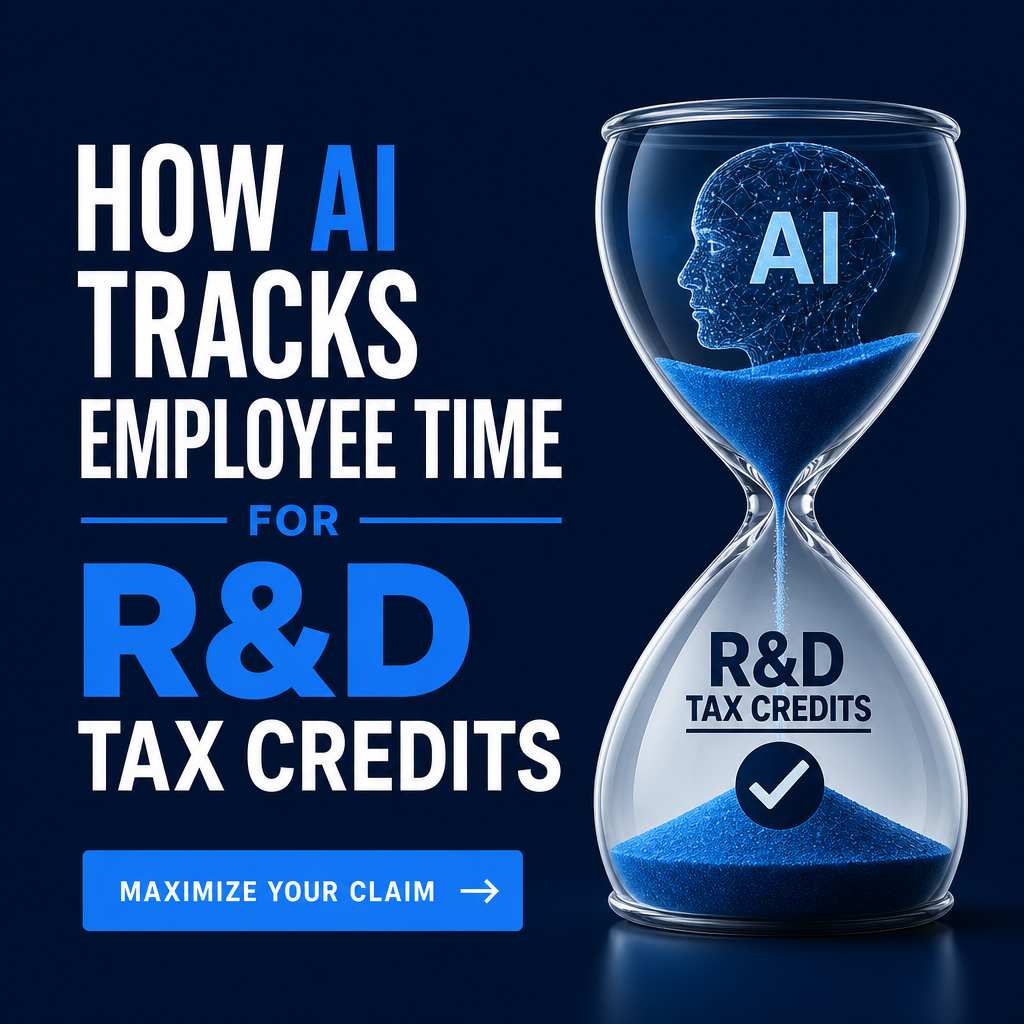
Don’t Ask Your Engineers in December What They Did Last January:
How much time did each employee actually spend performing qualified R&D?
For many companies pursuing R&D Tax Credits, that question isn’t asked until months after the work occurred—often at year-end, when finance starts the Research and Development Tax Credits process. Managers then reconstruct employee activities from memory, spreadsheets, calendars, and scattered project records. The result is often a fragile narrative, inconsistent time allocations, and documentation that doesn’t clearly connect wages to Qualified Research Activities (QRAs). Examination guidance repeatedly emphasizes contemporaneous books and records and the “nexus” between what employees did, how much time they spent, and the Qualified Research Expenses (QREs) claimed. Wages qualify only to the extent they’re attributable to qualified services—so time and activity detail matter.
This is where an AI R&D CTO—acting as an AI Chief Technology Officer, Virtual CTO, and AI Technology Advisor for R&D documentation—changes the game. Instead of year-end reconstruction, the AI R&D CTO supports continuous, evidence-based R&D activity capture that strengthens compliance while helping businesses maximize available R&D Tax Credits and improve Business Cash Flow.
Evidence-Based R&D Activity Record:
A credible approach is not “AI tracks every minute at a desk.” That framing creates audit risk and employee resistance. A stronger approach is building an evidence-based activity record that employees can review and confirm.
An AI R&D CTO supports a workflow that feels like good Innovation Management, not surveillance:
• Voice AI interviews or short check-ins where the employee describes work performed during the period
• Project identification to associate the work with the correct R&D project and business component
• Activity classification to separate potentially qualifying research from nonqualifying work
• Time allocation across projects and periods based on described activities and corroborating records
• Corroboration against sources such as Jira tickets, Git commits, calendars, test logs, meeting notes, lab notebooks, deployment notes, and project documentation
• Employee confirmation to finalize the record
The outcome is a quarterly time survey plus an activity ledger that supports qualified wage calculations—without relying on vague, after-the-fact percentages. This approach also supports the R&D Tax Credit Services goal: defensible documentation that ties QREs to QRAs and the underlying technical work.
Weekly Activity Ledgers That Create the “Nexus”:
Traditional approaches often end with a single line item like “Sarah — 40% R&D.” That’s exactly where audits get difficult: the allocation appears arbitrary because it isn’t derived from an underlying activity history.
An AI R&D CTO helps maintain a weekly activity ledger that connects:
Employee → Time → Activity → Experiment → Project → Business Component → QRA → Wage QRE → Supporting Evidence
A ledger can be granular enough to show what happened and why it may qualify. Conceptually, it can look like:
Week | Employee | R&D Project | Activity | Qualified?
This structure does two critical things for an R&D Study:
1) It documents technical uncertainties and experiments (the story of the research).
2) It supports qualified wage calculations from underlying records—rather than reverse-engineering a percentage at year-end.
For many small and mid-sized businesses, this is the missing link. They often perform qualifying work in Product Development, engineering, software, manufacturing, or process improvement, but fail to connect expenses to activities. The AI R&D CTO strengthens that connection, improving both defensibility and the likelihood of maximizing Tax Savings.

“Data extraction automation from unstructured data and conversion into structured and usable data, AI has tangibly amplified extracting data with high accuracy.” -dr. Jeremy Nunn – Forbes Technology Council
Identifying Qualified Research Activities and Mapping Them to the 4-Part Test:
Capturing time is only valuable if the work is properly tied to Qualified Research Activities. The AI R&D CTO supports teams in identifying where work aligns with the four-part test and documenting it in a consistent way:
• Permitted purpose: new or improved function, performance, reliability, or quality
• Technological in nature: grounded in engineering, computer science, physics, chemistry, or similar disciplines
• Elimination of uncertainty: capability, method, or design uncertainty
• Process of experimentation: modeling, simulation, prototyping, iterative testing, trials, and analysis
This is where sector-specific reasoning matters. For software teams, that might be latency testing, alternative architectures, or algorithmic experimentation. For manufacturers, it may involve iterative tooling changes, materials trials, or process parameter optimization. For engineering firms, it may involve load calculations, finite element analysis iterations, or design-validation cycles.
R&D Tax Credit Consultants typically gather this through long interviews and manual write-ups. The AI R&D CTO model modernizes the process by facilitating structured capture of uncertainties, hypotheses, tests, and outcomes throughout the year—supporting stronger contemporaneous documentation for the R&D Tax Credit claim.
From Activities to Qualified Research Expenses: Wage QREs, Contractors, and Supplies:
Once QRAs are identified, the next challenge is calculating Qualified Research Expenses accurately. The AI R&D CTO helps smaller companies operationalize a repeatable system to:
• Identify employees performing qualified services (direct research, direct supervision, and direct support)
• Allocate wages to qualified vs. nonqualified activities based on the activity ledger
• Capture contractor relationships and evaluate whether contractor costs may qualify under applicable rules
• Identify supply costs used in experimentation and testing where applicable
This is especially valuable for businesses seeking an R&D Tax Credit Refund (where eligible) or looking to apply credits to offset payroll tax (where applicable). Better capture and documentation typically leads to better outcomes: improved Business Cash Flow, reduced friction at filing time, and fewer surprises during review.
A practical note for planning: the “substantially all” concept in Treasury regulations can matter for certain employee qualified-services thresholds. But regardless of the method, the safest posture is a documented trail showing what the employee did and how qualified services were determined—exactly what continuous capture supports.
Automating R&D Tax Credit Claim Support Without Replacing Professional Judgment:
Traditional R&D Tax Credit Services often rely on year-end data calls, spreadsheets, and one-time narratives. The AI R&D CTO replaces that scramble with a continuous system that supports Form 6765 preparation inputs and R&D Study production—while still leaving final tax positions to qualified professionals.
This isn’t about letting AI “decide the credit.” It’s about reducing manual burden and improving precision by:
• Conducting and summarizing technical interviews throughout the year
• Producing time surveys tied to a corroborated activity ledger
• Generating technical documentation that describes uncertainties, experimentation, and outcomes
• Organizing supporting evidence so expenses connect to the underlying qualified research
• Flagging gaps early—before year-end—so teams can strengthen records while projects are active
By creating a tighter linkage between QRAs and QREs, the AI R&D CTO helps resolve the classic nexus problem: failure to connect specific research projects and activities to the expenses claimed. That can mean more defensible R&D Tax Credits and lower compliance risk compared to purely retrospective approaches.
Beyond the Credit: AI Product Intelligence and World-Class Technical Guidance:
While this is primarily a FUND conversation—turning innovation work into R&D Tax Credits—the AI R&D CTO also supports better decision-making across AI Product Strategy and AI Product Intelligence.
As a Virtual CTO and AI Technical Advisor, the AI R&D CTO can help smaller organizations access capabilities that previously required large teams:
• Product strategy insights to focus experimentation on the highest-value technical uncertainties
• Competitive benchmarking and innovation intelligence to understand where the industry is moving
• Emerging technology awareness to reduce technology risk and avoid dead-end approaches
• Technical barrier resolution by structuring experiments, tests, and learning loops
The result is a more level playing field: startups and small businesses gain both innovation funding leverage and higher-quality technical execution without the cost of building a large internal function.
Next Step: Turn Your R&D Tax Credit Into a Self-Funding Innovation Engine:
SHAIN’s positioning is simple: the AI R&D CTO democratizes innovation by helping startups, micro businesses, and small companies recover R&D Tax Credits while gaining access to technical leadership and innovation intelligence previously available only to large enterprises.
If you’re still reconstructing time allocations after the fact, you’re taking on avoidable risk and leaving value on the table. A continuous, evidence-based record—built from employee-confirmed activity ledgers and corroborated project data—can strengthen your R&D Study, improve eligibility support, and maximize R&D Tax Credit recovery.
To learn more about how an AI R&D CTO can enhance knowledge to world-class standards while seamlessly gaining R&D tax credits, and to get an estimate of your potential R&D Tax Credit, select the button below.