
 - EN
- EN  - EN
- EN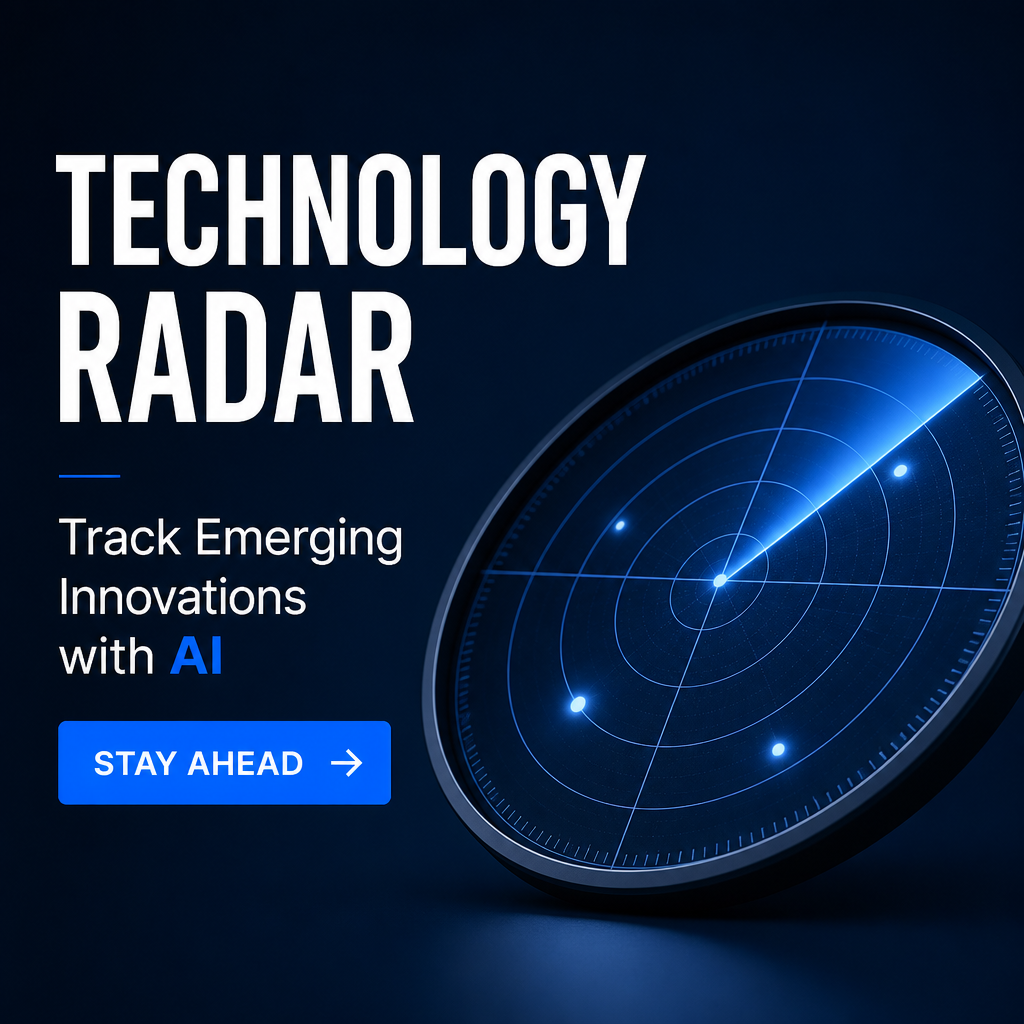
How an AI R&D CTO bridges the gap between current local teams and the best in the world, getting out of the day-to-day bubble.
The biggest innovation risk isn’t choosing the wrong technology. It’s discovering the right technology too late.
For most small and mid-sized businesses, engineers and product leaders are fully absorbed in today’s roadmap: shipping features, solving customer issues, managing reliability, and hitting deadlines. Meanwhile, outside the company, new architectures emerge, competitors launch new capabilities, research publishes breakthroughs, startups commercialize novel solutions, and previously experimental methods become viable.
Large enterprises can afford dedicated technology scouting, innovation management teams, and specialized R&D Tax Credit consultants. Most SMBs can’t. That’s where an AI R&D CTO—operating as a Virtual CTO and AI Technology Advisor—changes the equation: continuously scanning what’s coming next, translating signals into decisions, and ensuring that qualifying experimentation is captured for R&D Tax Credits.
An AI Technology Radar that turns noise into decisions:
An AI Technology Radar is not a news feed. It should not deliver “27 interesting technologies this month” and call that strategy. The value comes from converting information into intelligence that’s specific to your products, constraints, and technical challenges.
An AI R&D CTO (sometimes framed as an AI Chief Technology Officer or AI Technical Advisor) helps implement a practical radar workflow:
SCAN: What’s changing across emerging technologies, competitor innovation, scientific and technical research, patents & IP, startups & vendors, and broader industry signals.
FILTER: What is relevant to our product development goals, engineering bottlenecks, compliance needs, and customer outcomes.
ASSESS: How mature is it? What is the risk, readiness, and potential impact.
CONNECT: Where could it influence our roadmap, architecture, processes, performance, or cost structure.
RECOMMEND: What action fits now—Watch, Assess, Test, or Adopt.
This is where AI Product Intelligence and AI Product Strategy become concrete. Instead of generic trend-watching, the Technology Radar focuses your organization on the few innovations that matter, early enough to act.
GUIDE vs. Competitive Benchmarking—and why both matter:
Many leaders blend competitor tracking and future scouting into one activity. They shouldn’t.
Competitive Benchmarking asks: What are our competitors doing right now?
Technology Radar asks: What is coming next?
Together, they form a stronger “GUIDE” capability under an AI R&D CTO. Competitive Benchmarking prevents you from falling behind current market expectations. The Technology Radar prevents you from being late to the next technical inflection point.
For an SMB, this separation is strategic. Your engineers shouldn’t have to search the world for innovation while they’re busy creating it. A Virtual CTO powered by AI-driven technology intelligence can continuously scan the landscape, filter it against your company’s needs, and surface the innovations worth investigating.

“AI as a very powerful tool. What I’m most excited about is applying those tools to science and accelerating breakthroughs.
– Demis Hassabis, co-founder and CEO of DeepMind”
From GUIDE to SOLVE to FUND: how Technology Radar becomes self-funding:
The Technology Radar is not just “interesting”—it can directly create a repeatable cycle that improves both innovation outcomes and business cash flow.
Example: imagine the radar identifies an emerging manufacturing technique or materials approach that could reduce deformation, improve yield, or increase durability.
GUIDE: The AI R&D CTO identifies the technique, assesses readiness, and connects it to your product’s performance constraints.
SOLVE: Engineering evaluates whether it can overcome the company’s existing technical limitation. This often triggers real experimentation—prototype builds, process trials, test failures, parameter tuning, and iterative redesign.
FUND: That experimentation may create Qualified Research Activities (QRAs) and associated Qualified Research Expenses (QREs). Capturing those details correctly can translate into Research and Development Tax Credits.
REINVEST: The R&D Tax Credit Refund or reduced tax liability can be reinvested into additional product development, testing, and hiring—turning your tax credit into a self-funding innovation engine.
Where R&D Tax Credits fit: capturing uncertainty, experimentation, and advancement:
Many companies assume R&D Tax Credits only apply to labs or groundbreaking inventions. In practice, a wide range of software companies, manufacturers, engineering firms, and technology businesses perform qualifying work—often without realizing it.
What matters is whether your teams are attempting to resolve technical uncertainty through a process of experimentation and evaluation, and whether the work aligns with IRS expectations (including the 4-part test).
A modern R&D Study should clearly describe:
• The technical uncertainties faced (performance, scalability, manufacturability, reliability, security, cost targets, etc.)
• The alternatives evaluated and why
• The experiments performed (tests, prototypes, simulations, iterations)
• The resulting technological advancement and learnings
When a Technology Radar drives earlier and more frequent technical trials, it can increase the volume of potentially eligible Qualified Research Activities—provided you document them correctly and consistently.
How an AI R&D CTO automates and supports R&D Tax Credit claims:
Traditional R&D Tax Credit Services can be time-consuming and disruptive: manual interviews, spreadsheet time estimates, after-the-fact narratives, and document hunts that happen long after the work is done. That friction is a major reason SMBs under-claim or avoid claiming at all.
An AI R&D CTO supports a more precise and less burdensome approach by using sector-specific trained LLMs to assist with R&D Tax Credit intelligence—without changing how you build products. The goal is to make your claim better supported and easier to defend.
In practice, the AI R&D CTO helps smaller companies:
• Identify Qualified Research Activities (QRAs) across product development and engineering workstreams
• Calculate Qualified Research Expenses (QREs), including wages, contractor costs, and supplies where applicable
• Establish R&D Tax Credit eligibility by mapping projects to the 4-part test
• Create R&D Studies with clearer descriptions of uncertainty, experimentation, and advancement
• Generate technical documentation aligned with what the IRS expects to see
• Conduct technical interviews with structured prompts to capture real engineering detail
• Produce time surveys and contemporaneous substantiation with less disruption
• Support IRS compliance requirements and Form 6765 preparation support
• Maximize available R&D Tax Credits while reducing the burden on technical teams
This is the bridge between finance, tax, and engineering: your team keeps moving forward, while your documentation improves—leading to more reliable tax savings and improved business cash flow.
Why this levels the playing field for SMB innovation:
For decades, larger companies had structural advantages: full-time CTOs, product strategy teams, dedicated innovation management processes, competitive intelligence functions, and R&D Tax Credit consultants.
The AI R&D CTO democratizes innovation by helping startups, micro businesses, and small companies recover R&D Tax Credits while gaining access to technical leadership and innovation intelligence previously available only to large enterprises.
With a Technology Radar feeding product intelligence—and a disciplined approach to capturing QRAs and QREs—SMBs can move faster, make better technical decisions, and fund more experimentation without building a large internal overhead.
Learn more: turn your Technology Radar into an innovation funding engine:
If you want earlier visibility into emerging innovations—and a clearer, more supportable path to claiming Research and Development Tax Credits—an AI R&D CTO can help you reach world-class standards in technology scouting, AI Product Strategy, and AI Product Intelligence while seamlessly supporting R&D Tax Credit claims.
To learn more and get an estimate of how much your R&D Tax Credit could be, select the button below.