
 - EN
- EN  - EN
- EN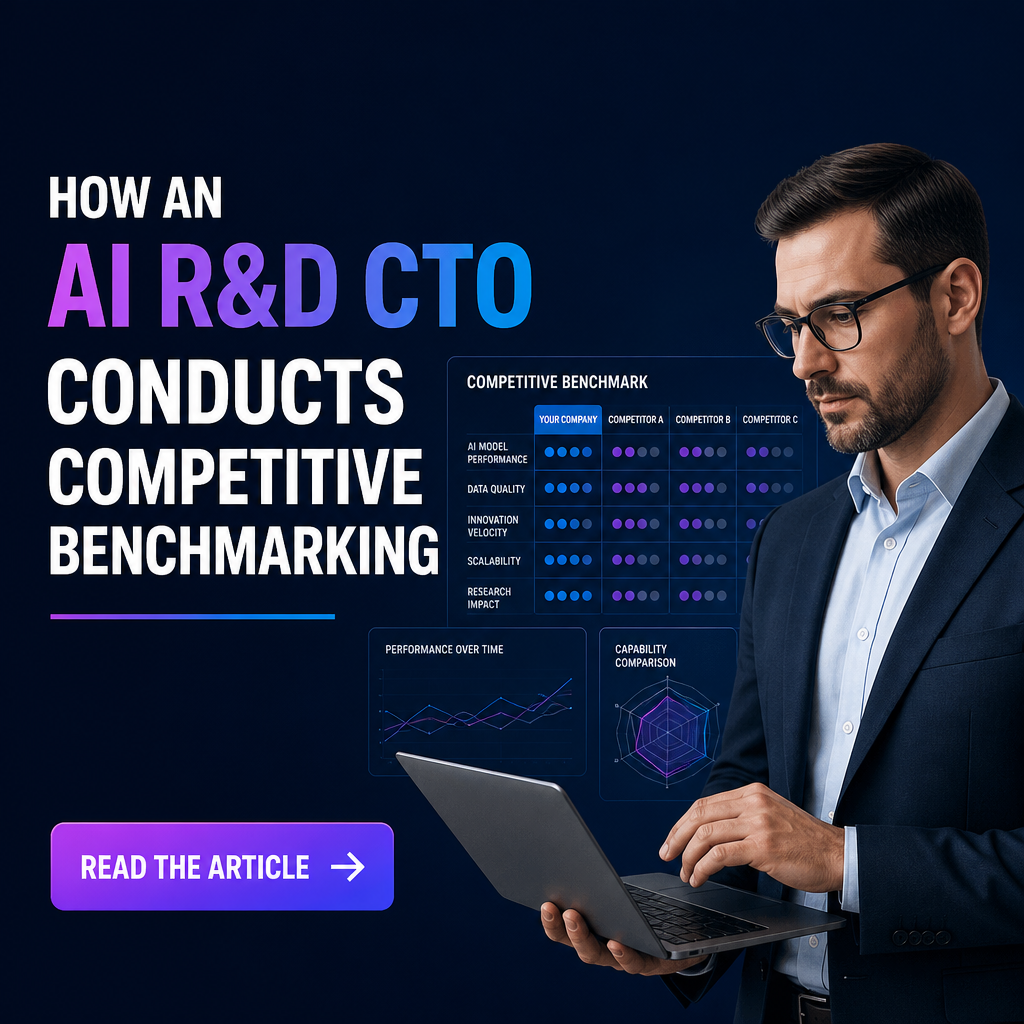
How an AI R&D CTO Conducts Competitive Benchmarking:
Your competitors aren’t standing still. But how often does your technical team systematically analyze what they’re building?
Most small and mid-sized engineering teams are consumed by their own roadmap, customer issues, and day-to-day development. They rarely have dedicated resources continuously comparing their products, technologies, and technical capabilities against competitors. That creates an information disadvantage that compounds over time.
This is where an AI R&D CTO becomes the SMB innovation advisory layer. Not generic “competitive analysis” focused on pricing, advertising, branding, or social media—but competitive benchmarking from a technical and product-development perspective. The goal isn’t to copy competitors. It’s to expand your technical team’s field of vision so your Product Development decisions are made with stronger external context.
An AI R&D CTO turns scattered external signals into practical recommendations tied to your Product Strategy, engineering constraints, and Innovation Management priorities.
And when benchmarking exposes technical uncertainties that require experimentation, the same work can often map to Qualified Research Activities—creating a clean path to Research and Development Tax Credits that improve Business Cash Flow through Tax Savings and potential R&D Tax Credit Refund outcomes.
Benchmark product capabilities, architecture, and performance—not market noise:
Competitive benchmarking is most valuable when it stays technical. A strong AI R&D CTO benchmarking program typically focuses on:
• Product capabilities: What can competing products do that yours cannot?
• Technical architecture: What technologies, integrations, platforms, APIs, or technical approaches appear to enable those capabilities?
• Performance: Where are competitors potentially stronger in speed, scalability, accuracy, reliability, usability, or automation?
• Innovation trajectory: What new capabilities are they introducing over time, and how fast?
• Technology adoption: Which emerging technologies are they incorporating, and what risks/opportunities does that create?
• Patents/IP: Where appropriate, what technical approaches or inventions are being protected, and what does that imply?
This is competitive technical intelligence. It’s not ordinary market research.
In practice, the AI R&D CTO synthesizes publicly available information from release notes, developer documentation, API references, product documentation, technical blogs, conference talks, standards bodies, patents, integration marketplaces, and industry publications. The point is to build a credible technical picture of “how they likely did it” and “what that means for us”.
This is also where an AI Innovation Platform and AI Product Intelligence discipline matter: competitive facts are less useful than competitive context. The AI R&D CTO is designed to connect competitor intelligence to your engineering realities—your tech stack, your team’s skills, your delivery constraints, and your strategic goals.
Turn benchmarking into decisions with AI Product Intelligence and AI Product Strategy:
Imagine a software company asks its AI R&D CTO: “How does our platform compare technically with our five largest competitors?”
A generic AI tool can list competitor features. An AI R&D CTO should go further by combining:
• Competitor intelligence
• Your product and roadmap
• Your technical challenges and constraints
• Your development history
Then it answers the only question that matters: What does this mean for us?
That’s the difference between information and intelligence.
Instead of stopping at “Competitor A has Feature X,” the AI R&D CTO helps the team pressure-test the implications:
• Why does Feature X matter to target users?
• What technical approach might enable it (architecture, data pipelines, caching strategy, model lifecycle, integration patterns)?
• Are we technically capable of matching it with our current stack and team?
• Should we match it, or leapfrog it with an alternative?
• What technical uncertainties would we need to overcome?
• What experiments would reduce risk fastest?
Competitive benchmarking tells you where competitors are. Competitive intelligence helps you decide where to go next.
Done well, this becomes a repeatable Innovation Management practice that continually sharpens prioritization, reduces technology risk, and improves execution quality without requiring a large internal strategy organization.

“AI as a very powerful tool. What I’m most excited about is applying those tools to science and accelerating breakthroughs.
– Demis Hassabis, co-founder and CEO of DeepMind”
Translate competitor gaps into technical uncertainties and test plans (the 4-part test lens):
Once benchmarking highlights a meaningful gap—say, a competitor appears to offer higher scalability or lower latency—the next step is translating that gap into engineering questions.
That translation is where the AI R&D CTO becomes especially valuable, because it pushes the team from “we should improve performance” into concrete uncertainty statements:
• Can we achieve required throughput with our current architecture?
• Will an alternative approach maintain reliability and data integrity?
• Can we meet accuracy targets under real-world constraints?
• Can we reduce compute cost without harming user experience?
These are technical uncertainties that naturally lead to a scientific method style of development: hypothesis, experimentation, prototyping, testing, and iteration.
Importantly for R&D Tax Credit purposes, this is also the same shape as the IRS 4-part test analysis used to evaluate Qualified Research Activities. When teams are truly resolving technical uncertainty through experimentation—and not just doing routine engineering—there may be a strong basis for a Research and Development Tax Credits position.
That connection is the foundation for turning competitive benchmarking into a self-funding innovation engine: Competitive Benchmarking → Opportunity/Gap → Technical Challenge → Experimentation → Product Improvement → Potential R&D Tax Credit → Reinvestment.
R&D Tax Credit Intelligence: how an AI R&D CTO helps prepare stronger claims with less manual effort:
When benchmarking drives legitimate experimentation, many SMBs miss the next step: documenting it well enough to support R&D Tax Credits.
Traditional R&D Tax Credit Services often rely on manual interviews, spreadsheets, after-the-fact narratives, and time-consuming backtracking. An AI R&D CTO modernizes that workflow by systematizing how evidence is captured and organized—so the R&D Study is clearer, more complete, and less disruptive to engineers.
With an AI R&D CTO supporting your R&D Tax Credit claim, smaller companies can more consistently:
• Identify Qualified Research Activities (QRAs) across software, manufacturing, engineering, and technology projects
• Calculate and support Qualified Research Expenses (QREs) such as wages (and where applicable, contractors and supplies)
• Establish R&D Tax Credit eligibility by mapping project work to the 4-part test
• Create R&D Studies that clearly describe technical uncertainty, experimentation, and technological advancement
• Conduct technical interviews with structured prompts that reduce omissions
• Produce time surveys and activity summaries that are easier for teams to complete accurately
• Generate technical documentation aligned to IRS compliance expectations
• Support Form 6765 preparation by organizing project and expense support in a consistent structure
This doesn’t replace professional judgment. It reduces the friction and inconsistency that often causes SMBs to under-claim or avoid claiming entirely. For many companies, better documentation and tighter QRA/QRE alignment can directly increase Tax Savings and improve Business Cash Flow—sometimes even enabling an R&D Tax Credit Refund depending on the company’s profile.
In other words, the AI R&D CTO helps ensure that qualifying work discovered through competitive benchmarking is not only executed well—but also captured well.
Where this shows up by sector: software, manufacturing, engineering, and emerging tech:
Competitive benchmarking isn’t limited to one industry. The pattern repeats across sectors:
• Software companies benchmark competitor release velocity, API depth, integrations, performance characteristics, and architecture signals—then run experiments to overcome scalability, reliability, or automation barriers.
• Manufacturers benchmark materials, tolerances, process controls, automation approaches, and reliability targets—then test alternative process parameters or equipment configurations to resolve technical uncertainty.
• Engineering firms benchmark design methods, simulation approaches, and compliance-driven performance requirements—then prototype and iterate to meet constraints that aren’t solvable through standard methods.
• Technology businesses benchmark emerging standards, platform shifts, and new implementation patterns—then evaluate feasibility through structured experimentation.
Across these scenarios, an AI R&D CTO acts as an AI Technology Advisor and AI Technical Advisor, ensuring the team’s learning loop is external-facing (competitor-aware) while the documentation loop is internal-facing (claim-ready). That combination supports stronger Innovation Management and more defensible R&D Tax Credit outcomes—often with less disruption than traditional R&D Tax Credit Consultants alone.
Learn more: build world-class technical intelligence while recovering R&D costs:
SMBs don’t lose because they lack talent. They lose because they lack time and external intelligence. A Virtual CTO delivered as an AI R&D CTO closes that gap—helping your team benchmark competitors technically, make better product decisions with AI Product Intelligence, and convert real experimentation into well-supported R&D Tax Credits.
If you want to see how an AI R&D CTO can enhance knowledge to world-class standards while seamlessly gaining R&D tax credits, you can also get an estimate of your potential R&D Tax Credit by selecting the button below.