

 - EN
- EN  - EN
- EN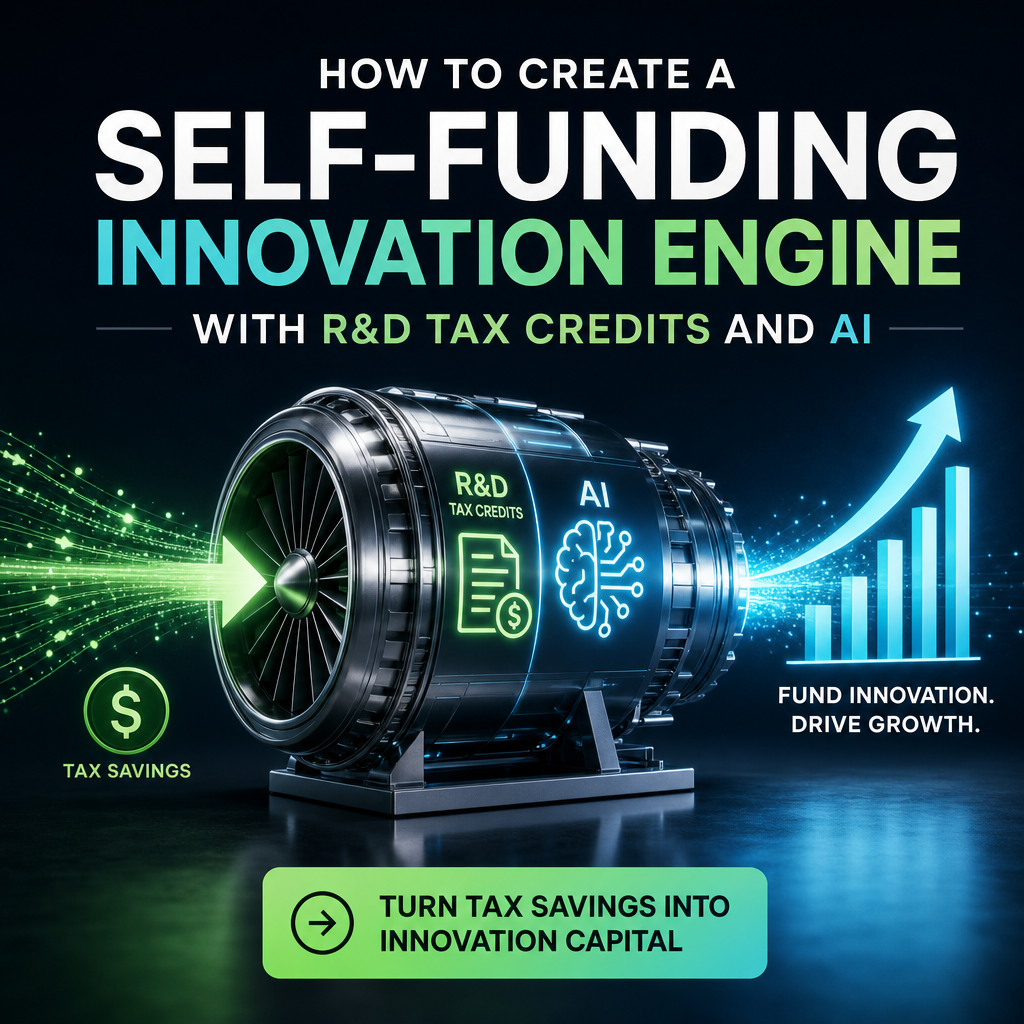
Innovation becomes much more powerful when it starts generating its own capital.
For CFOs, that means improving Business Cash Flow without taking on expensive debt. For CEOs and founders, it means funding AI Product Development and engineering growth without immediately raising capital. For SMBs competing with larger incumbents, it means unlocking an Innovation Investment Fund that can compound year after year.
Yet most companies still treat R&D Tax Credits as basic tax savings—something to think about once a year at filing time. That’s outdated.
The smarter approach is to build a repeatable, disciplined system where innovation work creates R&D Tax Credit eligibility, generates documentation, produces an R&D Study, and turns into measurable Tax Savings and even an R&D Tax Credit Refund.
That loop is the self-funding innovation engine:
Innovation → Qualified Research Activities (QRAs) → Qualified Research Expenses (QREs) → R&D Tax Credit → improved cash flow→ reinvestment into innovation.
The missing piece for many smaller organizations is operational capacity. Capturing R&D Tax Credits consistently requires structure, technical clarity, and defensible documentation.
This is where an AI R&D CTO—supported by Human in the Loop review—can transform R&D Tax Credit Services from a one-time project into a continuous, scalable system.
Identify Qualified Research Activities (QRAs) that actually pass IRS scrutiny:
The engine starts with recognizing what counts. Many startups, software companies, manufacturers, engineering firms, and technology businesses perform Qualified Research Activities every year and never capture them.
A defensible R&D Tax Credit claim typically hinges on documenting activities that align with the IRS “four-part test” (permitted purpose, technological in nature, elimination of uncertainty, and process of experimentation).
Practically, QRAs often appear in work like:
• Building or improving software functionality, performance, scalability, or security
• Developing prototypes, testing iterations, or refining designs
• Resolving technical uncertainty in materials, algorithms, architecture, or integration
• Running trials, simulations, or experiments to validate alternatives.
An AI R&D CTO functions as an AI Technology Advisor and AI Technical Advisor focused on R&D Tax Credit Intelligence— recognizing technical uncertainty as it happens and describe experimentation clearly. The objective is to accurately capture and explain the technical work already being performed so QRAs are identified early and consistently.
Calculate Qualified Research Expenses (QREs to convert technical work into dollar value):
Once QRAs are identified, the next step is measuring the spend tied to those activities.
Qualified Research Expenses commonly include:
• Wages for employees directly performing, supervising, or supporting qualified research
• Contractor costs (subject to applicable limitations)
• Supplies consumed during experimentation and prototyping (often more relevant in manufacturing and engineering)
• Certain cloud and compute expenses may be relevant depending on facts and documentation.
This is where many organizations stall. They may have strong engineering work, but weak cost tracing.
A modern approach combines R&D Tax Credit Consultants with an AI R&D CTO to streamline the mapping of labor and costs to projects, experiments, and milestones. Done correctly, these calculations become the financial fuel for the self-funding innovation engine—turning innovation spend into predictable Tax Savings.

We’re at the beginning of a golden age of AI. Recent advancements have already led to invention that previously lived in the realm of science fiction — and we’ve only scratched the surface of what’s possible.
– Jeff Bezos, Founder and Executive Chairman of Amazon
Build an audit-ready R&D Study that documents uncertainty, experimentation, and advancement:
A high-quality R&D Study is the bridge between technical reality and tax compliance. It explains why the work qualifies, what uncertainties existed, how alternatives were evaluated, and what technological advancement was sought.
For smaller companies, the biggest obstacle is that traditional R&D Study preparation can be too complex and expensive relative to the credit size. This is exactly why the “engine” breaks: companies either don’t claim or they claim with thin documentation.
An AI R&D CTO supports the R&D Study process by organizing the technical narrative, ensuring projects tie to QRAs, and prompting teams for specifics that matter (hypotheses, test results, iteration outcomes, and constraints).
Importantly, Human in the Loop remains the guard rail: expert reviewers validate the output, align it with IRS expectations, and prepare documentation that is CPA-ready for final review. This combination raises quality while reducing friction—making the credit feasible for micro, small, and medium-sized companies.
Automate documentation, interviews, and time surveys to keep the engine running year-round:
Traditional R&D Tax Credit Services are often reactive: a scramble at year-end, rushed technical interviews, reconstructed timelines, and best-effort estimates. That approach wastes internal time and creates inconsistency.
An AI R&D CTO can make the engine continuous by facilitating ongoing capture of:
• Technical interviews (structured, repeatable, and aligned to QRAs)
• Contemporaneous documentation (what was tried, why, and what changed)
• Time surveys (lightweight prompts that reduce manual burden)
• Support packages for IRS compliance requirements.
This is where AI Innovation Platform thinking applies to the tax credit workflow: instead of “remembering” work months later, teams capture essential substantiation as they go—without adding a heavy administrative layer. The result is no disruption to engineering, higher precision in documentation, and a more reliable R&D Tax Credit claim. And because the process is supported by Human in the Loop and expert R&D Tax Credit Consultants, the output remains defensible and aligned with compliance standards.
Use the AI R&D CTO as a Virtual CTO for product intelligence and innovation management:
A self-funding innovation engine shouldn’t stop at the credit. When an organization improves its ability to define, document, and measure technical work, it also strengthens decision-making.
Beyond Research and Development Tax Credits, an AI R&D CTO can act as a Virtual CTO and AI Chief Technology Officer focused on AI Product Intelligence and AI Product Strategy.
That includes:
• Clarifying technical priorities and tradeoffs
• Improving Innovation Management discipline (what gets tested, why, and what success means)
• Strengthening competitive benchmarking and innovation intelligence
• Accelerating barrier resolution by surfacing best-practice approaches
This support helps smaller organizations “get out of the day-to-day bubble” and benchmark against world-class development knowledge—without the cost of building a large internal technology leadership team. The outcome is a more level playing field: better products, clearer technical narratives, and a more repeatable path to capturing R&D Tax Credits.
Turn R&D Tax Credits into an Innovation Investment Fund:
When the loop is running, R&D Tax Credits stop being a one-time event and become an Innovation Investment Fund. The cash flow impact can be meaningful: credits reduce tax liability and, in some situations, may support an R&D Tax Credit Refund depending on eligibility and filing position.
For CFOs, the key is planning: forecast credits, understand timing, and align reinvestment decisions to the product roadmap. For founders, the advantage is optionality: credits can extend runway, fund key hires, or support new experimentation—without diluting ownership.
This is the engine in action:
1) Conduct technical innovation
2) Generate QRAs
3) Calculate QREs
4) Claim the R&D Tax Credit
5) Improve cash flow
6) Reinvest into innovation.
With an AI R&D CTO and Human in the Loop oversight, the process becomes more scalable and repeatable—helping teams claim what they are rightfully entitled to, year after year.
Learn more and estimate your R&D Tax Credit:
The AI R&D CTO democratizes innovation by helping startups, micro businesses, and small companies recover R&D Tax Credits while gaining access to technical leadership and innovation intelligence previously available only to large enterprises.
If you want to see how an AI R&D CTO can enhance your team’s knowledge to world-class standards while seamlessly preparing CPA-ready R&D Tax Credit documentation—with expert support and Human in the Loop review—select the button below to get an estimate of how much your R&D Tax Credit could be.