

 - EN
 - EN
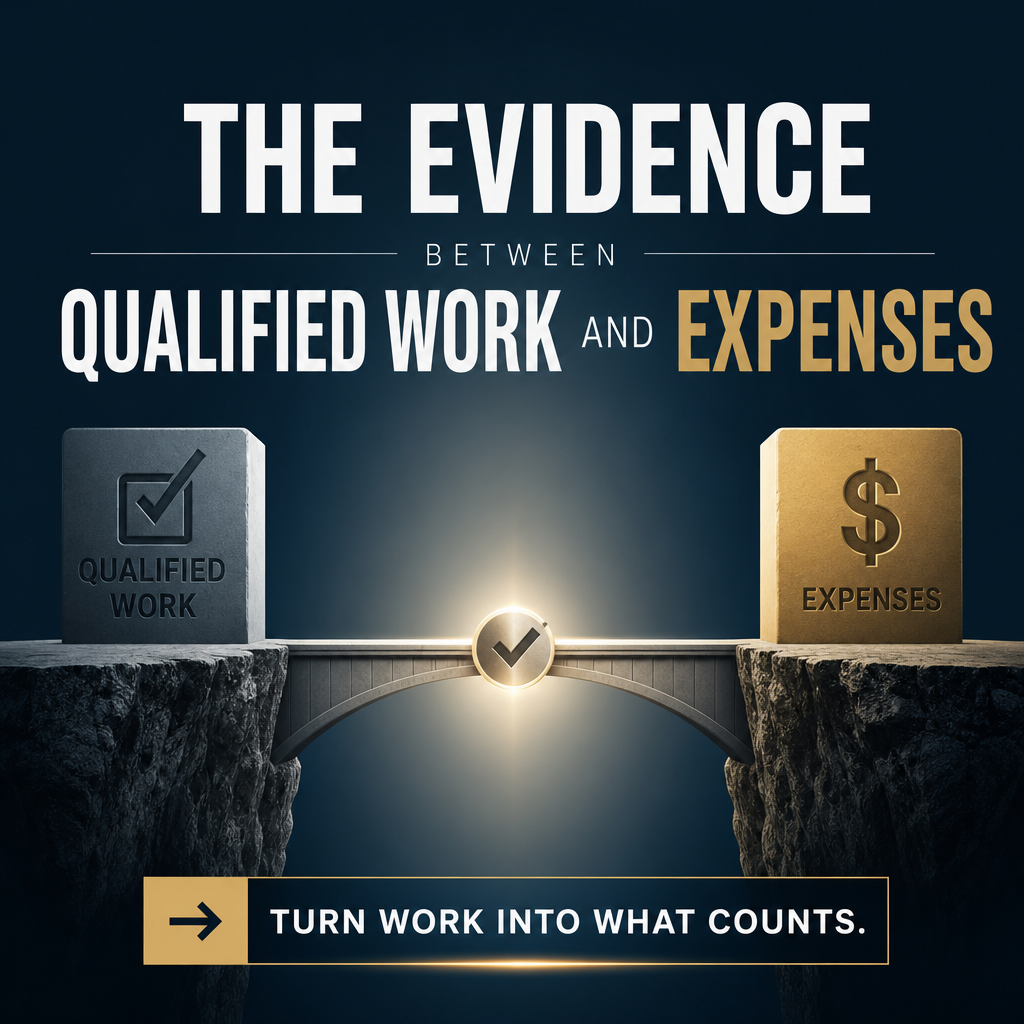
How to Build and Automate a compliant R&D Study:
For many US startups and small to mid-sized businesses, the biggest R&D Tax Credit risk isn’t whether you did innovation—it’s whether you can prove the connection between what your teams worked on (Qualified Research Activities) and what you spent (Qualified Research Expenses). This “evidence bridge” is what makes a Research and Development Tax Credits claim defensible, repeatable, and scalable.
An AI R&D CTO changes how that bridge is built. Instead of relying on end-of-year memory, scattered files, and expensive manual clean-up, an AI R&D CTO helps organize the technical narrative, map activities to costs, and produce contemporaneous documentation that supports IRS expectations—without turning your engineers into full-time bookkeepers.
This is the next wave of innovation support: R&D Tax Credit Services that combine compliance rigor with AI-powered R&D intelligence so companies can strengthen technical leadership while recovering innovation costs.
Define “qualified work” in a way to consistently document:
Creating evidence starts with a shared definition of what counts as qualified work. Many companies do real experimentation but document it like ordinary delivery work. A Virtual CTO or AI Chief Technology Officer can help translate day-to-day technical progress into a claim-ready structure by aligning work to the IRS “four-part test” (permitted purpose, technological in nature, elimination of uncertainty, and process of experimentation).
In practice, that means clarifying where the technical uncertainty lived (performance, scalability, accuracy, reliability, manufacturability, etc.), what alternatives were evaluated, what experiments were run, and what results informed the next iteration. With an AI Technology Advisor or AI Technical Advisor perspective, teams learn to capture the “why” behind engineering decisions—because that’s what substantiates Qualified Research Activities.
When your organization uses consistent terminology and documentation patterns, the R&D Tax Credit claim becomes more than a one-time exercise. It becomes a repeatable Innovation Management process that improves audit readiness and reduces friction every tax year.
Map Qualified Research Activities to cost categories that withstand scrutiny:
The evidence bridge fails when activities and expenses live in separate worlds. Your engineers can describe the work, and your finance team can list the costs, but the IRS cares about linkage: which people, which projects, which experimental tasks, and which time periods.
An AI R&D CTO helps establish a practical mapping method between Qualified Research Activities and Qualified Research Expenses across the most common QRE categories:
Employee wages: Who worked on the experimentation, architecture trials, prototyping, testing, refactoring for technical uncertainty, or iterative performance tuning—and when.
Contract research: Which outside specialists contributed to experimental development and how their deliverables support the technical narrative.
Supplies (where applicable): Materials consumed in prototyping and testing.
The goal isn’t to “maximize” by guesswork; it’s to maximize by evidence. Strong mapping helps you pursue R&D Tax Savings and improves Business Cash Flow through a defensible R&D Tax Credit Refund—especially important for smaller companies that can’t afford surprises.

“Artificial intelligence is a strong growth driver for our businesses.”
– Roland Busch, President and CEO of Siemens AG
Build an R&D Study that links decisions, experiments, and results to the dollars spent:
A high-quality R&D Study is where qualified work and expenses meet. It’s not just a summary—it’s the story of uncertainty, experimentation, and advancement, supported by records that tie back to your general ledger and payroll.
An AI R&D CTO strengthens the R&D Study by standardizing what evidence is collected and how it’s organized. Instead of vague descriptions like “developed new features,” the study should reflect technical depth: hypotheses, constraints, test outcomes, failures, iterations, and what was learned.
This is also where AI Product Intelligence and an AI Innovation Platform mindset can add value—by helping leadership see patterns across initiatives, technical barriers that repeat, and areas where the organization is investing heavily in experimentation. While the purpose of the R&D Study is substantiation for the R&D Tax Credit, the side benefit is clearer AI Product Strategy conversations: what are we trying, what is working, and what is draining resources without learning.
Done right, the R&D Study becomes a decision tool—not just a compliance artifact.
Replace “after-the-fact recollection” with contemporaneous documentation and time surveys:
Many R&D Tax Credit claims become painful because documentation is recreated long after the work happened. That increases risk, cost, and disruption. The evidence bridge is strongest when you can show contemporaneous documentation: design notes, test summaries, sprint artifacts, commit narratives, build logs, validation results, technical tickets, and meeting decisions.
An AI R&D CTO helps implement a lightweight system for capturing this evidence throughout the year—without requiring teams to change how they build products. Time surveys are often the turning point. When handled poorly, time surveys feel intrusive and unreliable; when handled well, they become a short, consistent routine that ties technical roles to qualified initiatives.
This is where modern R&D Tax Credit Consultants are evolving: less manual chasing and more structured, repeatable capture. The outcome is faster claim preparation, fewer late nights, and better IRS support if questions arise.
How AI R&D CTOs automate and facilitate the evidence bridge:
Creating the link between Qualified Research Activities and Qualified Research Expenses is exactly where AI can reduce the burden—without touching your company’s proprietary product workflows. Under an AI R&D CTO model, sector-aware language models can help track, organize, and prompt for substantiation that supports a claim.
For smaller companies, the biggest lift is often time tracking and expense attribution. An AI R&D CTO can facilitate ongoing capture by:
• Reducing the manual load of time surveys through consistent prompts that help employees summarize qualified experimentation in plain language.
• Organizing contractor work into claim-ready narratives that tie deliverables to technical uncertainties addressed.
• Tracking QREs in a structured way so wages, contractor costs, and other eligible categories align to projects and time windows.
• Creating a first-draft R&D Study that mirrors how technical teams actually worked, then routing it for review and sign-off.
This approach can make R&D Tax Credit eligibility practical even for micro businesses and early-stage startups—companies that historically skipped credits because the documentation burden outweighed the perceived benefit. The long-term result is Innovation Management at a higher standard, with improved cash flow and more consistent R&D Tax Credit recovery.
Turn the R&D Tax Credit into a self-funding innovation engine:
When the evidence bridge is strong, the R&D Tax Credit becomes predictable—something you can plan around instead of hoping for. That’s where the AI R&D CTO positioning matters: democratizing innovation by giving smaller organizations capabilities once reserved for large enterprises with in-house tax teams and full-time technology leadership.
With better documentation and better linkage between work and spend, companies can:
• Increase confidence in credit estimates and forecasting
• Reduce the cost and disruption of annual claim preparation
• Improve audit resilience by showing clear, consistent support
• Reinvest Tax Savings into continued AI Product Development and experimentation
In other words, your R&D Tax Credits can function like Innovation Funding—helping you extend runway, hire key technical roles, or fund the next iteration of experimentation that drives competitive advantage.
Learn more and estimate your credit:
If you’re building new or improved software, engineering solutions, manufacturing processes, or technical systems, you may be performing Qualified Research Activities without capturing the full benefit. An AI R&D CTO can help enhance knowledge to world-class standards while seamlessly gaining R&D Tax Credits—bridging qualified work to qualified expenses with stronger documentation and less effort from your team.
To learn more and get an estimate of how much R&D Tax Credit your business may qualify for, select the button below.