
 - EN
 - EN
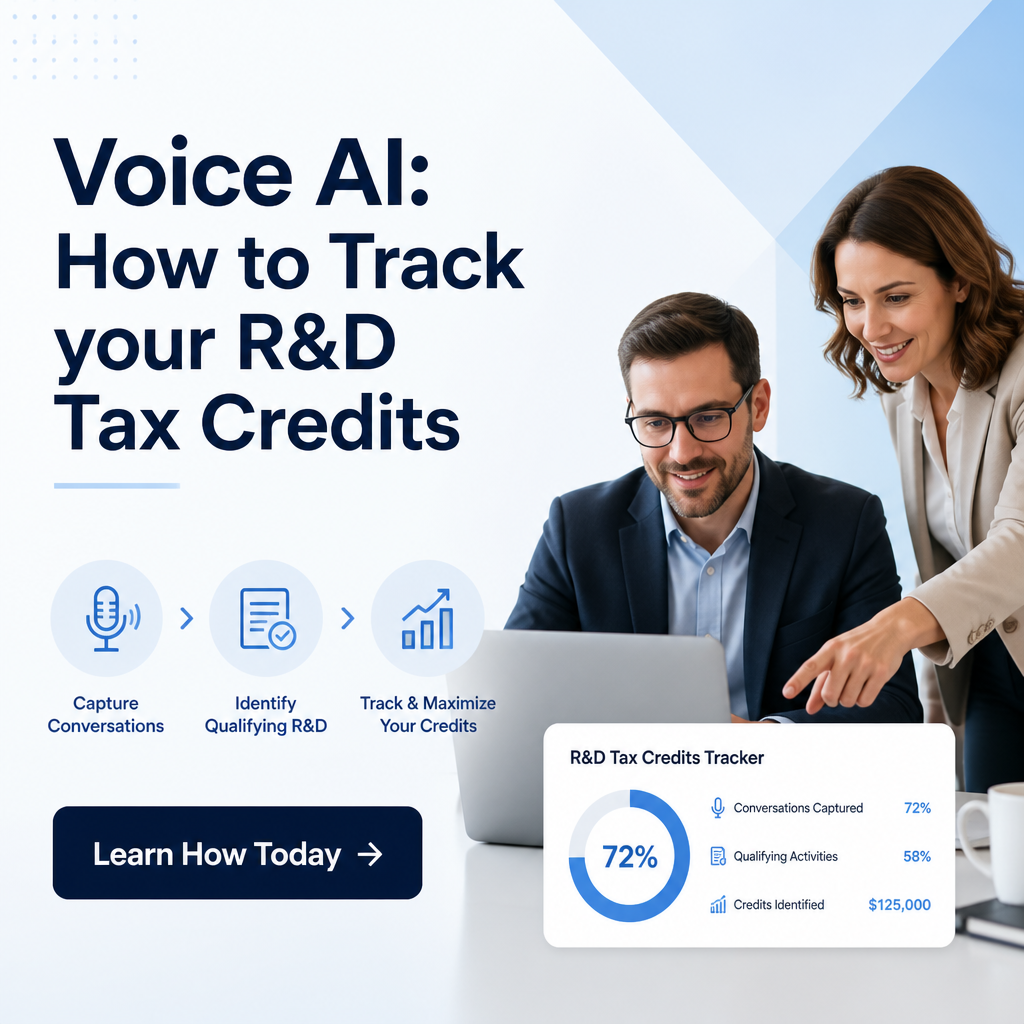
Voice AI for R&D Tax Credits tracking—why the approach matters:
“Voice AI” is quickly becoming a practical way for US businesses to reduce the friction of capturing documentation for R&D Tax Credits. The challenge isn’t usually whether innovation happened—it’s whether the company can prove it with clear, contemporaneous support tied to Qualified Research Activities and Qualified Research Expenses.
For startups and small teams, the problem is time: engineers build, founders sell, and finance closes the books. Months later, someone asks for details needed for an R&D Study and the team reconstructs technical uncertainty, experiments, and iterations from memory. That’s where an AI R&D CTO (including a Virtual CTO or AI Chief Technology Officer approach) changes the game—by making R&D Tax Credit tracking a lightweight, ongoing habit instead of a once-a-year scramble.
Voice-based capture can support the research narrative and the financial trail without forcing employees into complex spreadsheets. When guided by an AI Technology Advisor or AI Technical Advisor, the result is stronger R&D Tax Credit eligibility support, improved IRS readiness, and a smoother path to tax savings and better business cash flow.
Identify Qualified Research Activities with structured voice check-ins:
Most companies already perform Qualified Research Activities; they just don’t label them correctly. A voice-driven workflow can prompt short, recurring check-ins that help teams describe work in ways that map to the IRS 4-part test (permitted purpose, technological in nature, elimination of uncertainty, and process of experimentation).
In practice, Voice AI can capture quick “what changed this week?” updates: what technical uncertainty existed, what hypothesis was tested, what alternatives were considered, and what results were observed. For software teams this might include performance tuning, scalability work, architecture refactoring for reliability, new data pipelines, or novel integration approaches. For manufacturers or engineering firms it may involve process optimization, materials trials, prototype iterations, or test fixture design.
An AI R&D CTO then curates these voice logs into defensible activity descriptions, connecting them to specific projects and technical objectives. This supports R&D Tax Credit Services by reducing ambiguity and helping smaller companies establish R&D Tax Credit eligibility earlier—before year-end—so they can plan around expected tax savings.
Capture Qualified Research Expenses without burdening engineers:
Tracking Qualified Research Expenses is where many claims lose value. Wages, contractors, and supplies can qualify, but only when expenses are tied back to qualifying efforts. Traditional R&D Tax Credit consultants often rely on retroactive interviews, time allocations, and manual compilation—effective, but time-consuming and expensive for small teams.
A Voice AI approach can make time and expense attribution more realistic. Instead of asking engineers to fill out weekly timesheets, voice prompts can capture: which project they worked on, the nature of the experiment, and the approximate split of time between qualifying and non-qualifying tasks. For contractors, the process can record what deliverables were experimental or iterative versus routine implementation.
Under an AI R&D CTO model, these inputs can be reconciled with payroll, contractor invoices, and general ledger categories to produce more accurate QRE estimates. The objective isn’t perfection—it’s a repeatable method that produces reasonable, consistent allocations with traceable support. That’s how R&D Tax Credit Refund opportunities become more attainable for startups and small businesses that previously assumed credits were “only for big companies.”

“Useful AI has arrived.”
– Jensen Huang, founder and CEO of NVIDIA
Turn voice notes into IRS-ready documentation and an R&D Study:
A strong R&D Study is more than a narrative—it’s a coherent evidence package showing what was attempted, why it was hard, and how the team pursued advancement through experimentation. Voice-captured notes are valuable because they are close in time to the work performed, which supports contemporaneous documentation expectations.
With the oversight of an AI Chief Technology Officer or Virtual CTO operating as an AI Technology Advisor, voice inputs can be transformed into organized technical documentation: project summaries, uncertainty statements, experiment logs, and outcome descriptions. This is especially helpful for companies building internal systems, improving algorithms, or engineering novel designs—where the “innovation” is real but difficult to explain to non-technical reviewers.
For R&D Tax Credit Services, the benefit is twofold: (1) less reliance on employee memory months later, and (2) more precise alignment between Qualified Research Activities and Qualified Research Expenses. Well-organized documentation also makes it easier to support Form 6765 preparation and respond to IRS questions with clear project-level traceability.
How an AI R&D CTO replaces manual R&D tax credit tracking methods:
Traditional R&D Tax Credit tracking tends to be reactive: gather data after year-end, schedule interviews, draft narratives, request revisions, and hope the evidence is sufficient. An AI R&D CTO approach modernizes this by making tracking continuous and guided.
Instead of asking teams to “remember what happened,” an AI R&D CTO implements a simple cadence of voice-based technical interviews and prompts. These prompts are designed to surface experimental intent, document dead ends, and separate routine work from true technical uncertainty. When paired with an AI Innovation Platform mindset (focused on structured capture and governance rather than ad hoc notes), companies can create stronger audit-ready support with less disruption.
This shift can reduce dependence on costly, manual processes used by some R&D Tax Credit consultants, while still meeting compliance needs. The aim is not to eliminate expertise—it’s to redirect expert time toward higher-value review, eligibility judgment, and risk management. Done correctly, Voice AI becomes a documentation layer that helps maximize available R&D Tax Credits and improves business cash flow through innovation incentives.
Beyond the credit: Voice AI insights that elevate product and technology leadership:
The highest-performing teams don’t treat R&D Tax Credits as a paperwork exercise—they treat them as an innovation funding lever. An AI R&D CTO extends value beyond the claim by turning captured technical signals into practical guidance.
Because voice updates highlight recurring bottlenecks, dependency risks, and experiment outcomes, leadership can gain AI Product Intelligence and AI Product Strategy insights without adding meetings. Patterns emerge: where teams consistently struggle, which technical barriers consume the most time, and what options were tried. This supports Innovation Management by turning “tribal knowledge” into reusable learning.
For smaller organizations, this is where the category promise of AI R&D CTO becomes real. A Virtual CTO or AI Technical Advisor can help benchmark technical approaches, flag emerging technology considerations, and improve decision quality—while the company simultaneously builds the documentation backbone needed to recover R&D Tax Credits. The result is a more level playing field: enterprise-style technical leadership and innovation intelligence without enterprise overhead.
Next step: estimate your R&D Tax Credit and learn how an AI R&D CTO helps:
If your team is building, testing, prototyping, improving performance, or solving technical uncertainty, you may already have Qualified Research Activities—and you may be leaving Research and Development Tax Credits unclaimed.
An AI R&D CTO helps democratize innovation by supporting R&D Tax Credit eligibility, producing an R&D Study, improving documentation quality, and guiding smarter technical decisions through AI Innovation Management, AI Product Development alignment, and ongoing product intelligence.
To learn more and receive an estimate of how much your R&D Tax Credit could be, select the button below.