
 - EN
 - EN
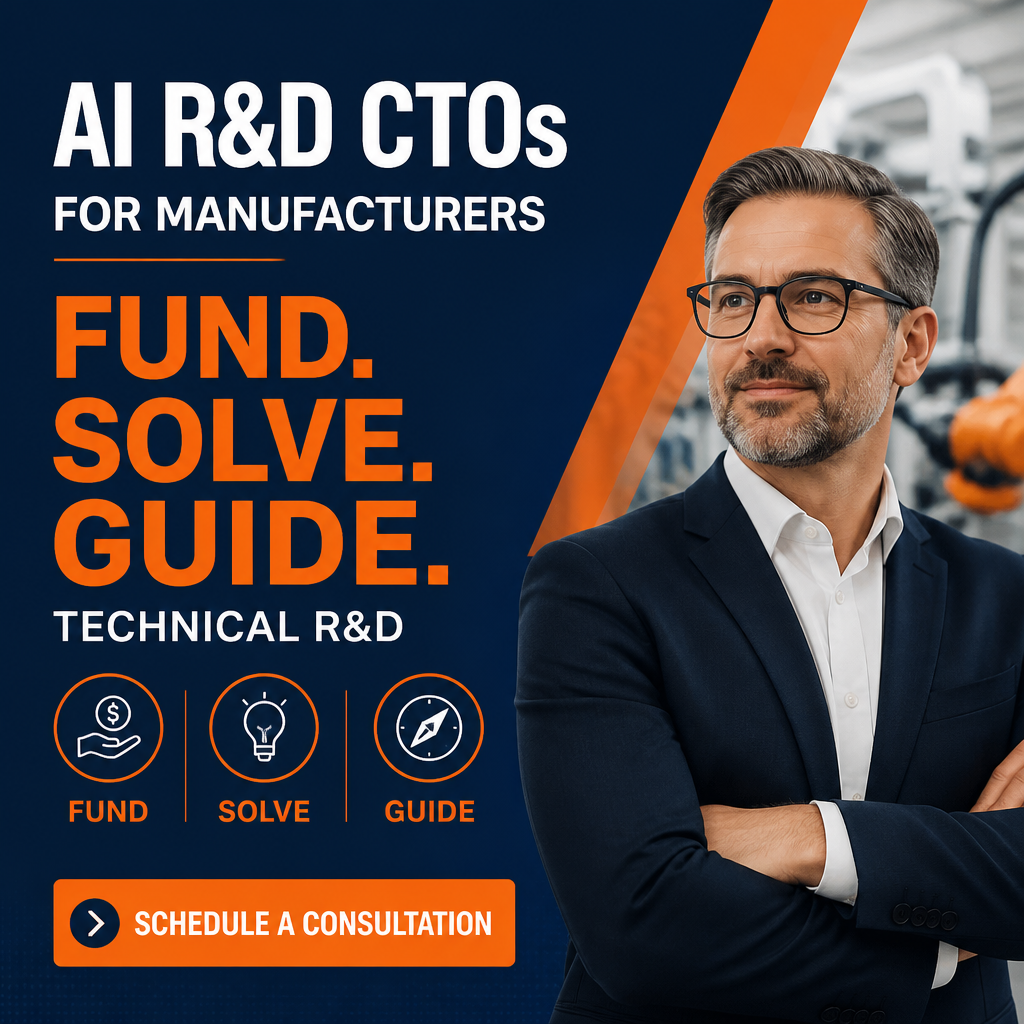
AI R&D CTOs for Manufacturers: A FUND, SOLVE & GUIDE operating model:
Manufacturers are under constant pressure to improve yield, reduce scrap, automate processes, and launch better products—often with lean engineering teams and limited time for documentation. At the same time, many of these same efforts may qualify for R&D Tax Credits, but the evidence and cost tracking frequently live in spreadsheets, tribal knowledge, and scattered project files.
An AI R&D CTO is an operating layer that sits across manufacturing engineering, quality, operations, and finance to do three things in one workflow: FUND innovation through R&D Tax Credit capture, SOLVE technical barriers by surfacing structured technical intelligence, and GUIDE technology strategy with ongoing competitive benchmarking. This is not “another tool.” It’s a new way to run technical R&D administration and decision support—where AI handles continuous capture, organization, drafting, and research, while people validate, decide, and sign off.
For many manufacturers, this model can also complement a Virtual CTO, an AI Chief Technology Officer, or an AI Technology Advisor—especially when internal technical leaders are overloaded and the company needs reliable Innovation Management without building a large staff.
FUND: Turning production experimentation into R&D Tax Credits and better business cash flow:
Manufacturing R&D is often hidden in plain sight: process changes to hit a tighter tolerance, tooling modifications to reduce wear, automation debugging, material trials to improve performance, or scale-up work to stabilize cycle time. These efforts can become Qualified Research Activities (QRAs) when they meet the standard four-part test and involve a systematic process to resolve technical uncertainty.
An AI R&D CTO helps manufacturers recognize and frame day-to-day engineering work as potential QRAs and then organize the supporting narrative and records needed for an R&D Study. Instead of waiting until year-end (when details are forgotten), the AI R&D CTO can facilitate lightweight, ongoing capture so your team isn’t reconstructing history under deadline.
On the cost side, an AI R&D CTO can support the identification and organization of Qualified Research Expenses (QREs) such as eligible wages, certain contractor costs, and supplies consumed during experimentation and trial runs. The goal is to translate real shop-floor uncertainty and experimentation into CPA-ready support for Form 6765 preparation and a defensible R&D Tax Credit claim.
The outcome is practical: improved business cash flow through tax savings and, in many cases, an R&D Tax Credit Refund (or payroll tax offset for eligible startups). Done well, the credit becomes a self-funding innovation engine—helping manufacturers reinvest in automation, prototyping, tooling, and process controls.
SOLVE: Resolving manufacturing technical uncertainty with AI Product Intelligence:
Manufacturing teams don’t need generic “AI transformation” promises. They need to solve specific technical problems: repeatability, tolerance stack-ups, scrap spikes, automation reliability, and material behavior that changes at scale.
An AI R&D CTO supports AI Product Intelligence and AI Product Development decision-making by bringing structured, outside-in learning into the same workflow used to capture R&D Tax Credits. This may include:
• Finding comparable engineering approaches across industries (e.g., methods used in packaging, automotive, or medical devices that translate to your process)
• Summarizing emerging methods in process control, sensing, or fixturing
• Organizing hypotheses and experiment plans around a defect mode (warpage, cracking, inconsistent surface finish)
• Helping engineering leaders document why a technical approach was uncertain and how experimentation reduced that uncertainty
This “SOLVE” capability is especially valuable for smaller manufacturers who can’t always hire a full bench of specialists. The AI R&D CTO does not replace your engineers; it reduces the time wasted searching, rewriting, and chasing documentation while providing an AI Technical Advisor layer that keeps teams from getting trapped in the day-to-day bubble.

“AI is creating a generational shift in technology.”
– Cristiano Amon, President and CEO of Qualcomm
GUIDE: A manufacturing Technology Radar that informs AI Product Strategy and capital decisions:
Manufacturing innovation is often constrained by what the plant has seen before. The “GUIDE” function of an AI R&D CTO adds ongoing technology strategy support: what’s changing in automation, metrology, process monitoring, materials, or tooling—and what competitors may be adopting.
In practice, this looks like a continuous Technology Radar and competitive benchmarking process that informs AI Product Strategy and operational roadmaps. For example:
• If your team is fighting recurring scrap tied to process drift, the AI R&D CTO can summarize trends in in-line inspection, statistical process control enhancements, or sensor fusion approaches.
• If your bottleneck is changeover time, it can surface methods in quick-change tooling design or mistake-proofing (poka-yoke) patterns used in adjacent sectors.
This is where an AI Innovation Platform model matters: not a single report, but an ongoing loop of learning, prioritization, and execution support that makes Innovation Management sustainable for lean teams.
How an AI R&D CTO replaces manual R&D Tax Credit preparation for manufacturers (workflow example):
Traditional R&D Tax Credit Services often rely on year-end interviews, retroactive project summaries, and manual time estimates. Manufacturers then face a familiar pain: engineers pulled off the floor to “write stories” about work they did months ago.
An AI R&D CTO can streamline the process by using sector-specific, manufacturing-trained LLM workflows to capture evidence in real time and draft documentation with higher precision. A tangible sequence looks like this:
Technical work occurs → AI voice interview or guided email check-in captures the change (tooling, parameter shifts, automation debugging) → potential QRA is identified and mapped to technical uncertainty → evidence is anchored (drawings, change orders, test results, scrap reports, QC charts) → employee activity is confirmed and categorized → QRE data is organized from payroll/accounting views → technical barrier is summarized with experimentation steps → human managers and R&D Tax Credit Consultants review, validate, and finalize.
This approach can also connect to existing project management, ERP, and accounting systems to reduce time survey burden and improve contemporaneous documentation. The result is a cleaner R&D Study package, stronger IRS compliance posture, and less disruption to operations.
Manufacturing examples that frequently support Qualified Research Activities (QRAs):
Manufacturers often assume R&D Tax Credits only apply to “new inventions.” In reality, QRAs can include disciplined experimentation to improve or develop processes, products, or software used in manufacturing operations.
Common examples include:
• Yield improvement without sacrificing performance: experimenting with process windows, fixtures, or inspection methods to reduce scrap
• Automation and controls troubleshooting: resolving reliability issues in robotics, PLC logic, vision systems, or integration steps where outcomes are uncertain
• Tooling and fixturing redesign: iterative changes to hold difficult specs, reduce vibration, or improve repeatability
• Material or supplier substitutions: trials to maintain strength, corrosion resistance, or surface finish while reducing cost or improving availability
• Scale-up challenges: when a process works in pilot runs but fails under throughput, heat, or wear conditions in production
An AI R&D CTO helps translate these into compliant documentation: what uncertainty existed, what alternatives were evaluated, what tests were run, and what knowledge was gained—then ties that narrative to QREs so the R&D Tax Credit claim is complete.
Learn more: Estimate your R&D Tax Credit and see how an AI R&D CTO can elevate your technical edge:
Manufacturers shouldn’t have to choose between running the plant and capturing innovation incentives. SHAIN’s AI R&D CTO positioning democratizes innovation by helping startups, micro businesses, and small-to-mid-sized manufacturers recover R&D Tax Credits while gaining access to technical leadership and innovation intelligence previously available only to large enterprises.
If you want to understand whether your process improvements, automation work, prototyping, or scale-up efforts qualify—and how much business cash flow you could unlock—select the button below to get an estimate and learn how an AI R&D CTO can enhance knowledge to world-class standards while seamlessly gaining R&D tax credits.