

 - EN
- EN  - EN
- EN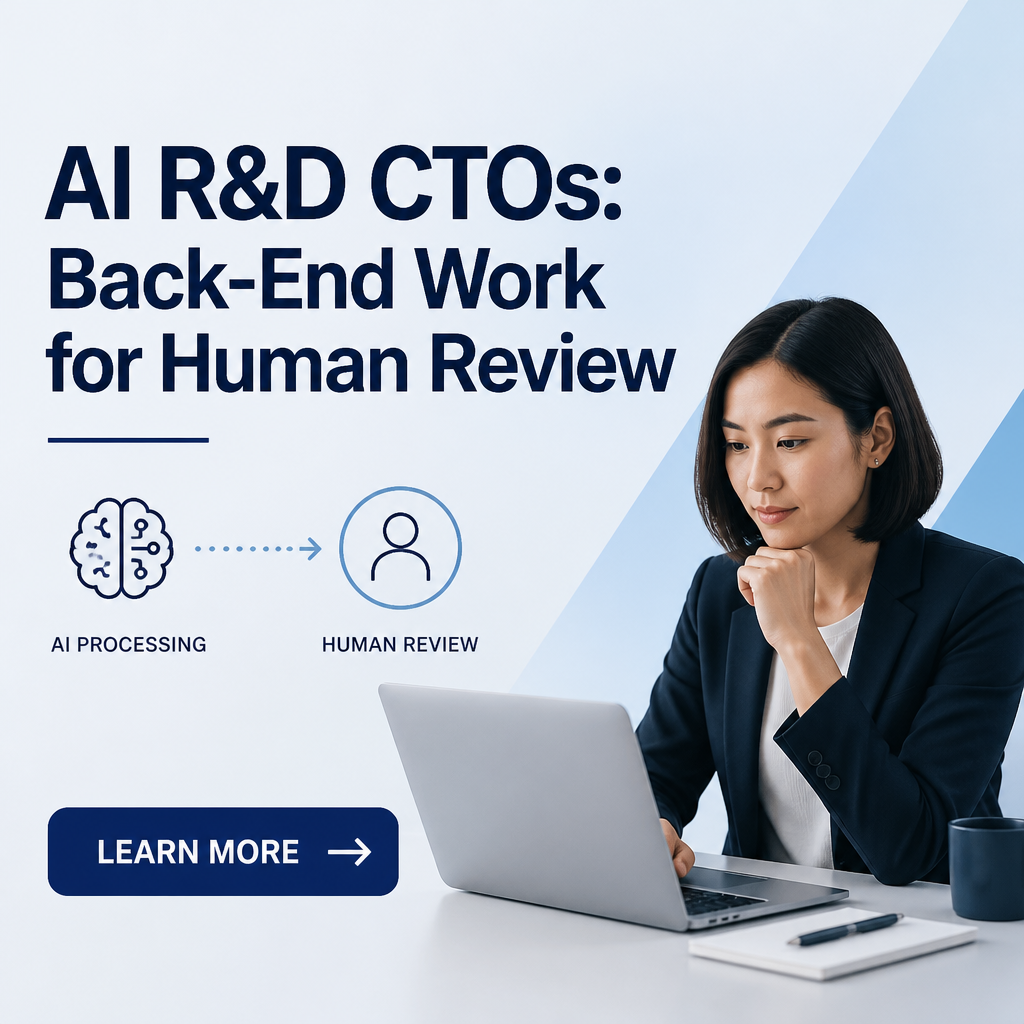
Explore What an AI R&D Back Office is:
The most valuable role for AI isn’t replacing experts—it’s completing the research, analysis, documentation, and preparation work before an expert ever needs to review it. That single shift changes how companies access R&D Tax Credits and how technical leaders operate.
Traditional professional services typically follow a labor-heavy path: collect information → analyze it → organize it → research it → draft it → check it → revise it. An AI R&D CTO model changes the sequence: AI collects → AI analyzes → AI prepares → human reviews.
This is exactly where an AI R&D CTO (often delivered as a Virtual CTO) creates leverage for small and mid-sized businesses. Instead of making a CPA, controller, or engineering manager “discover the R&D,” the AI Chief Technology Officer approach ensures the R&D is already organized for review—improving accuracy, accelerating turnaround, and making the R&D Tax Credit more feasible even when internal teams are lean.
In practice, an AI Technology Advisor and AI Technical Advisor focus on the back-end work: capturing technical evidence, mapping it to eligibility, structuring it into an R&D Study format, and assembling support that R&D Tax Credit consultants and CPAs can quickly validate. The result is a more scalable, review-first model that supports IRS compliance requirements while reducing disruption to engineering teams.
Identifying Qualified Research Activities with sector-aware R&D Tax Credit Intelligence:
Many startups, software companies, manufacturers, engineering firms, and technology businesses perform qualifying work without labeling it as R&D. The R&D Tax Credit doesn’t require lab coats—it requires a disciplined attempt to resolve technical uncertainty.
An AI R&D CTO helps teams identify Qualified Research Activities (QRAs) by first organizing projects and initiatives into “potential R&D candidates,” then mapping them to the 4-part test: permitted purpose, technological in nature, elimination of uncertainty, and process of experimentation. This is especially powerful when sector-specific trained language models are used to recognize patterns in technical work (for example: prototype iterations in manufacturing, algorithm tuning in software, test failures in engineering design, or performance optimization in systems).
The back-end work becomes tangible: the AI Innovation Platform can prompt teams to describe what was uncertain, what alternatives were evaluated, what tests were run, and what technical advancement was pursued—then draft the initial eligibility rationale. Human experts (CPA partners or R&D Tax Credit Consultants) stay in control of judgment and final positions, but they spend far less time chasing scattered details.
The goal is simple: establish R&D Tax Credit eligibility faster and with higher precision, without relying on memory at year-end.
Capturing technical evidence through structured interviews and contemporaneous documentation:
In an IRS-ready claim, what matters is not just that R&D occurred—it’s how well the company can substantiate it. That’s where the AI R&D CTO model excels at preparation.
Instead of ad hoc email threads and last-minute spreadsheet requests, the AI R&D CTO uses structured technical interviews (including voice-driven capture) to document what engineers and technical staff actually did. The system then converts raw explanations into organized artifacts: project summaries, lists of experiments, defined uncertainties, and identified outcomes.
Next, supporting-document mapping happens before the CPA ever reviews the file. Evidence can be associated to each project: commit histories, tickets, test logs, design drawings, simulation results, change orders, QA reports, and technical emails. This creates contemporaneous documentation that supports both the R&D Study and the R&D Tax Credit claim.
The human-in-the-loop design also addresses the trust question. The right promise is: AI prepares the package, and qualified humans validate, correct, and approve before anything consequential is filed. This protects compliance while dramatically reducing the hours wasted on low-value collection and formatting.

“A robot will likely be on the cover of time magazine as the best CEO.”
– Jack Ma, founder of Alibaba.
Calculating Qualified Research Expenses and producing time surveys without disrupting engineers:
For many companies, the biggest barrier to claiming Research and Development Tax Credits is not eligibility—it’s the burden of quantifying Qualified Research Expenses (QREs). Wages, contractors, and supplies must be associated to qualifying projects in a defensible way.
An AI R&D CTO reduces that burden by preparing time-survey drafts and allocation logic that reflect actual project activity. Instead of asking employees to reconstruct an entire year from memory, the system prompts quarterly (or periodic) confirmations and organizes responses into ready-to-review schedules.
The back-end output can include: employee lists mapped to projects, contractor scopes aligned to QRAs, supply usage summaries tied to experimental trials, and exception flags where data appears incomplete. That means fewer follow-ups and fewer cycles between finance and engineering.
This is where R&D Tax Credit Services become more scalable. More clients no longer automatically means more consultant hours spent assembling basic schedules. The AI R&D CTO does the heavy preparation, and humans focus on review, reasonableness checks, and final technical and tax judgment. The outcome is better Business Cash Flow through faster claims, improved Tax Savings visibility, and a clearer path to an R&D Tax Credit Refund when applicable.
Creating an R&D Study package that CPAs can review instead of starting from scratch:
A practical way to see the difference is to compare workflows.
Traditional CPA workflow: client sends spreadsheets → CPA asks questions → CPA identifies missing information → client contacts engineers → more documents arrive → CPA reconciles information → technical study prepared → tax review.
AI R&D CTO workflow: voice/structured interviews capture technical detail → projects are organized → 4-part test analysis is drafted → QRAs are identified → QRE schedules are assembled → technical narratives are drafted → supporting documentation is mapped → issues are flagged → CPA reviews a prepared package.
That last point is the positioning line that matters: the CPA shouldn’t have to discover the R&D. The CPA should receive the R&D already organized for review.
This approach improves collaboration with external R&D Tax Credit Consultants as well. Instead of paying experts to do foundational collection and drafting, the AI R&D CTO prepares first drafts and structured evidence, allowing consultants to concentrate on higher-value work: eligibility nuance, audit readiness, defensible methodology, and optimization across years.
The result is a cleaner path to Form 6765 preparation, with fewer missing fields, fewer inconsistencies, and faster completion of the R&D Study.
Extending beyond credits: AI Product Intelligence that supports better decisions (GUIDE) and faster barrier resolution (SOLVE):
R&D Tax Credits are the strongest proof case because the inputs and outputs are well-defined: identify eligible work, document it, quantify expenses, and support compliance. But the same AI R&D CTO architecture also supports broader Innovation Management.
SOLVE: when engineers hit a technical barrier, the AI R&D CTO can prepare research—reviewing public literature, comparing competing approaches, summarizing relevant methods, and drafting potential solution paths. Then the engineering team reviews and decides.
GUIDE: when leadership needs technology direction, the AI R&D CTO can prepare competitive benchmarking, track emerging technologies, and assemble a “technology radar” to support Technology Strategy and AI Product Strategy discussions. Then management reviews and decides.
This is where AI Product Intelligence and AI Product Development support become meaningful without touching or describing any company-specific product processes. The value is in preparation: the AI Technology Advisor compiles intelligence, drafts options, and flags risks so humans can apply judgment.
A simple operating model emerges:
1) AI WORK: research, analyze, interview, organize, compare, calculate, draft, document
2) HUMAN REVIEW: validate, correct, challenge, approve
3) HUMAN DECISION: file, experiment, invest, develop, act
That is how a Virtual CTO model can bring enterprise-level preparation capacity to smaller organizations—without the cost of large internal teams.
Turning the R&D Tax Credit into a self-funding innovation engine:
When companies consistently capture QRAs, quantify QREs, and maintain documentation, the R&D Tax Credit becomes more than an annual exercise—it becomes a repeatable innovation incentive. Strong claims improve predictability, making it easier to plan hiring, prototyping, testing, and technical experimentation.
This is the democratization effect: an AI R&D CTO helps startups, micro businesses, and small companies recover R&D Tax Credits while gaining access to technical leadership and innovation intelligence previously available only to large enterprises.
The best outcomes typically include:
– Improved cash flow through innovation incentives
– Stronger documentation and IRS readiness
– Better coordination between finance and engineering
– More consistent capture of Qualified Research Activities and Qualified Research Expenses
– A clearer innovation narrative that supports both technical leadership and tax reporting
With the right human review layer—CPA, tax leader, or experienced reviewer—the company gains speed and scalability without sacrificing control.
Learn how an AI R&D CTO can elevate your documentation and help estimate your R&D Tax Credit:
If your team is building, testing, improving, or experimenting to resolve technical uncertainty, you may already have substantial Qualified Research Activities—and may be leaving Research and Development Tax Credits unclaimed.
An AI R&D CTO brings modern, AI-powered preparation to R&D Tax Credit claims: identifying eligibility, drafting technical narratives, assembling support documentation, and preparing QRE schedules so experts can focus on review and judgment.
To learn more about how an AI R&D CTO can enhance knowledge to world-class standards while seamlessly gaining R&D tax credits—and to get an estimate of how much your R&D Tax Credit could be—select the button below.