
 - EN
- EN  - EN
- EN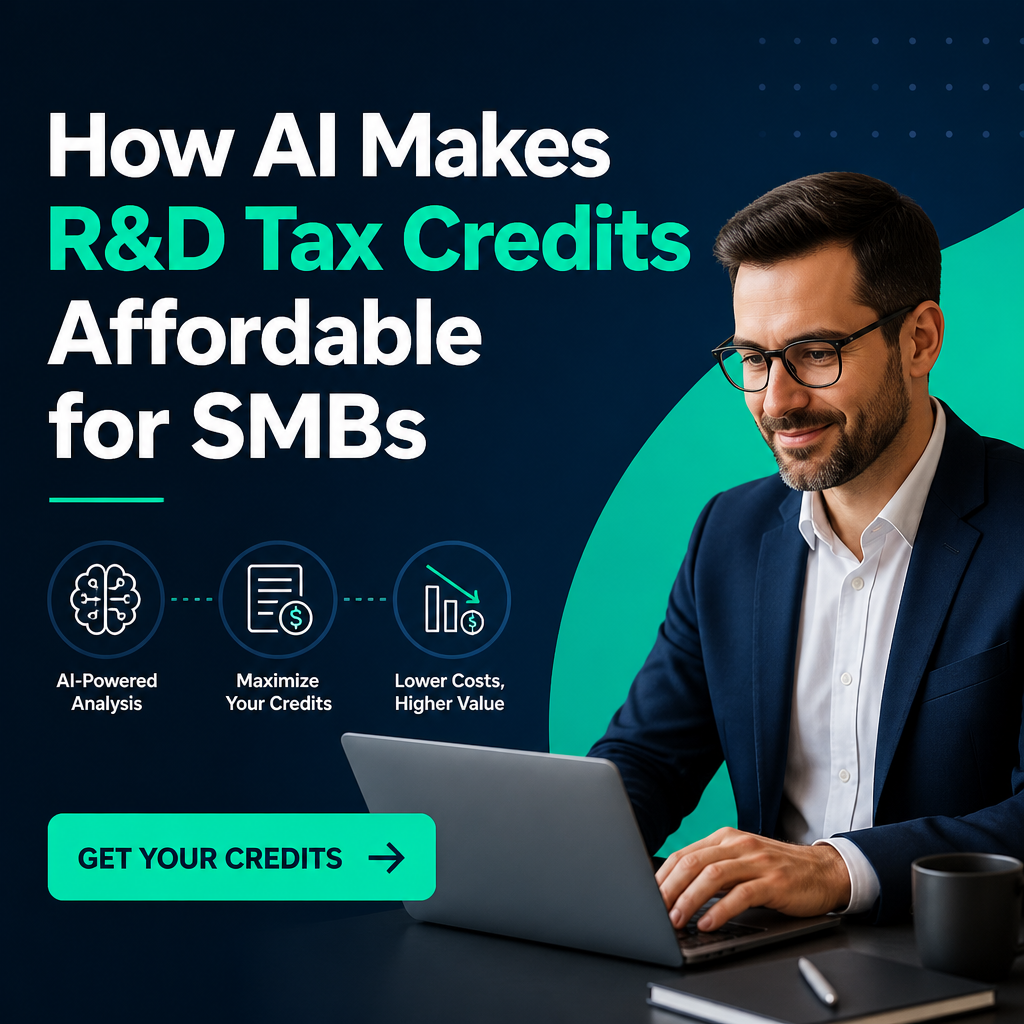
How AI makes R&D Tax Credits Affordable for SMBs:
R&D Tax Credits were created to encourage innovation—but for many small businesses, the cost and effort of claiming them can feel disproportionate to the benefit.
A company with five developers may be performing genuine Qualified Research Activities (QRAs), but it doesn’t have a tax department, an R&D documentation team, or employees with days to spend completing questionnaires.
AI is changing those economics.
The point isn’t simply that “AI is cheaper.” It’s that AI changes the cost structure of delivering R&D Tax Credit Services—reducing repetitive manual work, lowering the burden on internal teams, and allowing expert review time to focus on judgment, eligibility, validation, and IRS compliance. That shift is especially meaningful for startups and SMBs that previously assumed Research and Development Tax Credits were only practical for larger companies.
Why the traditional model can work against SMBs:
A $50 million company pursuing a substantial R&D Tax Credit can justify weeks of consultant time, multiple engineering interviews, documentation exercises, and internal administration. The cost may be high, but the credit can be higher.
Now consider a 10-person software company or a 20-person manufacturer. Even if it has real technical uncertainty, experimentation, and iterative development, obtaining R&D Tax Credits the traditional way can require:
• Management time coordinating data pulls and meetings
• Technical interviews that interrupt Product Development cycles
• Project reconstruction months after work occurred
• Detailed technical narratives drafted from scattered notes
• Analysis of Qualified Research Expenses (QREs) across payroll, contractors, and supplies
Many founders reach a rational conclusion: “This is too much work for us.”
That’s the market inefficiency. The smallest innovative businesses can be the ones that need innovation funding and Business Cash Flow relief the most—yet they’re least equipped to handle an administrative-heavy process. AI, used correctly and reviewed by professionals, helps close that gap while keeping the claim grounded in the facts and the rules.
Identify Qualified Research Activities (QRAs) with an AI R&D CTO lens:
At the center of affordability is faster, more precise identification of what actually qualifies. An AI R&D CTO (or AI Chief Technology Officer) approach combines R&D Tax Credit intelligence with technical leadership framing—so teams can recognize qualifying work while it’s happening.
For SMBs, QRAs often hide in plain sight:
• Software: resolving performance bottlenecks, improving scalability, refactoring for reliability, building novel data pipelines, or addressing security constraints
• Manufacturing: trial runs, process tuning, yield improvements, fixture and tooling iterations, materials experimentation
• Engineering: prototyping, simulation, failure analysis, and design alternatives tested under constraints
A capable AI Technology Advisor or AI Technical Advisor framework helps translate what engineers naturally do—hypothesis, testing, iteration—into the language that supports the four-part test. The goal is not to “force” eligibility; it’s to accurately capture technical uncertainty, the alternatives evaluated, and the experimentation performed.
This is also where Innovation Management improves: teams start to see R&D as an organized portfolio of learning, not a scramble to remember what happened at year-end.

“Firms that understand how to use AI as a new tool in the broader context of process reengineering will arguably get the most from AI in the long run.”
– Harvard Business Review
Calculate Qualified Research Expenses (QREs) without the year-end scramble:
For SMBs, the hardest part is often not the technology—it’s the time sink of tracing costs. QREs typically include wages for employees performing or supervising qualified research, certain contractor costs, and supplies used in experimentation.
AI-assisted R&D Tax Credit processes help reduce manual effort by organizing expense inputs and mapping them to projects and activities more consistently. Instead of relying on memory and scattered spreadsheets, an AI-guided workflow can prompt structured capture of:
• Which roles contributed to specific technical objectives
• Which projects involved experimentation versus routine work
• Which contractor efforts supported qualifying research
• Which supplies were consumed in prototype builds or experimental trials
The affordability breakthrough is that SMB employees spend less time doing “tax admin,” while R&D Tax Credit Consultants and tax professionals spend less time chasing missing information. Expert time shifts toward reviewing the work, confirming assumptions, and ensuring the claim is defensible.
Build an R&D Study and technical narrative that stands up to scrutiny:
A strong R&D Study is more than a summary—it’s the story of uncertainty and experimentation, tied to business objectives and supported by credible documentation.
An AI Innovation Platform approach—used specifically for R&D Tax Credit preparation—can assist in drafting technical narratives that describe:
• The technical uncertainty at the start of the work
• The alternatives considered (architectures, materials, processes, algorithms)
• The tests, prototypes, and iterations performed
• The technical advances achieved (or what was learned if attempts failed)
For SMBs, the value is consistency and speed. Instead of producing thin narratives that leave questions unanswered, teams can generate more complete first drafts and then apply professional review to ensure accuracy, proper framing, and compliance.
This is where AI Product Intelligence and AI Product Strategy matter in a supporting role: better structured capture of product and engineering decisions creates clearer documentation trails, which strengthens both Innovation Management and the eventual R&D Tax Credit claim.
Voice-driven technical interviews and time surveys that reduce employee burden:
Affordability isn’t only about the consultant’s invoice. Employee time is a real cost.
Traditional engagements often rely on long questionnaires, rigid meetings, and a year-end “reconstruction” of what happened. For SMBs, that can mean founders, a Virtual CTO, and key engineers spending hours answering repetitive questions while deadlines loom.
A modern AI R&D CTO model can replace much of that friction with lighter, periodic Voice AI check-ins designed to capture the essentials in the moment:
• What the team attempted to build or improve
• What technical barriers emerged
• What experiments were run and what changed
• Where time was spent across qualifying versus non-qualifying activities
Those conversations can be converted into structured notes that support time surveys and contemporaneous documentation—reducing the need for end-of-year memory games. Humans still validate the outcome, but the capture process becomes simpler, faster, and more consistent for small teams.
Automating R&D Tax Credit claim support:
When SMBs say R&D Tax Credits feel “too hard,” they’re usually reacting to the manual nature of the work: chasing documents, rebuilding timelines, coordinating interviews, and stitching together reports.
AI-enabled workflows can automate and facilitate major parts of the support process while keeping professional oversight where it belongs:
• Preliminary classification of activities as potentially qualified research (to be confirmed)
• Organizing project artifacts (tickets, commit summaries, test notes) into coherent project threads
• Drafting sections of documentation for review—rather than writing from scratch
• Flagging missing details needed for IRS compliance requirements
• Standardizing inputs used for Form 6765 preparation support
This is not about removing experts. It’s about ensuring that R&D Tax Credit Services scale down to SMB realities—so smaller companies can access Tax Savings and potential R&D Tax Credit Refund opportunities without absorbing disproportionate internal workload.
Beyond credits: AI R&D CTO support for product intelligence and competitive readiness:
The most compelling shift is that an AI R&D CTO is not limited to credit recovery. It can also provide ongoing technical leadership value that SMBs typically can’t afford.
In parallel with R&D Tax Credit Intelligence, the AI R&D CTO capability supports:
• AI Product Strategy: clearer technical tradeoffs and roadmap alignment
• AI Product Development guidance: barrier resolution and structured experimentation
• Competitive benchmarking: understanding how peers solve similar technical problems
• Innovation intelligence: preserving lessons learned so knowledge compounds
This creates a self-reinforcing cycle: better documentation and better decision-making improve the quality of both product outcomes and R&D Tax Credit claims. Over time, the credit becomes part of a self-funding innovation engine—supporting Business Cash Flow while the company keeps building.
Learn more and estimate your potential R&D Tax Credit:
The AI R&D CTO democratizes innovation by helping startups, micro businesses, and small companies recover R&D Tax Credits while gaining access to technical leadership and innovation intelligence previously available only to large enterprises.
If you suspect your team is solving technical problems, building prototypes, running experiments, or iterating on software and systems under uncertainty, you may have qualifying work—and unclaimed Tax Savings.
To learn how an AI R&D CTO can enhance knowledge to world-class standards while seamlessly gaining R&D tax credits, request an estimate of how much your R&D Tax Credit could be by selecting the button below.