
 - EN
- EN  - EN
- EN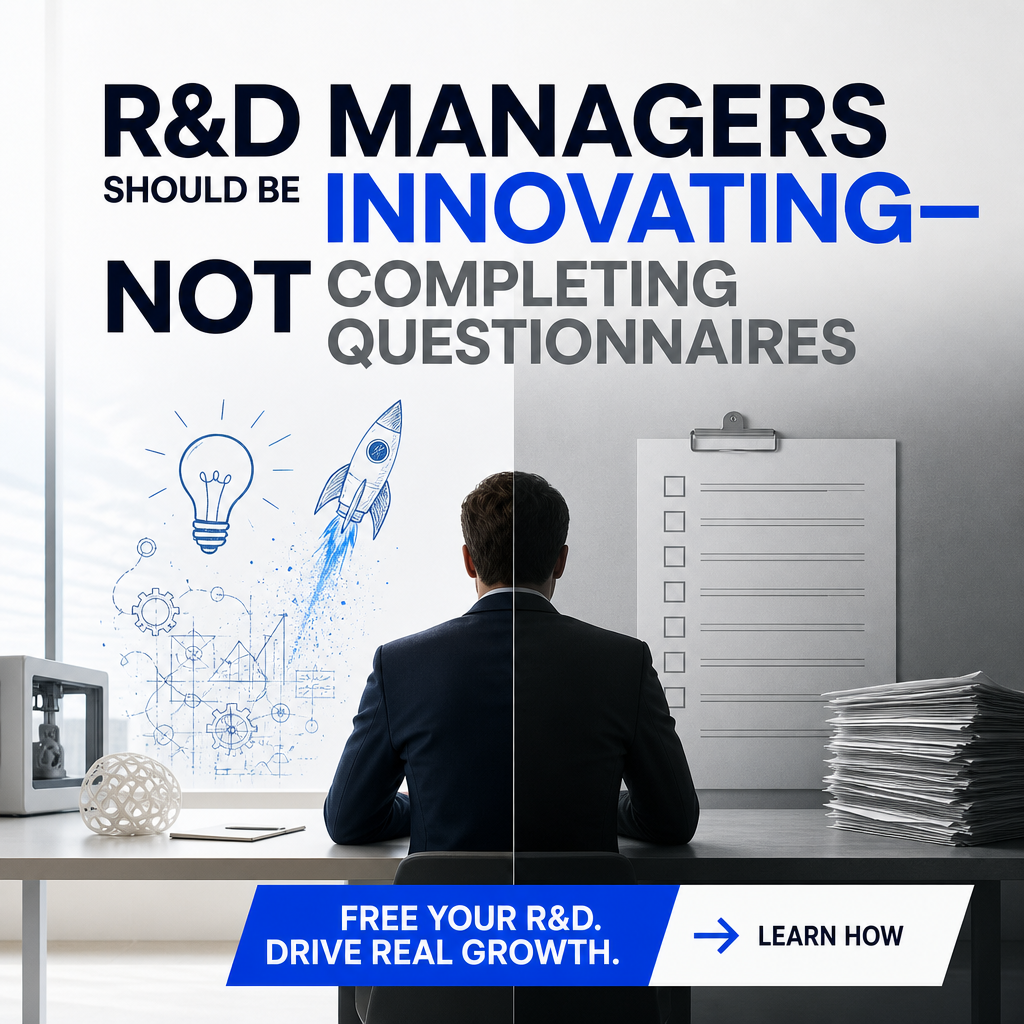
The challenge R&D managers face every year:
Some of the highest-paid and most technically skilled people in a company spend weeks every year completing questionnaires about work they’ve already finished.
Pause.
Does that really make sense?
For many R&D managers, the annual Research and Development Tax Credits process becomes an interruption cycle: late-stage data calls, spreadsheet wrangling, and repeated interviews that pull engineers away from the work that actually creates value. The irony is hard to miss—teams doing genuine innovation are asked to stop innovating to explain innovation after the fact.
The problem isn’t that questionnaires are inherently bad. The issue is timing. By the end of the year, projects have evolved, priorities have changed, and details have faded. What gets documented is often a reconstructed narrative rather than a precise record of technical uncertainty, experimentation, and advancement.
That creates a real business cost: innovation slows, morale drops, and the organization risks leaving R&D Tax Credits on the table—or producing weaker support if audited. The alternative operating model is simple: capture the right information while the work happens, not months later.
Why late questionnaires break the R&D Tax Credit process:
Traditional R&D Tax Credit workflows often rely on long questionnaires, spreadsheets, interviews, time estimates, and reconstructing technical work from memory. That approach creates predictable failure points for an R&D Study:
First, engineers are interrupted. When technical leaders and ICs are forced into retrospective “tell me what happened” sessions, it diverts time away from product iteration, experimentation, and problem-solving.
Second, important details are forgotten. The 4-part test and IRS expectations are met most cleanly when a company can show what uncertainty existed, what alternatives were evaluated, and how experimentation progressed. Months later, the nuance is missing.
Third, technical uncertainty is reconstructed instead of captured. That’s a subtle but meaningful difference. A reconstructed story may be accurate in spirit, but it often lacks evidence.
Finally, documentation quality depends on memory rather than contemporaneous documentation. When a claim depends on late recollection, the support package becomes inconsistent across teams and projects.
R&D Tax Credit consultants and R&D Tax Credit Services can still produce results using traditional methods, but the process often places the administrative burden on the same people the business needs focused on innovation. For small and medium-sized companies trying to improve Business Cash Flow, that friction can be the reason the R&D Tax Credit Refund is delayed, reduced, or never pursued at all.
Identify Qualified Research Activities while innovation is happening:
R&D managers don’t need more paperwork—they need a system that recognizes Qualified Research Activities (QRAs) as teams work through technical uncertainty. When the identification happens in real time, the R&D Tax Credit claim becomes clearer and more defensible.
This is where an AI R&D CTO model changes the operating cadence. Instead of waiting until year-end, the AI R&D CTO (or Virtual CTO support) helps teams consistently capture which initiatives likely qualify under the R&D Tax Credit framework—especially in software, manufacturing, engineering, and emerging technology environments.
Examples of QRAs that are commonly missed when documentation is late include:
• Software releases where teams experimented with performance, scalability, reliability, or security approaches
• Manufacturing process trials that tested parameters, tooling, tolerances, or material behavior
• Engineering redesigns where alternative architectures were evaluated to resolve technical constraints
• Data and systems integration work where teams iterated to overcome technical limitations
The goal is not to create more work. The goal is to establish R&D Tax Credit eligibility with less disruption—so the R&D manager can stay focused on innovation leadership.

“Smart companies are viewing the introduction of AI as the rationale for a new look at end-to-end processes.”- Harvard Business Review
Track Qualified Research Expenses without spreadsheets and memory:
Even when teams can describe their QRAs, the claim often stalls on Qualified Research Expenses (QREs). Time tracking estimates, contractor allocations, and supply usage frequently get assembled months later through spreadsheets and “best guess” apportionment.
A modern approach uses continuous capture to reduce that manual burden. Under an AI R&D CTO model, QRE tracking becomes a guided, lightweight process that helps smaller companies make claiming feasible—without turning engineers into accountants.
Done correctly, this approach supports:
• Employee time surveys that are prompted and confirmed closer to when work occurred
• Contractor and vendor activity mapping to qualifying technical objectives
• Supplies and trial costs tied to experimental iterations in manufacturing and engineering settings
• Clear project timelines that align technical milestones with cost attribution
This matters because QRE accuracy directly impacts Tax Savings and the size of the R&D Tax Credit Refund. Better expense capture also improves CPA readiness and reduces the back-and-forth that often occurs between internal teams, CPAs, and R&D Tax Credit Consultants.
Build CPA-ready R&D Studies and IRS support documentation:
A strong claim is an evidence-backed story of technical advancement. For many businesses, the biggest lift is producing an R&D Study and contemporaneous documentation that supports Form 6765 preparation.
When documentation is captured continuously, the study becomes a compilation task rather than a reconstruction exercise. Instead of relying on late interviews alone, the organization can maintain organized support that maps:
• The technical uncertainty that existed at project start
• The hypotheses or alternatives considered
• The experimentation performed (iterations, tests, prototypes, simulations)
• The results that drove technical decisions
• The advancement achieved relative to baseline capability
This is where an AI Chief Technology Officer approach—paired with an AI Technology Advisor and AI Technical Advisor perspective—helps translate complex technical work into consistent, audit-resilient narratives. The output isn’t “more words.” It’s better structure, clearer evidence, and tighter linkage between technical work and Qualified Research Activities.
For R&D managers, the benefit is immediate: fewer fire drills, fewer repeat interviews, and fewer disruptive data calls—while improving compliance readiness.
Replace late manual methods with continuous R&D Tax Credit intelligence:
The future of R&D Tax Credits isn’t asking engineers to remember what happened last year. It’s capturing innovation while it happens.
An AI R&D CTO operating model replaces the most painful parts of the traditional workflow—without criticizing questionnaires themselves. The point is that late documentation is the real enemy.
Instead of forcing end-of-year reconstruction, the AI R&D CTO continuously:
• Captures Voice AI interviews in short, project-based check-ins
• Identifies Qualified Research Activities aligned to the 4-part test
• Tracks Qualified Research Expenses with less reliance on spreadsheets
• Organizes experimentation notes into contemporaneous documentation
• Produces CPA-ready support and drafts that accelerate the R&D Study
The impact is both financial and operational. Financially, businesses improve Business Cash Flow through better, faster R&D Tax Credit recovery. Operationally, R&D managers get time back to lead innovation.
And because the AI R&D CTO also supports AI Product Intelligence, AI Product Strategy, and AI Product Development guidance at a leadership level, smaller organizations can access a Virtual CTO capability that helps them overcome technical barriers, benchmark competitors, and adopt stronger Innovation Management and AI Innovation Management practices—without building large internal teams.
Let R&D managers lead innovation—and let the credit fund it:
R&D managers should spend their time leading innovation—not reconstructing it.
When continuous documentation replaces late questionnaires, the organization gains a more reliable R&D Tax Credit process, stronger compliance support, and higher-quality technical narratives. The result is a more level playing field: small and medium-sized businesses gain access to additional innovation funding through R&D Tax Credits, improved cash flow, and better technical decision-making.
The AI R&D CTO democratizes innovation by helping startups, micro businesses, and small companies recover R&D Tax Credits while gaining access to technical leadership and innovation intelligence previously available only to large enterprises.
To learn how an AI R&D CTO can enhance knowledge to world class standards while seamlessly gaining R&D tax credits—and to get an estimate of how much your R&D Tax Credit could be—select the button below.