
 - EN
- EN  - EN
- EN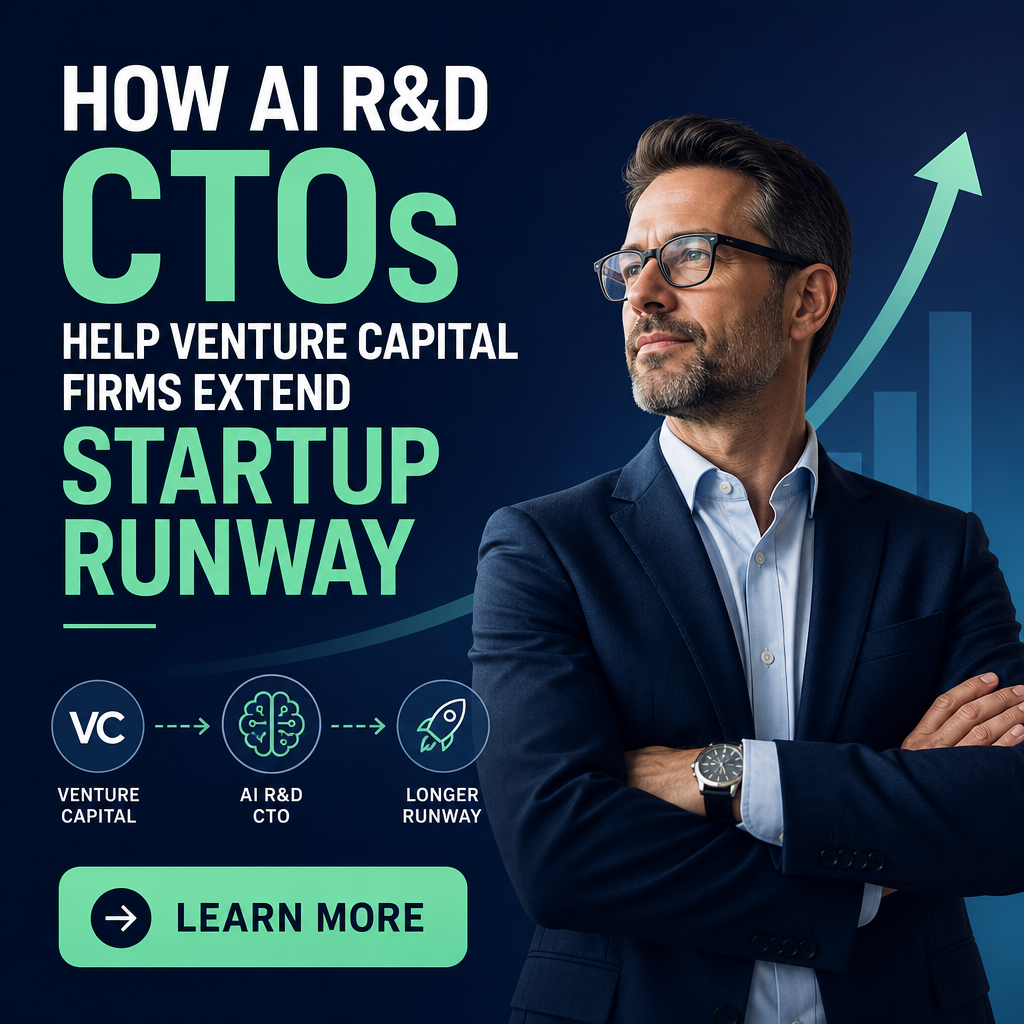
The VC’s real challenge: faster execution without higher burn:
Every venture capital firm asks the same question after making an investment: how do we help our portfolio companies execute faster without dramatically increasing burn? Capital alone doesn’t build successful companies—execution does. The best startups make better technical decisions, develop products more efficiently, and learn faster than their competitors.
Yet the reality inside many early-stage companies is messy: engineering priorities shift weekly, product roadmaps are under-defined, technical debt accumulates, and teams lack the time or leadership bandwidth to convert uncertainty into repeatable delivery. The VC sees the symptoms—missed milestones, slipping releases, and rising infrastructure and headcount costs—but the root cause is often consistent: insufficient technical leadership leverage at the exact moment the company needs it most.
Why portfolio companies struggle to access enterprise-grade technical leadership:
Most startups cannot afford the resources larger companies use to reduce risk and accelerate product development: experienced CTO advisors, product strategy teams, competitive intelligence, technology research, and innovation consultants. Even when a founder is technically strong, that does not automatically translate into scalable Innovation Management across teams, releases, security, architecture, and platform decisions.
This gap creates a compounding disadvantage. Startups may spend months rebuilding foundations, chasing the wrong features, or making architecture choices that slow future iterations. For VCs, this becomes a portfolio-level problem: the fund can’t staff a dedicated technical leadership team for every investment, but the need for strong technical decision-making shows up everywhere—especially when time-to-market determines the next round.
AI R&D CTO: a scalable layer of technical intelligence across the portfolio:
An AI R&D CTO is emerging as a practical way to give portfolio companies continuous access to the types of technical leadership and intelligence typically reserved for larger enterprises. Think of it as a modern Virtual CTO capability—an AI Chief Technology Officer and AI Technology Advisor layer that helps teams operate with higher clarity, stronger alignment, and better technical momentum.
For venture firms, the strategic appeal is scale. Instead of solving leadership gaps one company at a time, an AI R&D CTO can be deployed across dozens of portfolio companies to provide consistent support in:
• AI Product Strategy and technical roadmap clarity
• Technology monitoring and emerging-tech awareness
• Competitive benchmarking and AI Product Intelligence
• Engineering knowledge management and decision support
• AI Innovation Platform style guidance for experimentation discipline and learning loops
The outcome is not “more activity.” It’s higher-quality execution: fewer avoidable rebuilds, better prioritization, faster iteration, and improved technical confidence when the company must commit to a direction.

“Firms that understand how to use AI as a new tool in the broader context of process reengineering will arguably get the most from AI in the long run.”
– Harvard Business Review
Turning technical uncertainty into a documented engineering narrative:
Startups win by learning faster than competitors. But learning only compounds when it is captured, structured, and translated into decisions. Across software, manufacturing, engineering, and deep-tech, teams regularly face technical uncertainties: performance limits, scalability bottlenecks, model accuracy thresholds, integration constraints, reliability targets, or novel workflow design.
An AI R&D CTO helps teams transform those uncertainties into an explicit development narrative—what was unknown, what hypotheses were tested, what experiments were run, what failed, and what improved. This is where AI Innovation Management becomes real: repeatable methods, clearer technical goals, and cleaner handoffs across engineering, product, and leadership.
From a VC perspective, this improves governance and speed at once. Partners get cleaner technical storylines for board discussions. Founders get a stronger mechanism to justify build decisions and tradeoffs. And engineering teams get less thrash and more forward progress.
The financial angle: R&D Tax Credits as runway leverage:
As startups innovate, there is often an overlooked lever that can improve Business Cash Flow: R&D Tax Credits. Many venture-backed companies perform Qualified Research Activities without realizing that their work may support a Research and Development Tax Credits claim.
Here’s where the AI R&D CTO bridges execution and financial efficiency. In addition to technical guidance, the AI R&D CTO continuously identifies:
• Qualified Research Activities (QRAs) tied to technical uncertainty and experimentation
• Qualified Research Expenses (QREs) such as wages, contractors, and supplies (when applicable)
• Contemporaneous documentation that supports IRS expectations
• CPA-ready R&D Study outputs that align with eligibility and substantiation needs
Instead of treating the R&D Tax Credit as a once-a-year scramble, the AI R&D CTO supports a more continuous approach to capturing evidence as the work happens. The result can be a stronger, cleaner R&D Tax Credit claim and a more credible file if questions arise later.
For eligible startups, an R&D Tax Credit Refund (or payroll tax offset where applicable) can translate into meaningful Tax Savings—capital that can be reinvested into hiring, testing, and product iteration without increasing burn.
Replacing manual R&D Tax Credit methods with AI-driven R&D Tax Credit Intelligence:
Traditional R&D Tax Credit Services often rely on manual interviews, retroactive timelines, and spreadsheet-heavy reconstructions. That approach can be expensive, disruptive to engineers, and prone to missed details—especially in fast-moving startups where documentation lives across tickets, commits, notebooks, and chat threads.
An AI R&D CTO supports R&D Tax Credit Consultants and internal finance teams by reducing the friction of building an audit-ready claim. Using sector-aware R&D Tax Credit Intelligence, the AI R&D CTO helps:
• Identify likely QRAs mapped to the “4-part test” logic (permitted purpose, technological in nature, elimination of uncertainty, process of experimentation)
• Conduct technical interviews in a structured, repeatable way that engineers can answer quickly
• Produce time surveys that better reflect real project allocation
• Generate technical documentation and narratives that connect uncertainty → experimentation → advancement
• Support IRS compliance requirements with clearer contemporaneous records
• Accelerate R&D Study creation and Form 6765 preparation support (in coordination with the company’s tax preparer)
This is not about replacing the CPA or the tax professional. It’s about making their job easier by delivering higher-quality inputs: better timelines, stronger technical substantiation, and more complete QRE capture.
VC value proposition: one AI R&D CTO, dozens of companies, compounding benefits:
The VC doesn’t necessarily buy an AI R&D CTO for one company. The portfolio is the opportunity.
Deployed across multiple investments, an AI R&D CTO / Virtual CTO capability can create shared leverage:
• Better technical decision-making and fewer avoidable rebuilds
• Faster product development through stronger prioritization and technical clarity
• Stronger documentation discipline that supports fundraising narratives
• Better capture of available R&D incentives via consistent identification of QRAs and QREs
• Improved capital efficiency—potentially extending runway without raising burn
• Shared innovation knowledge across companies (patterns, benchmarks, common pitfalls)
Over time, this becomes a portfolio operating system for Innovation Management—helping smaller teams compete with the execution advantages of much larger organizations.
A bigger partner channel: the next generation of venture support is scalable intelligence:
The next generation of venture capital will be about more than providing capital. It will be about providing scalable intelligence. AI R&D CTOs give investors a practical way to strengthen technical execution, improve innovation discipline, and help portfolio companies recover qualifying R&D Tax Credits—creating stronger companies without proportionally increasing operating costs.
This model also extends beyond VCs. Startup accelerators, incubators, angel investor networks, innovation hubs, university commercialization programs, corporate venture groups, and economic development agencies all share a similar mandate: help companies innovate faster while using capital more efficiently.
Learn more about how an AI R&D CTO can enhance knowledge to world-class standards while seamlessly supporting R&D Tax Credit eligibility and documentation—and to obtain an estimate of how much your R&D Tax Credit could be by selecting a button below.