

 - EN
- EN  - EN
- EN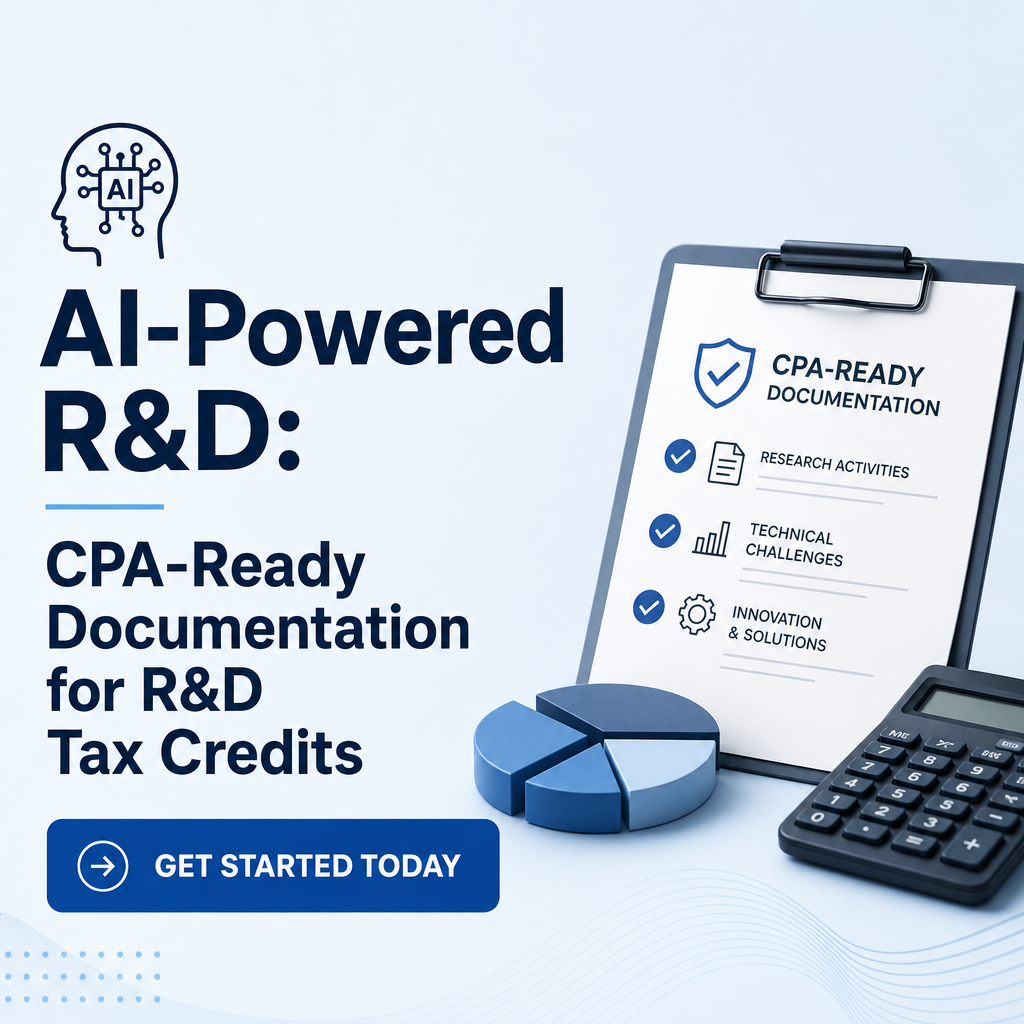
How to create an Automated R&D Study:
Most companies believe the difficult part of claiming R&D Tax Credits is determining eligibility.
It isn’t.
The real challenge is producing the technical documentation that supports the claim.
Every day, developers refactor systems to overcome scalability limits, engineers run design iterations to hit new performance thresholds, and manufacturing teams test alternative materials and methods to reduce defects. That work can often qualify as Qualified Research Activities. The costs can qualify as Qualified Research Expenses. But when tax season arrives, the details that make the work defensible—technical uncertainties, hypotheses, iterations, and outcomes—are rarely captured in a CPA-ready format.
By then, key decisions are forgotten, experiments have moved on, and the organization is forced into a painful reconstruction process.
The result is predictable: incomplete narratives, conservative calculations, and missed R&D Tax Credit Refund opportunities.
AI is changing that by creating the documentation that allows companies to claim the Research and Development Tax Credits they have already earned.
What “CPA-Ready” Means for an R&D Tax Credit Claim:
A CPA-ready R&D Study is more than a summary of projects. It is a structured record that connects technical work to the IRS requirements, including the 4-part test, and ties that work to the underlying costs.
In practical terms, CPA-ready documentation typically includes:
• Clear descriptions of technical uncertainties (capability, method, design, or performance uncertainty)
• A record of experimentation (modeling, prototyping, testing, trial-and-error, validation)
• The technological advancement being pursued
• Identification of Qualified Research Activities by project and role
• Calculation support for Qualified Research Expenses (wages, contractor costs, supplies where applicable)
• A coherent methodology that can support Form 6765 preparation
R&D Tax Credit Services often succeed or fail here. Eligibility can be straightforward, but without contemporaneous documentation, the claim becomes harder to support, harder to defend, and frequently smaller than it should be.
Why Traditional R&D Documentation Breaks Down at Year-End:
The traditional approach to R&D Tax Credit documentation is reactive. It usually looks like:
• Year-end interviews
• Spreadsheets and after-the-fact project lists
• Guessing employee percentages
• Reconstructing timelines months later
• Searching through emails and ticket histories
• Asking technical staff to remember what happened
This approach is expensive, disruptive, and often inaccurate. Engineers and product teams are asked to “relive” last year’s uncertainties long after the work has evolved. Meanwhile, finance teams are left trying to translate technical context into a compliant narrative.
Even strong R&D Tax Credit Consultants face the same constraint: if the inputs are incomplete, the R&D Study will be incomplete. This is the core reason many companies underclaim Tax Savings and miss meaningful Business Cash Flow improvements.

“Data extraction automation from unstructured data and conversion into structured and usable data, AI has tangibly amplified extracting data with high accuracy.” -dr. Jeremy Nunn – Forbes Technology Council
AI R&D CTO: Continuous Documentation That Turns Work Into Value:
An AI R&D CTO changes the timing and quality of documentation. Instead of reconstructing history, the AI R&D CTO documents technical work continuously throughout the year.
Think of the AI R&D CTO as an AI Chief Technology Officer and AI Technology Advisor focused on R&D Tax Credit compliance outcomes:
• Captures project-level technical uncertainty as it occurs
• Prompts periodic technical check-ins to record experimentation and results
• Produces structured technical summaries suitable for an R&D Study
• Organizes contemporaneous documentation that supports IRS compliance expectations
This is the heart of AI-powered R&D for tax purposes: AI doesn’t create R&D Tax Credits. It creates the documentation trail that converts everyday technical work into Qualified Research Activities and converts engineering spend into Qualified Research Expenses.
For startups and small teams without a dedicated tax department, this “always-on” documentation model can make the difference between a minimal claim and a well-supported R&D Tax Credit claim that materially improves cash flow.
Identifying Qualified Research Activities With Higher Precision:
One of the most practical benefits of an AI R&D CTO is improved consistency in identifying what qualifies.
Across software, manufacturing, engineering, and technology sectors, teams often overlook qualifying work because it looks like “normal problem solving.”
But Qualified Research Activities frequently include:
• Developing or improving software performance, scalability, reliability, security, or data integrity
• Iterating on system architecture to overcome latency, throughput, or integration constraints
• Designing prototypes and testing alternative materials or processes in manufacturing
• Engineering new methods to achieve tighter tolerances, higher yield, or reduced scrap
An AI Technical Advisor capability, tuned to R&D tax concepts, helps teams articulate the technical uncertainty, the alternatives evaluated, and the experimental process used to resolve those uncertainties—exactly what CPAs and tax teams need when building or reviewing an R&D Study.
This is especially valuable when multiple departments contribute to R&D: engineering, product, quality, DevOps, and even certain supporting technical roles. Better identification means fewer missed activities and a more complete claim.
Calculating Qualified Research Expenses Without the Spreadsheet Guesswork:
Even when companies can describe their technical projects, the next bottleneck is quantifying Qualified Research Expenses.
Traditional QRE estimation often relies on retroactive time allocations and broad percentage estimates.
An AI R&D CTO supports a more defensible approach by maintaining a continuous record of who worked on what, when, and why it was technically uncertain. That record can then be mapped into wage allocations and supporting schedules that your CPA can use in Form 6765 preparation.
The outcome is not just faster calculations—it’s stronger calculation support. For many businesses, that translates directly into larger, more confident R&D Tax Credit recovery and better year-round planning for innovation funding.
Replacing Manual R&D Tax Credit Preparation With an “Always-On” R&D Study:
This is where AI-powered R&D documentation materially replaces manual methods.
Instead of a once-a-year disruption, the AI R&D CTO enables a continuous workflow:
• Conducts structured technical interviews during the year (not 12 months later)
• Produces draft narratives while the facts are fresh
• Creates time-survey-style prompts to reduce end-of-year scrambles
• Organizes supporting notes into a CPA-ready R&D Study format
For companies that have never claimed before—or that have claimed conservatively—this can be transformative. R&D Tax Credit eligibility is established earlier, documentation is created contemporaneously, and the business is positioned to pursue an R&D Tax Credit Refund (where applicable) or reduce income tax liability with stronger support.
In short: the claim becomes continuous instead of reactive.
Beyond Tax: AI Product Intelligence and Innovation Management Advantages:
Once an AI R&D CTO understands your technical work at a documentation level, it can also deliver higher-level guidance for team brainstorming.
This turns tax documentation into strategic leverage:
• Innovation Management support through clearer visibility into recurring technical barriers
• AI Product Intelligence that highlights patterns in uncertainty, iteration cycles, and engineering constraints
• AI Product Strategy insights based on where technical time is actually being spent
• Competitive benchmarking and innovation intelligence to help leadership ask better technical questions
In this role, the AI R&D CTO functions as a Virtual CTO and AI Technology Advisor—bringing enterprise-style technical leadership perspective to smaller organizations that cannot justify a full executive technical team.
The result is a more level playing field: better technical decision-making alongside stronger R&D Tax Credit outcomes.
Turn R&D Tax Credits Into a Self-Funding Innovation Engine:
For decades, large enterprises could afford specialized R&D tax teams, deep documentation processes, and dedicated technical leadership. Many startups and SMBs could not—so they left Research and Development Tax Credits unclaimed and operated with less technical leverage.
The AI R&D CTO democratizes innovation by continuously transforming technical work into CPA-ready documentation while supporting better decision-making through product intelligence.
If you want to improve Business Cash Flow, increase Tax Savings, and reduce the friction of claiming R&D Tax Credits, the first step is simple: build documentation while the work is happening.
To learn more about how an AI R&D CTO can enhance knowledge to world class standards while seamlessly gaining R&D tax credits, and to get an estimate of how much your R&D Tax Credit can be, select the button below.